

Gear
Years of technical progress have allowed Hansheng Automation to become an industry innovator in China in the manufacturing of precision gears; our most advanced and well-known service is Gear Skiving Service. We have provided this service with efficiency and accuracy for several clients. With strong R&D resources at our disposal, we specialize in offering specialized gear solutions that meet specific client needs. With the backing of excellent expertise and advanced CNC machining processes, we provide innovative, trustworthy gear solutions to a wide range of industries.
-
![Hypoid Gear]() Hypoid GearHansheng supplies custom hypoid gear sets produced on Gleason-system CNC bevel gear generators, with mean module ranging from 0.5 to 5.0 and precision up to ISO/DIN Level 5. Each matched...read more
Hypoid GearHansheng supplies custom hypoid gear sets produced on Gleason-system CNC bevel gear generators, with mean module ranging from 0.5 to 5.0 and precision up to ISO/DIN Level 5. Each matched...read more -
![ISO 5 Precision Custom Metal Worm Gear Sets]() ISO 5 Precision Custom Metal Worm Gear SetsCustom-engineered ISO/DIN Grade 5 metal worm gear sets manufactured from high-performance materials like phosphor bronze, aluminum bronze, and case-hardened alloy steel. Supporting non-standard...read more
ISO 5 Precision Custom Metal Worm Gear SetsCustom-engineered ISO/DIN Grade 5 metal worm gear sets manufactured from high-performance materials like phosphor bronze, aluminum bronze, and case-hardened alloy steel. Supporting non-standard...read more -
![Custom Metal Bevel Gear]() Custom Metal Bevel GearHansheng Automation manufactures high-precision custom metal bevel gears tailored for industrial automation, robotics, packaging machinery, and transmission systems. We provide complete OEM gear...read more
Custom Metal Bevel GearHansheng Automation manufactures high-precision custom metal bevel gears tailored for industrial automation, robotics, packaging machinery, and transmission systems. We provide complete OEM gear...read more -
![Gear Cutting Services]() Gear Cutting ServicesWith over 10 years of experience in precision gear manufacturing, we provide full-precision gear cutting services ranging from ISO 5 to 11.read more
Gear Cutting ServicesWith over 10 years of experience in precision gear manufacturing, we provide full-precision gear cutting services ranging from ISO 5 to 11.read more
Module Range: M0.1 - M5.0
Outer Diameter... -
![Custom Metal Spur Gear]() Custom Metal Spur GearCustomized metal spur gears, with ISO class 5-11 accuracy, ±0.01mm tolerance, support M0.1 - M5 module and non-standard structure, drive precision transmission, according to your application...read more
Custom Metal Spur GearCustomized metal spur gears, with ISO class 5-11 accuracy, ±0.01mm tolerance, support M0.1 - M5 module and non-standard structure, drive precision transmission, according to your application...read more -
![Custom Helical Gears]() Custom Helical GearsCustomized helical gears suitable for precision transmission scenarios, with small module (0.1-5.0), high precision, and low vibration characteristics, widely used in robot joints, medical...read more
Custom Helical GearsCustomized helical gears suitable for precision transmission scenarios, with small module (0.1-5.0), high precision, and low vibration characteristics, widely used in robot joints, medical...read more -
![Gear Shaping]() Gear ShapingKey Equipment: Nidec SE25FR (Japan) & YS5120CNCread more
Gear ShapingKey Equipment: Nidec SE25FR (Japan) & YS5120CNCread more
Max. Workpiece Diameter: Up to 200mm - 250mm
Min. Shaping Module(Machine):2.5 M
Max. Shaping Module (Machine):4.0 M -
![Gear Broaching]() Gear BroachingPrecision gear broaching — M0.1 to M5.0, Ø3mm to Ø300mm, GB/T Grade 8–11. Custom broach tooling, broad material compatibility, and proven capacity for medium to high-volume production.read more
Gear BroachingPrecision gear broaching — M0.1 to M5.0, Ø3mm to Ø300mm, GB/T Grade 8–11. Custom broach tooling, broad material compatibility, and proven capacity for medium to high-volume production.read more -
![Custom Gear Manufacturing]() Custom Gear ManufacturingThe custom gears we produce are carefully processed by the advanced Kashifuji gear skiving machine KPS30.read more
Custom Gear ManufacturingThe custom gears we produce are carefully processed by the advanced Kashifuji gear skiving machine KPS30.read more
We provide custom gear manufacturing services. You only need to provide the design... -
![Epicyclic Gear]() Epicyclic GearEpicyclic Gear, also referred to as planetary gear drive, is a high performance concentric transmission mechanism composed of sun gear, planet gears, planet carrier, and internal ring gear. As a...read more
Epicyclic GearEpicyclic Gear, also referred to as planetary gear drive, is a high performance concentric transmission mechanism composed of sun gear, planet gears, planet carrier, and internal ring gear. As a...read more -
![Miter Gear]() Miter GearAs a specialized OEM manufacturer, we produce custom 1:1 miter gears (straight and spiral) with uncompromising precision up to ISO Grade 5. From premium material selection to high-precision gear...read more
Miter GearAs a specialized OEM manufacturer, we produce custom 1:1 miter gears (straight and spiral) with uncompromising precision up to ISO Grade 5. From premium material selection to high-precision gear...read more -
![Gear Machining]() Gear MachiningHansheng Automation is a professional manufacturer in custom precision gear machining. We produce a wide range of gear types, including spur gears, helical gears, bevel gears, gear racks, and gear...read more
Gear MachiningHansheng Automation is a professional manufacturer in custom precision gear machining. We produce a wide range of gear types, including spur gears, helical gears, bevel gears, gear racks, and gear...read more


Preface
Though commonly using one or more gear manufacturing techniques, gear manufacture does not follow a single process; the particular manufacturing techniques must be decided depending on the kind and use of the gear.
Gears usually have somewhat severe running conditions as they are mostly employed for power transfer. Thus, gears have to be in absolute flawless condition first; second, they must always be dependable, with extremely little or insignificant probability of fracture propagation and small residual stress.
Though fulfilling these criteria is somewhat difficult, their significance cannot be disputed. This is the reason gear manufacturing is a highly specialized industry with rather restricted tolerances and margin of error.
The below are the gear processing techniques typically employed in our business along with frequently used gear processing tools and supplies.
Gear manufacturing process
A variety of methods exists for efficient gear manufacturing such as skiving, hobbing, gashing (shaping), and broaching. Hobbing is only possible for external gears, while gashing is only possible for larger size internal ring gears from 6 inches (150 millimeters) and up to several feet in diameter using a special head in the hobbing machine. Broaching is a fast and efficient method for internal gears and is well-suited for gears smaller than 8 inches, but is inflexible and uses large tools. A common way of making internal gears is shaping, which is a reciprocating method that’s much slower than both broaching and gear skiving. Gear skiving is being seen as a viable alternative to broaching to manufacture internal gears (and external gears) since it is faster and more flexible than the other methods.
Gear Skiving
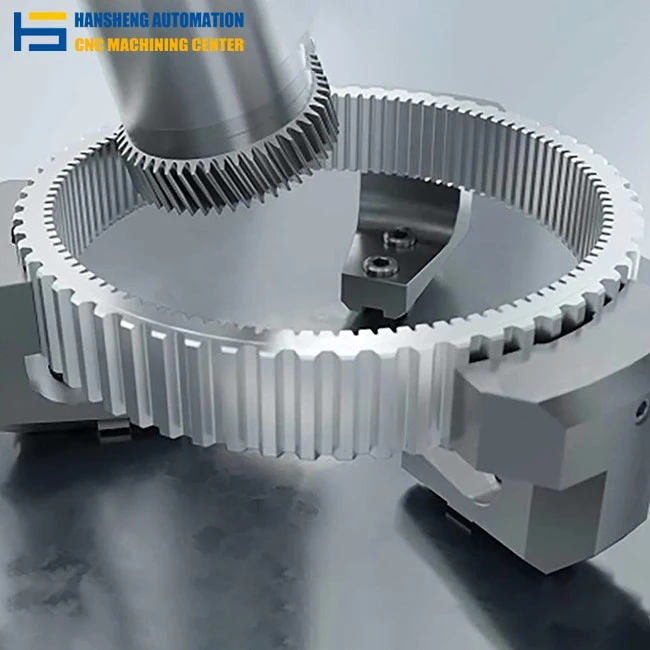
What is Gear Skiving
It is a gear manufacturing process with a dedicated solution for both internal and external gears. Skiving – especially solutions with interchangeable solid carbide heads – can complete the finishing of the tooth profile, and nowadays it can be done not only with the latest generation of CNC gear cutting machines, but also with multi-task machines or modern machining centers.
Since the first scraping patent was filed in Germany in 1910, scraping cannot be considered a new manufacturing method. However, for nearly a century, scraping has not been widespread due to technical limitations in terms of software and hardware, and reliability, precision, and speed cannot be guaranteed, making it impossible to achieve convenience and efficiency.
How Gear Skiving Works?
Gear skiving is a continuous machining process where the tool meshes with the gear being made — similar to the way a pinion and gear mesh in a gear train. This is the reason that an extremely accurate synchronization is needed between the workpiece spindle and the tool spindle. The difference is, while the tool that we can consider “the pinion” meshes with the gear, it is also pushed axially in the direction of the axis of the gear. The front side of the tool (“pinion”) is sharp, and it cuts the gear while meshing. The cutting speed is generated by an inclination “E” between the axis of the gear being made and the axis of the tool. Figure 1 shows the tool (on the left) inclined with respect to the ring gear; both are spinning at high speed while meshing perfectly. The cutting action occurs on the front side of, in this case, the inserted cutting tool. The fixture has openings around the spindle for chip evacuation.

Gear Hobbing

What is gear hobbing?
The foundation of gear manufacture is the quick and flexible technique known as gear hobbing. Gear hobbing machines develop tooth forms on gears as they move through the machine by use of spinning cutting tools or hobs. Gear hobbing is a perfect technique for gear manufacture as its accuracy and precision define it.
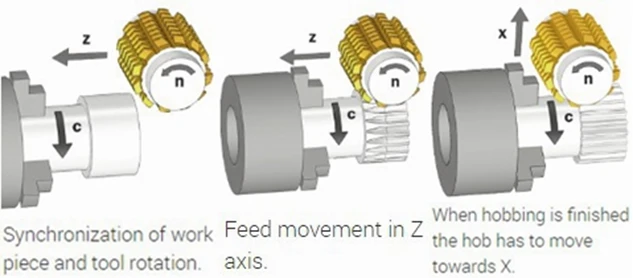
Two inclined axes makes up the gear hobbing machine. The hob lives in one of the shafts; the gear blank lives in another. The kind of gear being produced determines mostly the relative positioning angle between these two shafts.
The machine will start to rotate the shaft at a speed ratio fit for the gear type after the spindle is positioned at the correct angle. The hob progressively chops the teeth into the gear at the correct depth as the shaft turns. Manufacturers may stack many blanks on the spindle and have the hob cut the teeth into several gears at once to hasten output.
There are several gear hobbing machines available, much as manufacturers may alter the process utilising many different angles, speeds, and procedures. Typically, gear hobbing machines are intended for many uses. Two kinds of gear hobbing machines—single-threaded hobs and multi-threaded hobbs—are used to handle gears of a designated size. Though they produce more than single-threaded machines, multi-threaded machines are not as precise.
Gear Shaping
What is Gear Shaping
One unique characteristic of which we all relate gears with is the little interlocking teeth. The operation of a gear depends on these teeth, which also provide seamless running of machinery. But have you ever given any thought to how those little teeth are fashioned and cut? Gear hobbing and gear shaping then become rather important. Cutting and shaping gear teeth depend on these two mechanisms. Manufacturing premium gears used in anything from vehicles to industrial equipment depends on teeth cutting and shape. This blog article will cover gear manufacturing and investigate what gear shaping and gear hobbing include, their benefits, when employed, as well as notable variations between them.
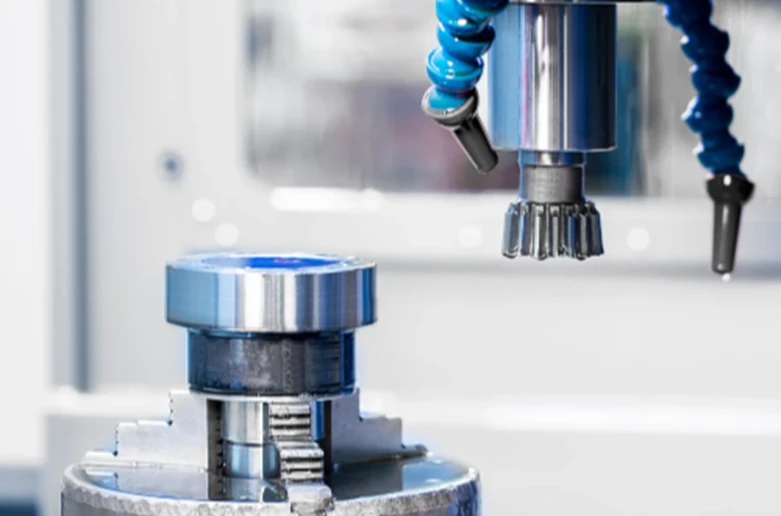
Since the gear shaping method generates teeth with a more exact form and size, it is regarded as quite successful. Lower noise levels during operation, longer life, and increased efficiency follow from this for gears.
Still another major advantage of using a gear shaping machine is versatility. Versatility in that this method may produce a broad spectrum of gears, including spur, helical, bevel, internal gears and more. Furthermore more is what? Even the toughest materials, such as steel alloys or non-ferrous metals, modern gear-shaping machines can handle.
Because gear shaping calls for less tooling changes during manufacturing runs, it also provides more design freedom than many other techniques. This implies that, should it be required, manufacturers may quickly alter their designs without having to halt production completely.
Gear Broaching
Gear broaching is a machining process that uses a toothed tool, called a broach, to remove material. There are two main types of broaching: linear and rotary. In linear broaching, which is the more common process, the broach is run linearly against a surface of the workpiece to produce the cut. Linear broaches are used in a broaching machine, which is also sometimes shortened to broach. In rotary broaching, the broach is rotated and pressed into the workpiece to cut an axisymmetric shape. A rotary broach is used in a lathe or screw machine. In both processes the cut is performed in one pass of the broach, which makes it very efficient.
Gear Broaching is used when precision machining is required, especially for odd shapes. Commonly machined surfaces include circular and non-circular holes, splines, keyways, and flat surfaces. Typical workpieces include small to medium-sized castings, forgings, screw machine parts, and stampings. Even though broaches can be expensive, broaching is usually favored over other processes when used for high-quantity production runs.
Broaches are shaped similar to a saw, except the height of the teeth increases over the length of the tool. Moreover, the broach contains three distinct sections: one for roughing, another for semi-finishing, and the final one for finishing. Broaching is an unusual machining process because it has the feed built into the tool. The profile of the machined surface is always the inverse of the profile of the broach. The rise per tooth (RPT), also known as the step or feed per tooth, determines the amount of material removed and the size of the chip. The broach can be moved relative to the workpiece or vice versa. Because all of the features are built into the broach, no complex motion or skilled labor is required to use it. A broach is effectively a collection of single-point cutting tools arrayed in sequence, cutting one after the other; its cut is analogous to multiple passes of a shaper.
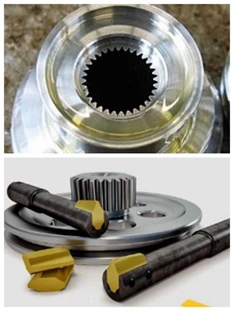
The process of gear broaching
The gear broaching process depends on the type of broaching being performed. Surface broaching is very simple because either the workpiece moves against a fixed surface broach or the workpiece remains stationary while the broach moves against the workpiece.
Internal broaching is more complex. The process begins by clamping the workpiece into a special fixture (called a workholding fixture) installed in the broaching machine. A broaching lift is a part of the machine that moves the broach above the workholding and lowers the broach through the workpiece. Once passed, the broacher's puller (essentially a hook) grabs the broach's guide. The lift then releases the top of the follower and the puller pulls the broach completely through the workpiece. The workpiece is then removed from the machine and the broach is lifted back up to re-engage with the lift. Broaches usually only do linear motion, but sometimes they also rotate to create spiral splines or barrel rifling.
Gear processing equipment
There are many types of gear processing equipment provided in the industry, and Hansheng Automation have mainly introduced several more advanced production equipment to ensure the high quality, stability and output of our own products. A brief introduction to a few of our commonly used processing equipment.
1.Kashifuji Gear Skiving Machine KPS30
2.Ningjiang CNC Horizontal Gear Hobbing Machine YK3610Ⅳ
3.RICHUANG YKS3612 III CNC High Speed Horizontal Gear Hobbing Machine
|
Pictures of the device |
The name of the device |
Kashifuji Gear Skiving Machine KPS30 |
|
|
Machining diameter |
3-300mm |
|
Maximum processing modulus |
4 |
|
|
The angle of inclination of the tool axis |
±30° |
|
|
Maximum speed of the tool spindle |
2,500 rpm |
|
|
Maximum table speed |
1,500 rpm |
|
|
Pictures of the device |
The name of the device |
Ningjiang CNC Horizontal Gear Hobbing Machine YK3610Ⅳ |
|
|
Machining diameter |
3-300mm |
|
Numerical control system |
NJ-i50H CNC system, seven-axis control, four-axis linkage |
|
|
Spindle drive |
Hob spindle: spindle servo motor direct drive; Workpiece spindle: Built-in torque motor direct drive |
|
|
Processing capacity |
It can process cylindrical gears, worm gears, sprockets, toothed timing pulleys, flexible pulleys and splines, etc |
|
|
Pictures of the device |
The name of the device |
YKS3612 III CNC High Speed Horizontal Gear Hobbing Machine |
|
|
diameter range of workpiece |
3~120mm |
|
Max. module |
3 |
|
|
the Range of Numbers of Teeth |
2~400 |
|
|
Max.Speed of spindle |
4000rpm |
|
|
Max. helix angle |
±45° |
|
|
Processing capacity |
It is used for processing various high-precision spur cylindrical gears, helical gears, worm gears, drum gears, and splines. |
|


The material of the gear selection
If you want to make gears, there are many types of materials to choose from, but how to choose gears that are suitable for your factory's application conditions is actually not difficult. When selecting materials, many factors need to be evaluated, including but not limited to the following.
|
Factors Affecting Gear Material Selection |
|||
|
Strength |
Hardness |
Toughness |
Wear Resistance |
|
Processing Performance |
Heat Resistance |
Corrosion Resistance |
Fatigue Strength |
|
Elastic Modulus |
Density |
Damping Performance |
Thermal Expansion Coefficient |
|
Cooling Capacity |
Chemical Stability |
Thermal Conductivity |
Resistance To Electrical Corrosion |
Although your evaluation of these elements may not be as thorough, our engineers have extensive knowledge having been closely engaged in gear production for more than 10 years. Your gear drawings and particular application situations will help us to evaluate your needs and deliver the most complete options for your reference and choice.
|
Material |
Characteristic |
Common Specifications |
|
Carbon Steel |
Low cost, suitable for low-speed and light load applications, easy to process and heat treat |
AISI 1045、AISI 1050、AISI 1060 |
|
Alloy Steel |
High strength, good wear resistance, suitable for high load and high-speed transmission |
AISI 4140、AISI 4340、AISI 8620 |
|
Stainless Steel |
Excellent corrosion resistance, suitable for humid or chemical environments |
AISI 304、AISI 316、AISI 17-4PH |
|
Cast Iron |
Good wear resistance, excellent seismic performance, suitable for low-speed and low load applications |
ASTM A48、ASTM A536 |
|
Forged Steel |
More toughness and good impact resistance than ordinary carbon steel, suitable for high stress applications |
AISI 4140、AISI 1045 |
|
Bronze |
Strong wear resistance and corrosion resistance, suitable for low-speed and high load transmission |
C93200、C95400、C90700 |
|
Aluminum Alloys |
Lightweight, corrosion-resistant, suitable for occasions with high lightweight requirements |
6061-T6、7075-T6 |
|
Plastic |
Lightweight, low-cost, good self-lubricating performance, suitable for low load applications |
POM、PC |
|
Nylon |
Lightweight, self-lubricating, suitable for low-speed, low load transmission |
Nylon 6、Nylon 66 |
|
Titanium Alloys |
Lightweight, high strength, corrosion-resistant, suitable for high-tech applications |
Ti-6Al-4V、Grade 5 Titanium |
|
High-Performance Polymers |
High temperature resistance, chemical corrosion resistance, and good self-lubricating performance, suitable for harsh industrial environments |
PEEK |
Customer stories


The important things you should know
A. What is gear manufacturing?
Gear manufacture is the systematic production of gears, which are fundamental components for the transfer of motion and power in many different mechanical systems. Using precise machining and forming techniques lets gears in mechanical systems efficiently manage direction, speed, and torque.
Types of gear manufacturing have gear skiving, gear hobbing, gear shaping, and gear broaching among other techniques. These techniques find wide use in many fields, including robotics, automotive, aerospace, and industrial machines.
B. What are the raw materials for gear manufacturing?
The application and necessary qualities of the gear determine the raw materials used in gear production. Typical elements are:
Highly durable and sturdy, steel—carbon steel, alloy steel, stainless steel—is the most often used material for gears.
Applications needing strong wear resistance and manufacturing simplicity of use call for cast iron.
Often used in worm gears, brass and bronze are prized for their resistance to corrosion and wear.
Low-load uses for plastics need for weight and noise reduction as main considerations.
Lightweight and corrosion-resistant aluminium finds usage in fields where weight is a major factor.
C. What is the fastest method of gear manufacturing?
The gear type and production volume determine the quickest gear manufacturing technique is used. Usually regarded as one of the quickest techniques for mass external gear manufacturing is gear hobbing. Because of its constant cutting action, spur and helical gears find great efficiency. Designed using a multi-tooth cutting tool known as a broach, gear broaching is the quickest approach of machining gears. Generally, every tooth on the broach is higher than the one before it. The depth of cut therefore rises with every tooth as the broaching procedure advances. Usually, internal gear teeth are produced via broaching. One may broach external teeth using "pot broaching". The gear teeth are cut in this operation using a hollow broaching tool known as the pot.
D. What machining process is used to make gears?
Different machining techniques are used to produce gears; the most often used ones are:
Gear Hobbing: Applied for fast external gear manufacture. By progressively cutting into the gear blank, the hob—a spinning cutting tool—forms the teeth. Large amounts of spur and helical gears would find it perfect.
Suitable for both internal and exterior gears, particularly in cases where hobbing is not feasible, gear shaping By repeatedly cutting through the material, a reciprocating cutter forms the teeth.
One rather effective technique for manufacturing internal gears is gear broaching. Pulled or pushed through the gear blank, a broach—a multi-tooth cutting tool—forms the teeth in a single pass. When accuracy is crucial or large volume internal gear manufacture calls for it, our rapid and precise procedure is perfect.
Though it may be used for both internal and exterior gears, gear skiving is a fast cutting technique akin to hobbing. Particularly for gear manufacture in more complicated configurations, it provides great accuracy and efficiency.
Company advantages
Product Quality
We have strict quality inspection flow, which guarantees that every product passes exact testing and thorough quality control as we firmly follow worldwide quality criteria.
Technological Innovation
Strong R&D team and superior technologies enable us to constantly provide clever and sustainable creative ideas to assist customers in a competitive market.
Customer Service
Our staff in customer service guarantees 24/7 help so that every client's problems are quickly addressed. Regular customer feedback systems let us additionally constantly improve tailored after-sales support.
Customized Solutions
To satisfy different particular demands, we provide customized solutions including product design and function optimization as we realize that every customer has different wants.
Industry Experience
Having more than ten years of industry expertise, we have effectively carried out many projects including supplying significant amounts of gear components to Germany, Japan and other coutries, proving our professional ability and building customer confidence.
Competitive Pricing
We control our manufacturing facilities and guarantee excellent quality by means of a full-service approach including design, selection, and material procurement through to production, therefore enabling more affordable pricing.
FAQ
Hansheng Automation (Dongguan) Co., Ltd. is one of the leading gear manufacturers and suppliers in China. We warmly welcome you to buy discount gear for sale here from our factory. All customized products are with high quality and competitive price.
high quality gear, industrial machinery gear, gear cutting