The linear vibration device on a premade bag automatic packaging machine uses controlled mechanical vibration to arrange materials in order and convey them steadily. It usually works with a combination weigher, weighing hopper, and premade bag station to move material from the hopper to the packaging position.
Basic structure and power source
The linear vibration device mainly consists of a hopper, a vibration bowl, a controller, and a vibration motor. The vibration motor is the power source. Eccentric blocks inside the motor rotate and generate centrifugal force, driving the system to vibrate at a set frequency and amplitude. This provides energy for material movement. The hopper, vibration bowl, linear track, spring plates, vibration damping pads, and adjusting bolts all affect vibration transmission.
Material conveying principle
After the device starts, the linear track produces directional vibration. Material on the track surface gains continuous forward force and moves steadily along a preset path to the packaging station. Products such as potato chips can enter the packaging process continuously. Track angle, spring plate angle, and eccentric block phase affect conveying speed and stability.
Material arrangement principle
The track structure and vibration parameters are calculated. After the vibration mode is adjusted, disordered materials gradually align as they move. Under a specific amplitude, flat materials line up along the track edge, providing positioning for later weighing and bag insertion. Track width, sidewall shape, and discharge gap also affect arrangement.
Frequency and amplitude control
The controller can adjust motor parameters to suit different material characteristics. Light and small materials suit high frequency and low amplitude to avoid splashing. Heavier or larger materials need low frequency and high amplitude to ensure forward force. This adjustment method lets the machine handle a range of materials.
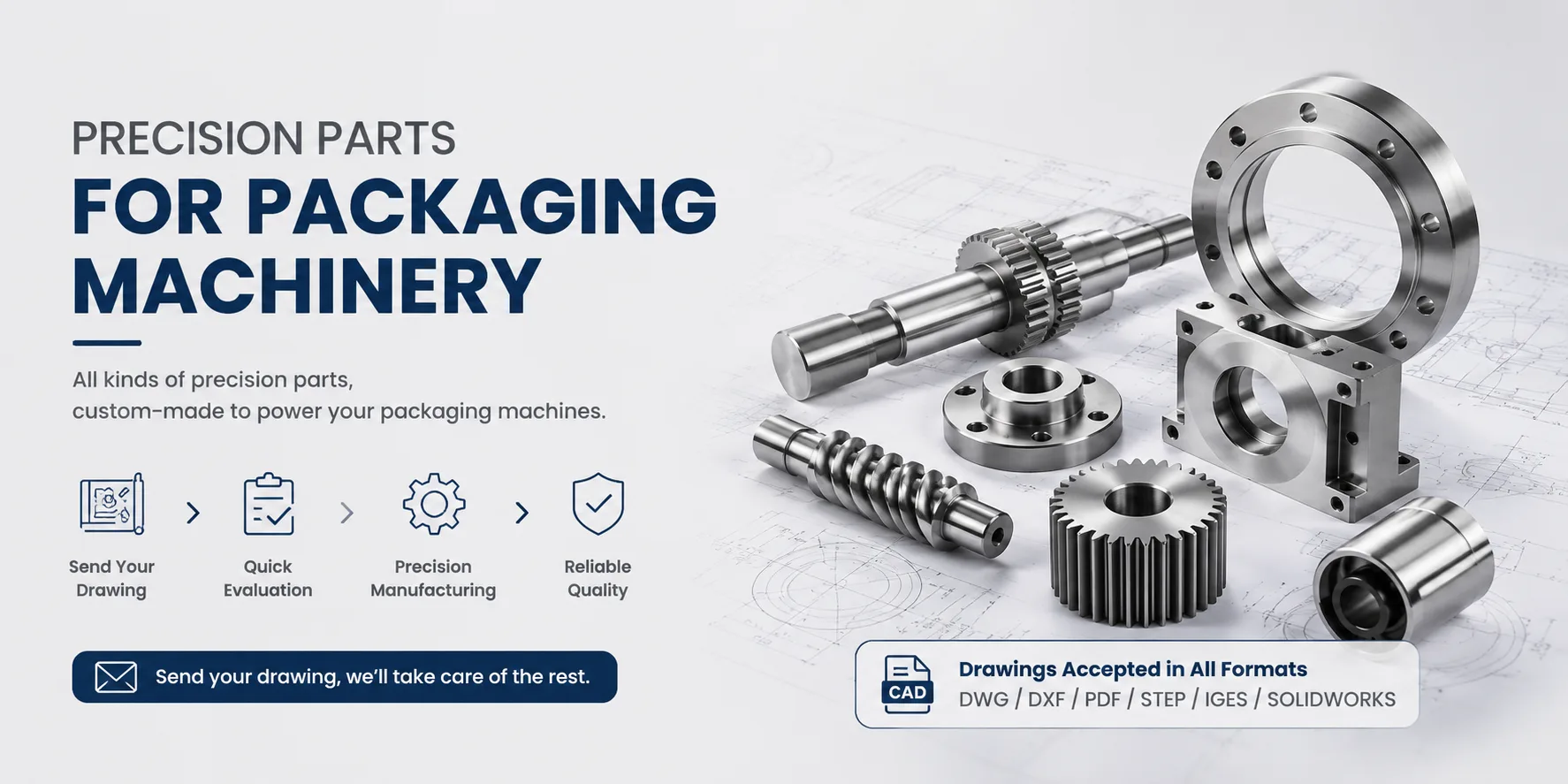
Among these parts, vibration bowls, linear tracks, eccentric blocks, spring plates, vibration damping pads, adjusting bolts, hoppers, and controller brackets often need to be custom made to drawings. Hansheng Automation can precision-machine these packaging machinery parts in single pieces or small batches according to customer design drawings. We can use stainless steel, aluminum alloy, carbon steel, or engineering plastics, control tolerances to drawing requirements, and provide surface treatments such as anodizing, blackening, nickel plating, or powder coating. This helps the linear vibration device maintain stable frequency, amplitude, and conveying direction.
Our custom precision machining capability is not limited to the linear vibration feeder on premade bag automatic packaging machines. In addition to food packaging machinery parts, filling machinery parts, and medical device parts, we can machine yacht precision parts, RC car precision parts, tobacco packaging machinery parts, printing machinery parts, and feed packaging equipment parts according to drawings. After customers provide drawings, Hansheng Automation can support prototyping and batch production for non-standard parts.