Robotic arms are more suitable for current large-scale industrial production needs, while humanoid robots are more suitable for non-standardized flexible scenarios.
1. Efficiency Comparison
Robotic arms: repeatability of 0.02 mm (based on the latest ABB IRB 6700 parameters), with a cycle time of up to 0.3 seconds per operation.
Humanoid robots: Tesla Optimus has a maximum payload of 20 kg, a moving speed of 8 km/h, and a single grasping time of about 2 seconds.
2. Cost Structure
Robotic arms: a six-axis robot used in an automotive welding production line costs approximately RMB 150,000–250,000 per unit, based on the 2023 Estun quotation.
Humanoid robots: the estimated unit price of Optimus is about RMB 150,000 before mass production, and its maintenance cost is more than 30% higher.
3. Applicable Scenarios
Robotic arms are advantageous in the following areas:
Automotive welding, with a cycle time error of ±0.05s.
3C product assembly, with a precision requirement of 0.1 mm.
Food packaging, with more than 3,000 cycles per hour.
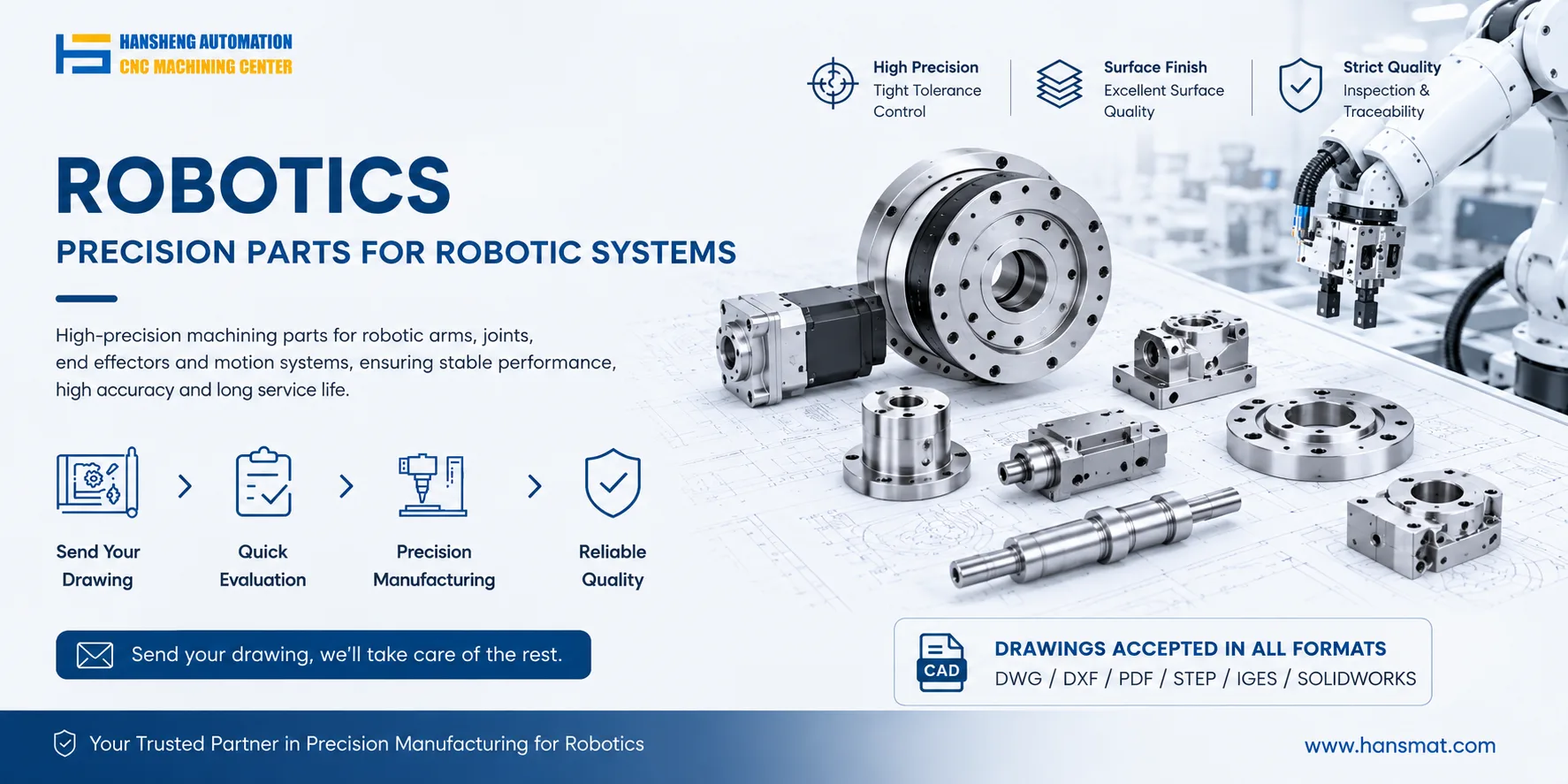
For these high-precision and high-cycle robotic arm applications, Hansheng Automation provides custom machining of non-standard end effectors, fixture plates, and replacement mechanical parts based on customer drawings, helping support stable large-scale production.
Humanoid robots are more suitable for:
Material handling on complex terrain.
Multi-process interleaved operations.
Inspection in unstructured environments.
4. Technical Maturity
The mean time between failures of industrial robotic arms has reached 80,000 hours, according to the FANUC 2024 white paper.
The current continuous working time of humanoid robots does not exceed 8 hours, based on measured data from Boston Dynamics Atlas.
5. Deployment Difficulty
Production line modification cycle for robotic arms: a standard cell can be put into production within 2 weeks.
Humanoid robots require restructuring the entire production process, and there are no mature industrial cases yet.