Coating machines fall into seven main types based on technical features and application. Each type suits different substrates, coating requirements, and production scales.
Brush coating machines
Brush coaters are the oldest coating equipment. They were first used in the 1850s to coat wallpaper with clay coating. The coating head comes in three forms:
Rotary brush head: rotating circular bristles spread coating evenly.
Blanket roller head: a roller wrapped in blanket transfers coating, suitable for rough surfaces.
Blanket sleeve head: combines a blanket sleeve and roller to improve coating uniformity.
Early brush heads were simple but gave uneven thickness and low efficiency. Modern technology has largely replaced them.
Air knife coating machines
Air knife coaters appeared in the 1930s. They use high-pressure air to control coating thickness and solved the defects of brush coaters. How it works: a metering roller applies coating evenly to the substrate. A high-pressure air stream from the air knife blows off excess coating, forming a uniform layer. This technology raised coating speed and quality and drove rapid growth in the coated paper industry.
Doctor blade coating machines
After the doctor blade coater patent appeared in the 1950s, the technology iterated quickly and produced several types:
Hard blade doctor coater: rigid blade, for high-viscosity coatings.
Trailing blade doctor coater: blade at an angle to the substrate, reducing friction.
Soft blade doctor coater: elastic material such as rubber, for curved surface coating.
Fountain feed doctor coater: coating sprays from below the blade to form a liquid film.
Short dwell doctor coater: shortens coating dwell time at the blade to reduce defects.
Bill blade doctor coater: combines metering roller and blade for precise thickness control.
Blade roller coater: blade works with a roller, for high-speed production.
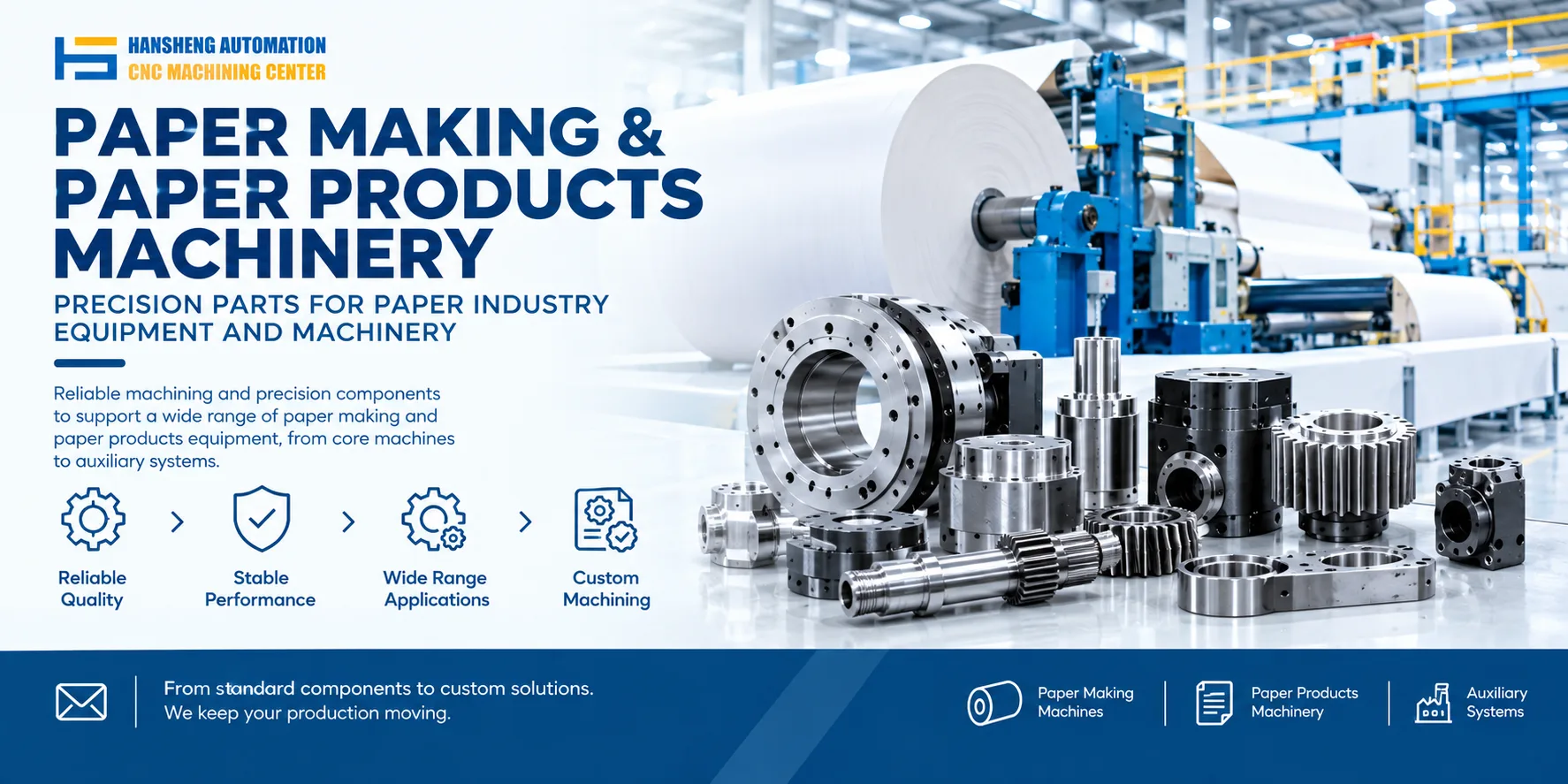
When doctor blades or coating rollers need replacement, we machine these precision parts from customer drawings in single pieces or small batches.
Roll coating machines
Roll coaters transfer coating to the substrate through an application roller, mainly for in-machine coating. Coating weight is adjusted by pressure between metering rollers:
Higher pressure: less coating passes through, thinner layer.
Lower pressure: more coating passes through, thicker layer.
Common types include:
Squeeze roll coating head: two rollers squeeze to control coating.
Reverse roll coating head: two rollers rotate in opposite directions, reducing coating bounce.
Transfer roll coating head: multiple rollers transfer coating for better uniformity.
Gravure roll coating head: gravure roller grooves hold coating for precise application.
Spray coating machines
Spray coaters use controlled high-pressure spraying to coat or size paper or paperboard on one or both sides. Features:
Non-contact coating: avoids mechanical friction damage to the substrate.
Uniform atomization: nozzle pressure and angle adjust coating thickness.
Wide applicability: works with high-viscosity or particle-containing coatings.
Curtain coating machines
Curtain coaters use multiple liquid curtains to build complex coating structures. A typical application is three-layer surface coating on inkjet paper: base layer, absorption layer, and top layer. Advantages:
Multiple layers in one pass: improves production efficiency.
High uniformity: forms even coating even on uneven substrate surfaces.
High coating utilization: reduces waste and cost.
Slot die coating machines
Slot die coaters apply coating through a precision slot nozzle. Core components include:
Coating liquid storage tank: holds coating.
Pump and supply line: pushes coating to the nozzle.
Control unit: adjusts pump and nozzle working parameters.
Pressure detection unit: monitors line pressure in real time to ensure the nozzle discharges at the set pressure.
This technology suits high-precision coating, such as lithium battery electrodes and optical films.
These seven types cover the full range from traditional to modern and from low precision to high precision. Users can choose equipment based on substrate properties, coating requirements, and production scale.
Our precision custom machining is not limited to coating machine parts. We also produce non-standard components for medical devices, printing equipment, food machinery, yacht hardware, RC car parts, tobacco packaging machinery, and filling machinery. Hansheng Automation supports single-piece and small-batch production from customer drawings. We focus on precision parts machining and delivery, which helps maintenance and replacement across different industries.