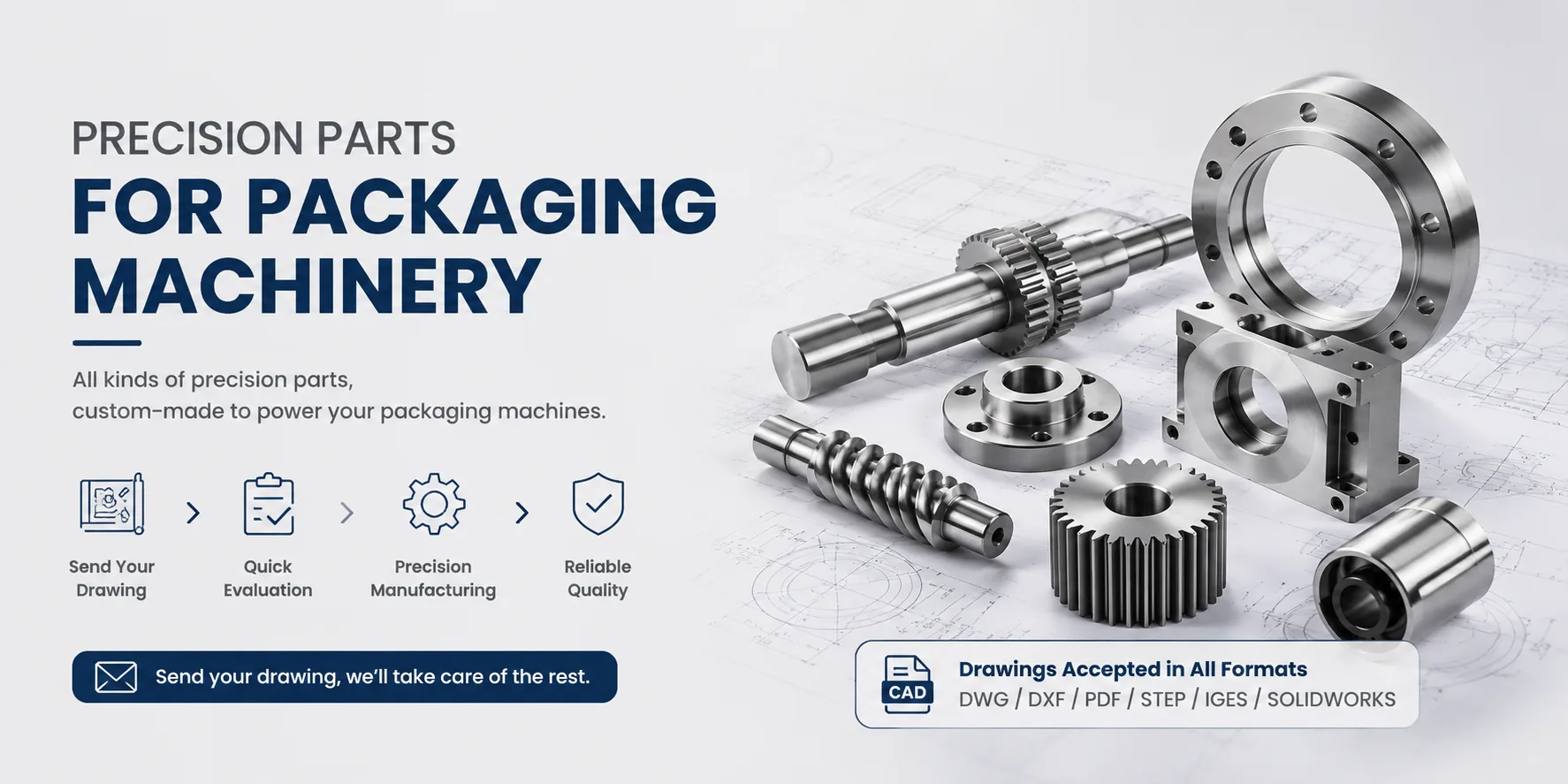
When the bag sealing line on a vertical sealer is loose, check the feed pulling mechanism, heat sealing and pressing system, bag material tension, and synchronous speed matching. Adjust them in the order below. If non-standard parts such as pulling rubber rollers, heat sealing cutter holders, or guide rollers are worn and need replacement to site dimensions, we can custom machine them according to customer drawings. Hansheng Automation supports single-piece and small-batch delivery.
- Feed pulling mechanism
- Pressure and wear check
Manually turn the gap between the pulling rubber roller and the steel roller. In normal condition, it should clamp the bag material without slipping. If the gap is too large, tighten the adjusting bolts on both sides of the pulling rollers and reduce the roller gap to 0.1 to 0.2 mm. Adjust according to bag material thickness. Thinner bag material needs a smaller gap.
Check the surface of the pulling silicone roller. If it is flattened, cracked, or covered with residual adhesive, friction drops significantly. Replace it with a silicone roller of the same specification. Roller surface hardness is recommended at Shore A 60 to 70, which suits the pulling needs of most composite bags and PE bags.
- Heat sealing and pressing system
- Pressure and parallelism check
For pneumatic heat sealing models, confirm that compressed air pressure is stable at 0.4 to 0.6 MPa. Adjust the pressure regulating valve to correct the air pressure. For spring-loaded models, replace aging and loose springs to ensure even pressing force when the upper and lower heat sealing cutters close.
Use a feeler gauge to check the parallel gap between the upper and lower heat sealing cutters. The gap error over the full length should be kept within 0.05 mm. If local gap is too large, adjust the positioning bolts of the heat sealing cutter holder to correct holder offset.
- Bag material conveying tension
- Unwinding and guide roller check
Adjust the damping device on the unwinding rack, either a magnetic powder brake or a spring damper, to increase the initial tension during bag material feeding. This prevents loose accumulation during unwinding. Tension should be set so the bag material has no obvious sag and no wrinkles during pulling.
Clean dust and residual adhesive chips from the conveying guide rollers. Add No. 32 machine oil to ensure smooth roller rotation and avoid uneven bag material feeding caused by jamming.
- Synchronous speed matching
- Check the pulling motor speed and the stepping cycle of the heat sealing cutter. Adjust the pulling speed through the equipment frequency converter so bag material conveying speed matches the bag discharge rhythm at the heat sealing station. This prevents loose sealing lines caused by feeding ahead of or behind the sealing cycle.
- Check the tension of the drive belt and sprocket. If the V-belt slips, adjust the tensioner position or replace the worn drive belt to ensure power transmission without step loss.
Cut off the main power before adjusting the equipment to prevent rotating parts from catching hands. When replacing parts such as pulling rubber rollers and heat sealing cutters, use dedicated tools and have qualified equipment maintenance personnel perform the work.
Our custom precision parts machining capability is not limited to vertical sealers. In addition to parts for food packaging machinery, pharmaceutical packaging equipment, and daily chemical packaging equipment, Hansheng Automation can machine yacht precision parts, RC car precision parts, tobacco packaging machinery parts, and filling machinery parts according to drawings. We also machine non-standard parts for printing machinery and medical devices, supporting drawing-based customization and small-batch delivery.