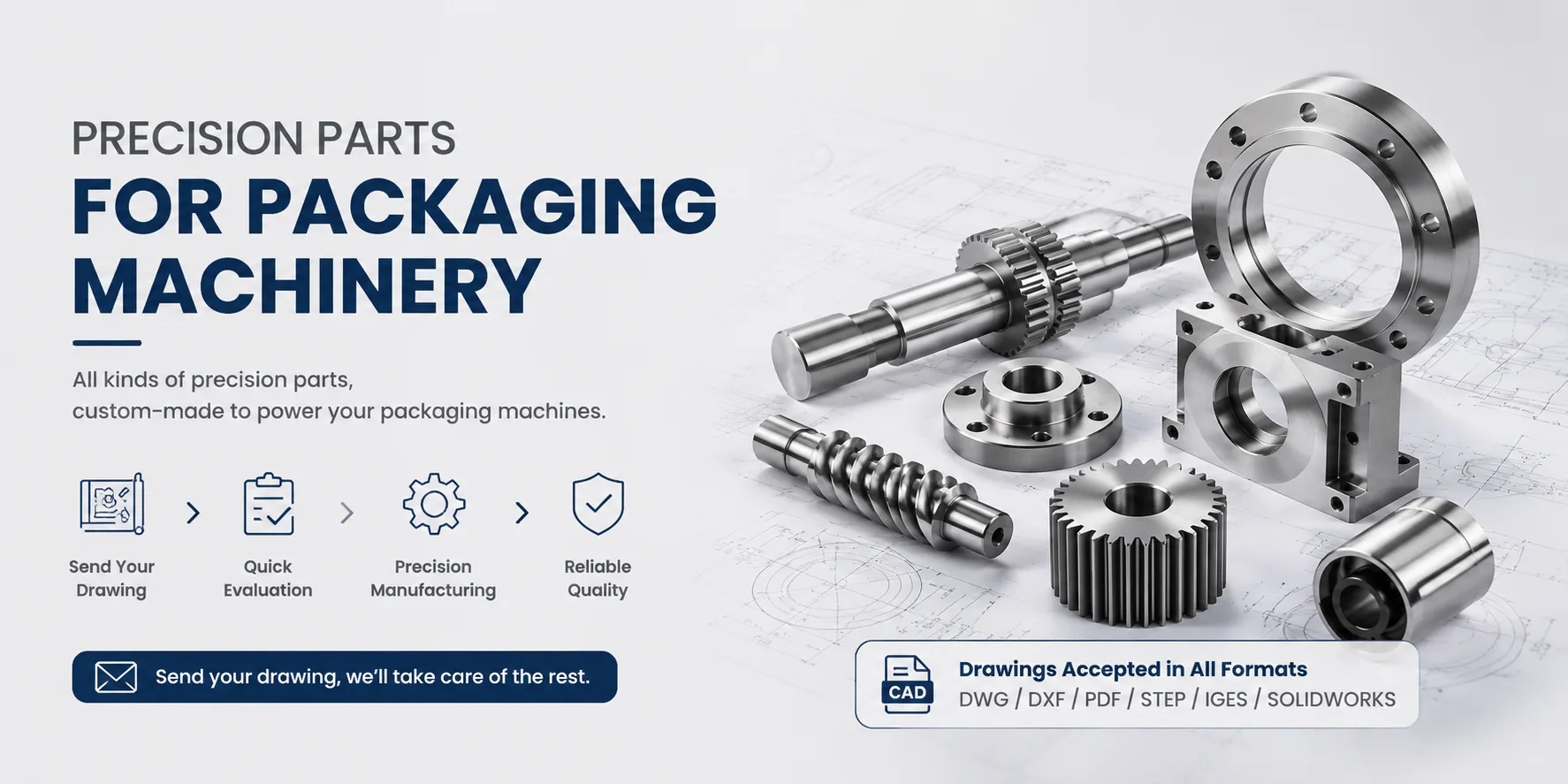
Thread breakage after a bag sewing machine finishes sewing usually falls into three groups: consumables, equipment, and operation. Check the thread and needle first, then the feed dog, shuttle bed, and tensioner, and finally the threading path and bag feeding. If non-standard parts such as feed dogs, shuttle bed components, or tensioners are worn and need replacement to site dimensions, we can custom machine them according to customer drawings. Hansheng Automation supports single-piece and small-batch delivery.
Consumable faults
Poor thread quality: the bag sewing thread has insufficient toughness or too few plies. For example, ordinary sewing thread is used instead of industrial bag sewing thread. The tensile strength is not enough, so the thread breaks when the bag mouth is tightened. Replace it with industrial bag sewing thread that meets GB/T 20028-2005. Polyester high-toughness thread is preferred.
Moisture and aging: improper storage causes the thread to absorb moisture, soften, and lose strength. It is then worn or broken by the needle during sewing. Store thread in a dry, cool, sealed container. Replace thread that has absorbed moisture.
Equipment faults
Damaged needle or wrong specification: the needle has a rolled edge, a broken tip, or wear, or the needle is too thin. It can cut the thread during stitching. Replace it with the dedicated needle for the bag sewing machine model. For example, the GK9 series is recommended to use a No. 16 industrial needle. Before replacement, confirm the needle installation direction is correct and the needle shank is fully inserted into the needle bar.
Improper feed dog and stitch length adjustment: if the feed dog is too high, it can catch the thread. If the stitch length is too tight, the thread is under too much tension. Adjust the feed dog height until it is level with the needle plate surface. When the bag mouth is thicker than 5 mm, loosen the stitch length knob appropriately.
Worn shuttle bed parts: burrs on the bobbin case or rotating hook, or excessive wear clearance, can scrape and break the thread as it passes. Use fine sandpaper to smooth sharp areas on the shuttle bed. Replace severely worn parts with original matching shuttle bed components.
Excessive tensioner pressure: the tension plates clamp the thread too tightly, so resistance is too high and the thread breaks. Turn the tension nut clockwise slightly until the thread passes easily through the two tension plates. When pulled lightly by hand, the thread end should slide smoothly.
Operation faults
Wrong threading steps: the machine is not threaded according to the standard procedure, so the thread wraps around the needle or shuttle bed and breaks under force during sewing. Re-thread according to the equipment manual and make sure every thread guide is correctly engaged.
Bag mouth too thick or feed speed too fast: feeding too many thick layers at once exceeds the sewing capacity of the bag sewing machine. Feeding too fast does not give the thread time to slide and tighten. Feed the bag mouth in layers and slow the feed speed so the machine sews at a steady pace.
Needle and material position deviation: the bag mouth is not aligned with the center of the feed dog, so the needle or feed dog scrapes the thread. Adjust the bag mouth position so sewing always follows the center of the bag mouth.
Our custom precision parts machining capability is not limited to bag sewing machines. In addition to parts for packaging machinery, grain processing equipment, and chemical packaging lines, Hansheng Automation can machine yacht precision parts, RC car precision parts, tobacco packaging machinery parts, and filling machinery parts according to drawings. We also machine non-standard parts for printing machinery, food machinery, and medical devices, supporting drawing-based customization and small-batch delivery.