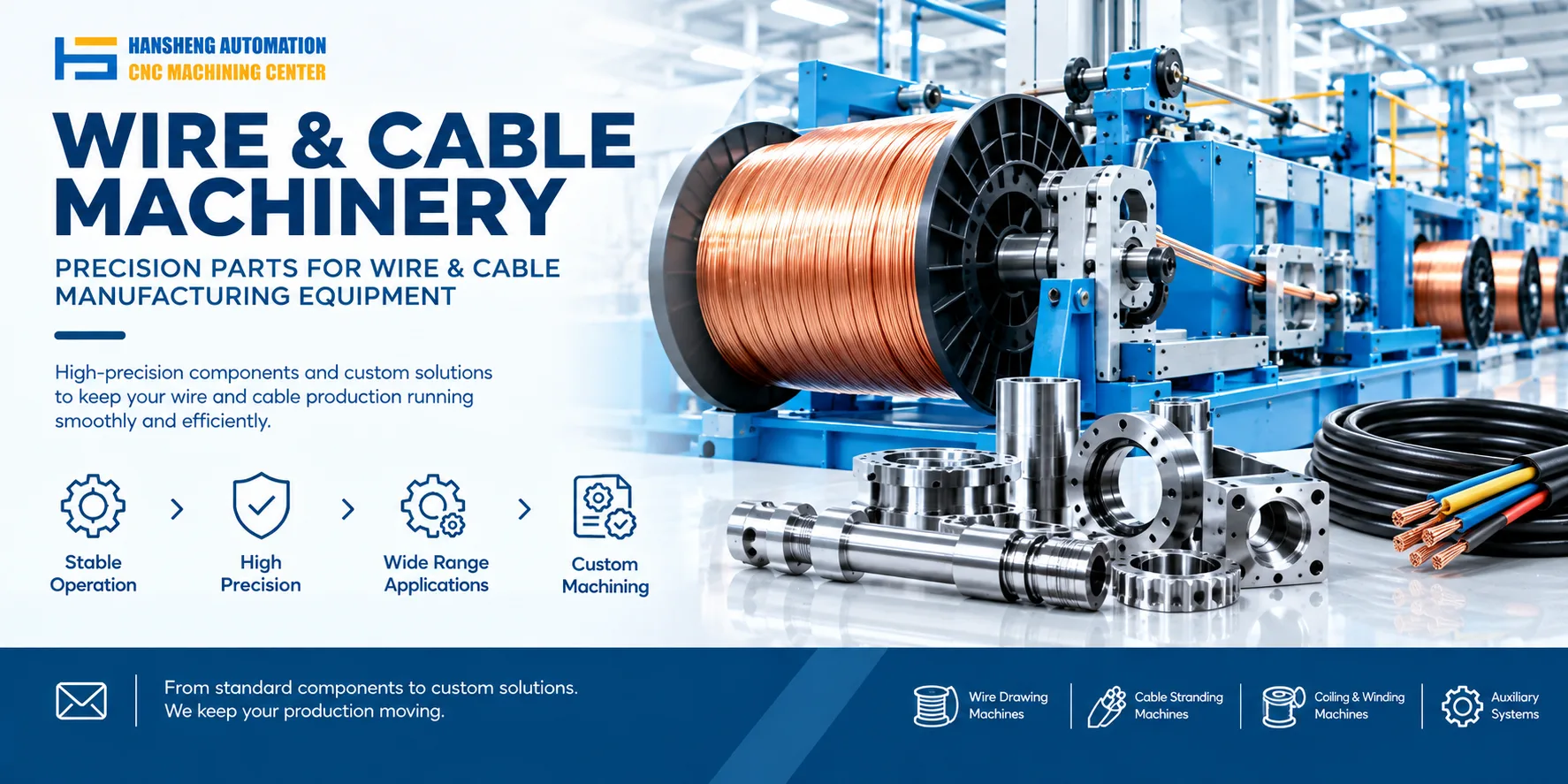
Different wire routing machines vary widely in structure. These designs determine wire path, tension stability, and traverse quality. Hansheng Automation can machine guide wheels, sliders, connecting rods, tape holders, wire guide wheels, swing arms, and slide rails from customer drawings, in single pieces or small batches.
1. Mica tape rewinding wire routing machine
The core drive system consists of a linear motor, slider, connecting rod, and tape holder. The through-hole design of the tape holder ensures even mica tape winding. The liftable connecting rod works with the linear motor to control the reciprocating motion path precisely.
2. Wire routing structure on a winding machine
It uses a felt wire guide mechanism. Multiple layers of felt adjustment devices control tension. The adjusting nut allows dynamic tightness fine adjustment. Compared with traditional roller structures, this design reduces mechanical noise by 75%.
3. Wire routing fixing structure on an automatic line marking machine
It has a combined straight and curved wire routing groove. A plug-in structure allows modular expansion. The L-shaped wire pressing plate and telescopic rubber plate form a dynamic positioning system. The connecting strip on the cover adapts to wire diameter changes from 0.5 to 3 mm.
4. Cable routing machine
The core assembly includes a four-axis linkage system:
Frame: a 316L stainless steel frame that carries the main structure.
Stopper: a pneumatically controlled rotatable limit module.
Straightener: a guide rail with ball bearings.
Wire routing unit: a main traction unit driven by dual variable frequency motors.
5. Wire routing machine for drawing equipment
It uses a five-wheel wire guide system:
The third and fourth guide wheels are arranged on the upper connecting plate.
The fifth guide wheel uses a swing arm for dynamic compensation.
The first and second guide wheels are installed on the sliding block vertical plate.
This three-level arrangement keeps take-up deviation within ±0.3 mm.
Selection points
After understanding the structural features of each wire routing machine, focus on three engineering parameters when selecting: guide wheel arrangement, tension control accuracy, and modular expansion capability.
Beyond wire routing machines, our precision custom machining capability is not limited to one industry. Hansheng Automation can machine non-standard metal parts for medical devices, food machinery, and printing equipment from customer drawings. We also machine yacht components, RC car components, and specialized parts for tobacco packaging and filling machinery. We focus on build-to-print custom machining and produce single pieces or small batches according to customer drawings. We do not sell complete machines.