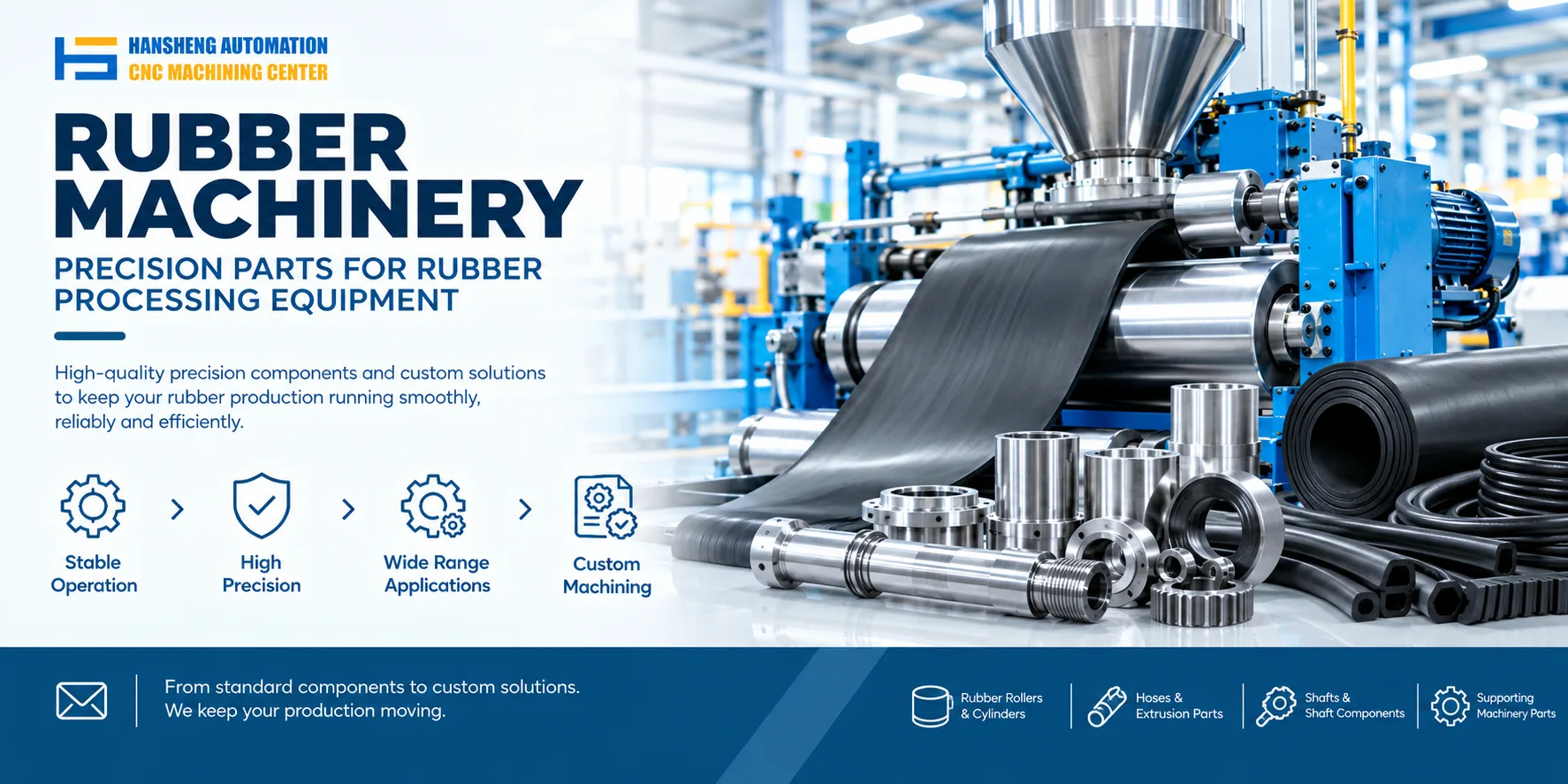
Industrial belts include rubber conveyor belts, PVC/PVG conveyor belts, timing belts, and V-belts. Their manufacturing processes generally involve four stages: rubber compounding, belt forming, vulcanization, and post-processing. Each stage requires equipment suited to the belt material, structure, dimensions, and production volume.
1. Equipment for rubber compounding
Rubber compounding prepares the material for subsequent forming and vulcanization.
1.1 Open mill
An open mill mixes raw rubber with carbon black, sulfur, and other compounding ingredients through the shearing action of two counter-rotating rolls.
The roll speed ratio is typically 1:1.2 to 1:1.5, according to the supplied reference. Open mills are suitable for small batch trials and applications with lower production requirements. A dust collection system should be provided where needed to reduce dust emissions.
1.2 Internal mixer
An internal mixer is widely used in large scale rubber production. Rotors shear and knead the compound inside an enclosed chamber, allowing efficient mixing while reducing material loss and dust release.
Internal mixers use different rotor designs, including intermeshing and tangential rotor configurations. The appropriate design depends on the rubber compound and mixing requirements.
1.3 Rubber strainer
A rubber strainer removes contaminants and undispersed gel particles from the mixed compound to improve material cleanliness. Pressure filtration is one common design.
Rubber strainers may be used in the production of higher grade conveyor belts and precision timing belts where material cleanliness is important.
2. Equipment for belt forming
The forming stage produces rubber sheets, profiles, or belt structures with the required dimensions and reinforcement layers.
2.1 Calender
A calender presses compounded rubber into sheets of a specified thickness. It can also apply rubber to reinforcing materials during the initial assembly stage.
Calenders are available in two roll, three roll, and four roll configurations. A four roll calender can process the upper and lower cover rubber together with the intermediate fabric layer, making it suitable for producing layered conveyor belt structures.
2.2 Extruder
An extruder produces rubber profiles and other materials with specified cross sections. Typical applications include toothed rubber layers for timing belts and the main rubber body of V-belts.
Single screw extruders are commonly used for conventional rubber compounds. Twin screw extruders can combine compounding and extrusion when processing thermoplastic elastomers, depending on the material and process design.
2.3 Belt forming machine
A belt forming machine assembles the belt structure by positioning and bonding reinforcement materials, such as textile fabric or steel cord, with the rubber layers in the required sequence.
Automated forming machines may include online alignment correction to maintain belt width and thickness within the required tolerances. They are commonly used in large scale conveyor belt production.
2.4 Cutting machine
A cutting machine cuts the formed belt material to the specified length or shape.
Hydraulic cutting machines are suitable for conventional batch cutting. Laser cutting equipment can provide precise cutting for suitable timing belt and narrow belt applications. The cutting method should be selected according to the belt material and dimensional requirements.
3. Equipment for vulcanization
Vulcanization uses heat and pressure to cure the rubber compound and establish the required physical properties and final shape.
3.1 Platen vulcanizing press
A platen vulcanizing press uses heated upper and lower platens to apply heat and pressure to the belt material.
The supplied reference gives a typical vulcanization temperature range of 145°C to 160°C and a pressure range of 8 to 15 MPa. Actual settings depend on the rubber formulation, belt construction, and curing requirements.
The equipment includes vertical platen presses and jaw type vulcanizing presses. Jaw type presses are used for vulcanizing wider conveyor belts.
3.2 Continuous vulcanization line
Continuous vulcanization lines are used for large scale production of long or wide conveyor belts.
A drum vulcanizer, for example, uses a heated rotating drum to carry the belt material continuously through the vulcanization section. This arrangement supports continuous production and can reduce the need for separate batch curing cycles.
3.3 Injection vulcanizing machine
An injection vulcanizing machine injects rubber compound into a custom mold, where the material is formed and cured.
It is suitable for certain small, precision molded rubber belts and timing belt products. The process can provide consistent dimensions and surface appearance when the mold and process parameters are properly controlled.
4. Post-processing and inspection equipment
After vulcanization, belts may require edge finishing, surface treatment, dimensional inspection, and performance testing before packaging.
4.1 Trimming machine
A trimming machine removes flash and burrs from belt edges after vulcanization.
Disc type and knife type trimming machines are available for different belt widths and edge finishing requirements.
4.2 Surface treatment equipment
Surface treatment equipment prepares the belt surface for subsequent applications.
Grinding machines can adjust surface roughness where required. Corona treatment machines may be used on PVC, TPU, and other suitable plastic belt materials to improve surface adhesion for printing or bonding.
The selected treatment should be compatible with the belt material and the next manufacturing process.
4.3 Testing equipment
Inspection equipment is used to verify the dimensions and performance of finished belts. Common examples include:
Thickness gauges: Check belt thickness against the specified dimensions.
Tensile testing machines: Measure tensile strength and related mechanical properties.
Aging test chambers: Evaluate changes in material performance after aging tests.
X-ray inspection systems: Inspect the internal steel cords of reinforced conveyor belts for broken wires or other defects.
The inspection plan depends on the belt construction and the customer's quality requirements.
4.4 Packaging and handling equipment
Automatic film wrapping machines and strapping machines prepare finished belts for storage and transport. Appropriate packaging helps protect belts against moisture, deformation, and handling damage.
5. Custom machining for belt manufacturing equipment
Belt production lines also use mechanical components that must meet specific dimensional and assembly requirements. When a replacement component is non-standard or requires a drawing-based design, Hansheng Automation can assess custom machining based on customer drawings, material specifications, and dimensional requirements.
Our precision machining services also cover components for other industrial applications, including tobacco packaging machinery and filling equipment. We can also assess custom parts for yacht equipment and RC racing cars, subject to the drawing requirements and machining feasibility.