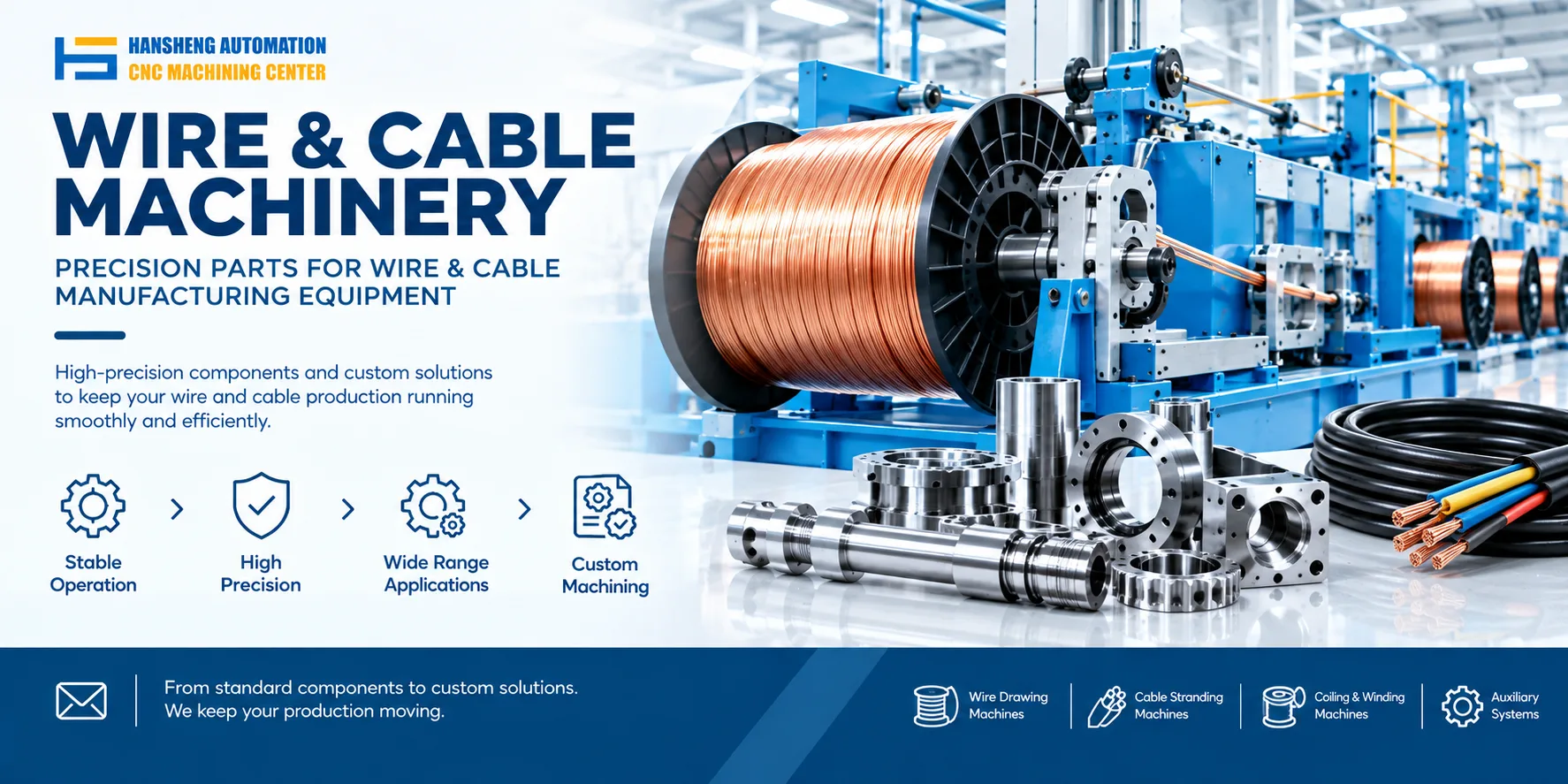
In ACSR (aluminum conductor steel reinforced) production, common problems include oil stains, scratches, score marks, loose strands, and snake-like bends. These issues affect surface quality, corona loss, and line operation. At Hansheng Automation, we provide build-to-print custom machining for drawing and stranding equipment. We make precision parts such as die holders, capstan wheels, guide wheels, and reel centers from customer drawings.
1. Oil stains on the conductor surface
ACSR used for overhead transmission lines is often questioned or even returned because of surface quality problems. These problems mainly come from the drawing process. Causes include:
(1) The finished drawing die is too large, the reduction ratio is small, and the working zone of the die is too short to remove oil stains from the conductor surface.
(2) The lubricating grease temperature is too low, its viscosity is high, and it does not evaporate easily, so drawing oil sticks to the aluminum wire surface.
(3) The wiping felt at the exit of the finished die is too dirty.
(4) The strander body or capstan wheel is too dirty during stranding.
(5) Too much water collects under the capstan wheel.
To avoid oil stains, select a suitable drawing die and adjust the lubricating grease temperature during drawing. Replace the wiping felt often. Keep the stranding equipment and dies clean and free of oil during stranding.
2. Surface scratches
When drawing equipment, drawing dies, stranding equipment, or stranding merging dies have sharp metal edges, surface scratches can occur during drawing or stranding. This defect affects conductor surface quality. When the conductor is not smooth during operation, corona can also occur. Once surface scratches are found, check the equipment and dies immediately.
3. Score marks on the conductor
Continuous score marks are a common cause of corona, and corona is one of the most important causes of power loss in power systems. To avoid score marks, control production from the following aspects.
From the conductor itself:
First, keep the aluminum rod from moisture. Moisture in the aluminum rod causes aluminum chips to stay in the working zone of the drawing die hole. Lubricating oil cannot fully enter the working zone. The drawn aluminum wire is then not round or smooth.
Second, keep the drawing oil clean and free of water. During drawing, the drawing oil is at high temperature when it moves from the lubrication zone into the working zone. If it contains water, the lubricating oil is diluted. Lubrication drops sharply, causing score marks and aluminum wire breakage.
From production:
In the drawing process:
(1) Check whether the drawing machine die is placed correctly.
(2) Check whether the drawing drum has grooves from friction and whether there is wire pinching.
(3) Check whether the surface finish of the lubrication zone of the drawing die meets requirements and whether aluminum chips block it.
In the stranding process:
(1) Check whether the reel center rotates smoothly.
(2) Check whether reel tension is uniform and consistent.
(3) Check whether single wires have slight pinching or uneven traverse.
(4) Check whether single wires stay in the guide wheel grooves during stranding.
4. Loose strands and snake-like bends
(1) Adjust reel pay-off tension properly during stranding. Tension depends on experience built up in daily work. An experienced operator can usually set it to a suitable level.
(2) When choosing the merging die, the die hole diameter should be 0.3 to 0.5 mm smaller than the stranded cable outer diameter.
(3) Adjust the untwisting device so the single wire forms an S shape before stranding. This helps remove internal stress created during stranding.
(4) Reduce stops during stranding. It is best to run the same stranded wire at the same fixed speed. Uneven speed or stopping and starting can change the lay length and cause loose strands.
(5) Before using the steel core for stranding, inspect it in advance to make sure it is not loose. During stranding, the steel core should maintain sufficient and constant pay-off tension.
Beyond ACSR production equipment, our precision custom machining capability is not limited to one industry. Hansheng Automation can machine non-standard metal parts for filling machinery, printing machinery, medical devices, and food machinery from customer drawings. We also machine yacht components, RC car components, and specialized parts for tobacco packaging machinery. We focus on build-to-print custom machining and produce single pieces or small batches according to customer drawings. We do not sell complete machines.