An old-style tungsten wire drawing machine has seven main part groups: pay-off unit, lubrication and cooling system, drawing die assembly, drawing pulley group, take-up unit, tension control mechanism, and frame with safety guards.
Pay-off unit
It consists of a pay-off reel stand, friction brake mechanism, and tension damping wheel. It releases coarse tungsten wire stock steadily and prevents wire tangling or breakage. Because tungsten wire has high strength, old machines often use a purely mechanical brake. Friction plate damping controls pay-off tension.
Lubrication and cooling system
It includes a liquid storage tank, circulation pump, spray piping, and coarse filter. Old machines often use emulsion-type drawing fluid. The fluid sprays directly on the contact area between the drawing die and tungsten wire. It reduces friction heat, carries away drawing debris, and prevents surface scratches and die hole overheating.
Drawing die assembly
This is the core working part for tungsten wire drawing. Old machines commonly use YG8 or YG6 cemented carbide dies. The assembly has a steel die holder, a carbide die core, and a compression nut. The die core bore has a gradual taper of 15° to 30°. It reduces the tungsten wire cross section to the target diameter.
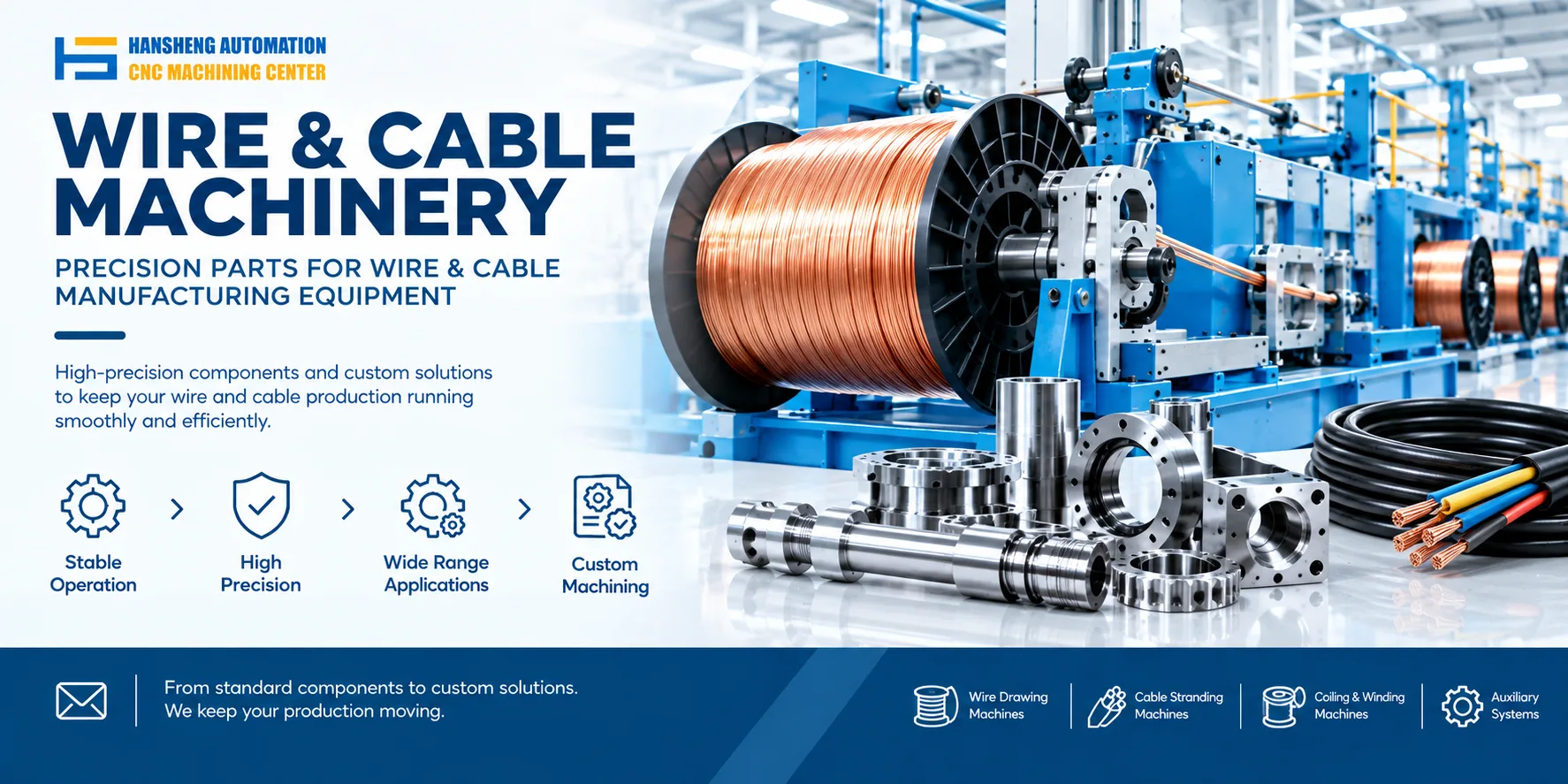
When dies, die holders, or capstans need replacement, Hansheng Automation can machine custom parts from customer drawings in single pieces or small batches.
Drawing pulley group
It consists of several passive pulleys linked in series to form the wire path. Pulley surfaces are hard chrome plated or fitted with carbide bushings. They change wire direction and maintain drawing tension. Each pulley group matches one drawing die set for multi-stage continuous drawing. Power comes from the main motor through gears or belts.
Take-up unit
It includes a take-up reel stand, take-up reel, DC variable speed motor, and transmission gear set. It synchronizes take-up speed with the drawing speed of the die. This keeps the tungsten wire wound neatly and tension even, and avoids wire pile-up or breakage.
Tension control mechanism
Old machines often use a lever-type tension dancer. The dancer displacement feeds back wire tension. Adjustable counterweights set tension level. This keeps tension stable in each drawing pass and prevents wire breakage from too much tension or slack from too little.
Frame and safety guards
The frame is usually a cast iron welded structure. It holds all core parts. Guards are usually metal mesh covers over pulleys and the wire path. They protect operators from high-speed pulleys and flying wire if a break occurs.
Our precision custom machining is not limited to tungsten wire drawing machine parts. Hansheng Automation also produces non-standard components for yacht hardware, RC car parts, filling machinery, tobacco packaging machinery, printing equipment, medical devices, and food machinery. We work from customer drawings for single pieces or small batches. The focus stays on precision parts machining and delivery, which keeps maintenance and replacement flexible across different industries.