

Both gear grinding and gear honing are post-heat-treatment finishing operations that use abrasives to refine gear tooth surfaces. Both can achieve high precision. But they work through fundamentally different mechanisms, produce different surface textures, and are suited to different production scenarios.
Grinding remains the most mature and widely adopted gear finishing process, but it presents limitations in surface micro-geometry that are unfavorable for noise reduction. Gear honing, by contrast, generates unique surface patterns that effectively suppress transmission noise. This characteristic has driven its growing adoption, particularly in automotive gear manufacturing.
This guide breaks down exactly what separates these two processes, where each excels, and how leading manufacturers are combining them.

What is Gear Grinding
Gear grinding is a meticulous processing technique that removes material from the sides of hardened gears using a high-speed grinding wheel. The main task of grinding is to precisely and repeatedly correct the geometric deformations caused by heat treatment.

There are two main methods. In contour grinding, a shaped grinding wheel is inserted directly into the tooth groove and sequentially grinds each side. This method is accurate but slow and is more suitable for large gears or complex contours. In generating grinding, a worm-shaped grinding wheel continuously rolls against the gear and removes material from the entire tooth side through a single continuous generating motion. Due to its high speed, generating grinding dominates in large-scale automotive production. It is also the only process that can precisely control the side profile even if the grinding material is uneven.
However, the cost is that heat is generated. The cutting speed of the grinding operation is higher than 30 meters per second. The intense cutting removal process generates a large amount of heat energy on the tooth surface. If the parameters are not carefully controlled, grinding burns will become a real risk. The surface roughness after grinding is usually within the range of Ra 0.4 - 0.8 micrometers, and the resulting texture has obvious parallelism and directional characteristics along the grinding path.
Hansheng Automation specializes in providing high-precision CNC gear grinding services for industrial mechanical gears. We can achieve a surface roughness of less than 0.4 micrometers and maintain a tolerance range of ±0.005 millimeters. If you need to achieve precise geometric control and excellent surface finish in a single operation in your application, please explore the gear grinding services of Hansheng Automation.
What is Gear Honing
Gear honing is a low-speed abrasive finishing process in which a gear-shaped honing wheel meshes with the workpiece gear at a deliberate cross-axis angle. This crossed-axis geometry means that as the honing wheel and gear mesh, the contact point traces a curved path diagonally across each tooth flank.
The relative sliding along the tooth profile direction and the relative sliding along the tooth width direction combine to generate a unique curved honing arc pattern on the tooth surface. This pattern that gives honed gears their characteristic noise reduction advantage.
Unlike traditional grinding, honing operates at much lower cutting speeds, typically 0.5 to 6.5 m/s, which effectively prevents thermal damage to the gear surface.
Modern power gear honing goes further still. Using electronically synchronized, forced meshing between a rigid CBN honing wheel and the workpiece, power honing can achieve DIN class 5 accuracy and surface roughness of Ra < 0.2 µm, with material removal reaching 0.1 mm.
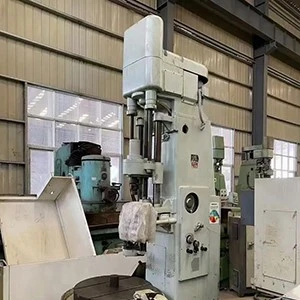
Gear Grinding vs. Gear Honing
Grinding corrects large errors left by upstream processes. Honing optimizes the surface for how the gear will actually behave in service. Here is how the two processes compare across the dimensions that matter most to a process engineer:
|
Parameter |
Gear Grinding |
Gear Honing |
|
Primary purpose |
Correct tooth geometry, remove heat distortion |
Refine surface texture, reduce noise, improve contact |
|
Cutting speed |
> 30 m/s |
0.5–6.5 m/s |
|
Material removal |
0.1–0.5 mm |
0.01–0.1 mm |
|
Surface roughness Ra |
< 0.4 µm |
< 0.2 µm (power honing) |
|
Surface texture |
Parallel/directional grooves |
Cross-helical arc pattern |
|
Heat generation |
High |
Very low |
|
Geometry correction |
Excellent - handles severe distortion |
Limited - depends on pre-process quality |
|
DIN accuracy achievable |
Class 3–4 |
Class 5–6(power honing) |
|
NVH performance |
Baseline |
Up to 8 dB noise reduction vs. grinding |
|
Residual stress |
Risk of tensile stress if burn occurs |
Maintains/enhances compressive stress |
|
Tooling cost |
Higher |
Lower |
|
Best application |
High-precision, large distortion, diverse geometry |
High-volume automotive, NVH-critical, EV transmission |
Still unsure whether gear grinding or gear honing fits your production needs? Contact our engineering team for a free process recommendation.
When Should You Choose gear Grinding or gear Honing
Neither process is universally superior. The right answer depends on what your gear needs to correct, what it needs to achieve, and how many of them you are making.

Choose gear grinding When
- Post-heat-treatment distortion is significant (stock > 0.1 mm) and requires reliable geometric correction.
- You need to hold DIN 3–4 accuracy with controlled flank topography modifications like tip relief, crowning and lead corrections.
- You are producing large, complex, or low-volume gears where honing tooling economics don't apply.
- Your application requires robust geometry control that remains accurate even with variable stock removal across the batch.
Choose gear honing When
- Surface finish and NVH are primary requirements, and pre-process quality is already good.
- You are running high volumes of automotive or EV transmission gears where cycle time and tool cost matter.
- The application demands unique surface patterns to suppress transmission noise, particularly where grinding's parallel surface micro-geometry is unfavorable.
- Thermal damage risk from grinding is a concern for your material or case depth specification.

Conclusion
Gear grinding and gear honing are not competing processes. They are complementary tools in the precision gear finishing toolkit, each solving a different problem.
Grinding is where geometry is won. It corrects the distortions that heat treatment inevitably introduces, holds tight tooth profiles, and gives you the dimensional control that separates a DIN 4 gear from scrap. Honing is where function is optimized. It takes a geometrically correct gear and transforms its tooth surface into something that runs quietly, wears slowly, and holds lubrication under load.
For engineers working on industrial mechanical gears where both geometry and surface integrity must be uncompromised, partnering with a specialist like Hansheng Automation ensures that precision grinding is executed to the tightest standards from the very first part.