The biggest difference between a 2D mixer and a 3D mixer lies in the movement pattern of the materials during mixing and the resulting mixing performance. Their working mechanisms are different, so they are suited to different material characteristics and process requirements.
1. Movement Pattern
2D Mixer
In a 2D mixer, materials mainly move within a relatively limited two-dimensional space. The mixing process typically involves horizontal movement, turning, and vertical displacement generated by the rotation or movement of the mixing vessel or agitator. Materials repeatedly undergo tumbling, shear, and diffusion, but their movement paths are comparatively simple.
3D Mixer
A 3D mixer allows the material to move through multiple directions within three-dimensional space. Through the compound movement of the mixing vessel, materials can continuously undergo tumbling, rotation, convection, and diffusion from different directions. This more complex movement pattern increases material exchange throughout the mixing chamber and helps reduce localized accumulation.
2. Mixing Performance
2D Mixer
Because the material movement in a 2D mixer is relatively straightforward, the equipment can be suitable for conventional mixing applications where the material properties are relatively uniform. However, when the components have significant differences in particle size, density, shape, or flowability, the material may be more susceptible to segregation or localized concentration differences.
3D Mixer
The multi-directional movement of a 3D mixer generally provides more frequent material exchange and a wider range of movement paths. This can improve dispersion and mixing uniformity, particularly when processing powders or granules with different physical properties. For applications with relatively demanding uniformity requirements, a 3D mixer may offer advantages over a conventional 2D mixing method.
3. How to Choose Between Them
The choice between a 2D mixer and a 3D mixer should not rely solely on the nominal mixing method. Material characteristics, required mixing uniformity, batch size, filling level, mixing time, and production conditions should all be considered.
For relatively easy-to-mix materials with stable flowability and moderate uniformity requirements, a 2D mixer may provide a practical solution. For applications involving multiple powders or granules with significant differences in density, particle size, or flowability, a 3D mixer can provide more complex material movement and potentially better mixing uniformity.
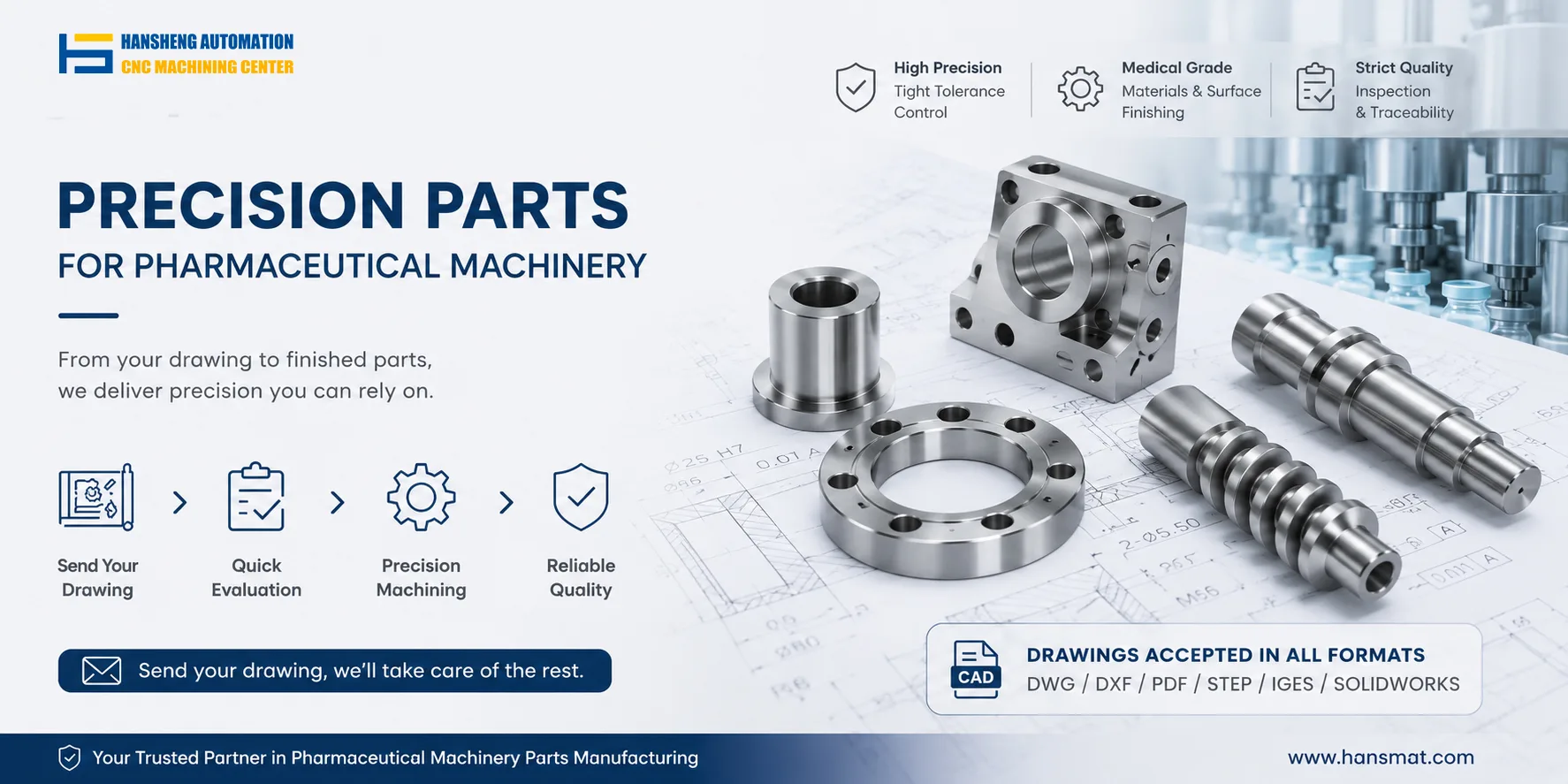
For pharmaceutical, food, chemical, and other processing equipment, we can also provide custom-machined precision components according to customer drawings. Hansheng Automation supports drawing-based production of shafts, sleeves, gears, flanges, connectors, and other non-standard mechanical parts, with machining specifications determined according to the actual assembly and operating requirements of the equipment.