3D motion mixers and trough mixers are both commonly used for blending powders and granular materials, but they differ in their movement patterns, mixing performance, equipment structure, and cost. Under the same nominal vessel capacity, a trough mixer generally offers a lower equipment cost, while a 3D motion mixer provides more complex material movement and is typically better suited to applications with higher mixing-uniformity requirements.
1. Mixing Performance
The main difference between the two mixers is how they move and exchange materials during operation.
A 3D motion mixer uses multi-directional movement of the mixing vessel. Materials continuously tumble, rotate, and disperse in different directions, creating more frequent material exchange throughout the mixing chamber. This movement can reduce localized accumulation and material segregation caused by differences in density, helping achieve more uniform mixing.
A trough mixer, by comparison, uses a horizontal trough and an S-shaped mixing paddle. As the paddle rotates, it pushes the materials back and forth within the trough, producing repeated folding, turning, and mixing. This structure provides effective mixing for many conventional applications, although some materials may accumulate near the bottom or certain areas of the trough during operation.
For applications where mixing uniformity requirements are relatively moderate, the slight difference in material movement of a trough mixer may have little practical impact. When the formulation contains components with significant differences in density, particle size, or flowability, a 3D motion mixer may provide better overall mixing performance.
2. Structural Differences
A 3D motion mixer mainly consists of a mixing vessel, transmission system, multi-directional motion mechanism, machine frame, and control system. Its distinctive feature is the compound movement of the vessel, which allows materials to travel along multiple directions during mixing.
A trough mixer generally has a horizontal trough, S-shaped mixing paddle, drive system, frame, and control components. The rotating paddle creates a relatively controlled material flow inside the trough, making the structure comparatively straightforward and convenient to operate and clean.
3. Cost and Application Considerations
When comparing mixers with similar nominal capacities, trough mixers generally have a lower equipment cost because their mechanical structure and movement mechanism are comparatively simple. The actual price difference depends on the model, materials of construction, sanitary requirements, motor configuration, and other specifications, so equipment selection should not be based on price alone.
A 3D motion mixer is more suitable when the process places greater emphasis on uniformity and multi-directional material exchange. A trough mixer can be a practical option for conventional applications where the materials are relatively easy to mix and the required uniformity is not particularly demanding.
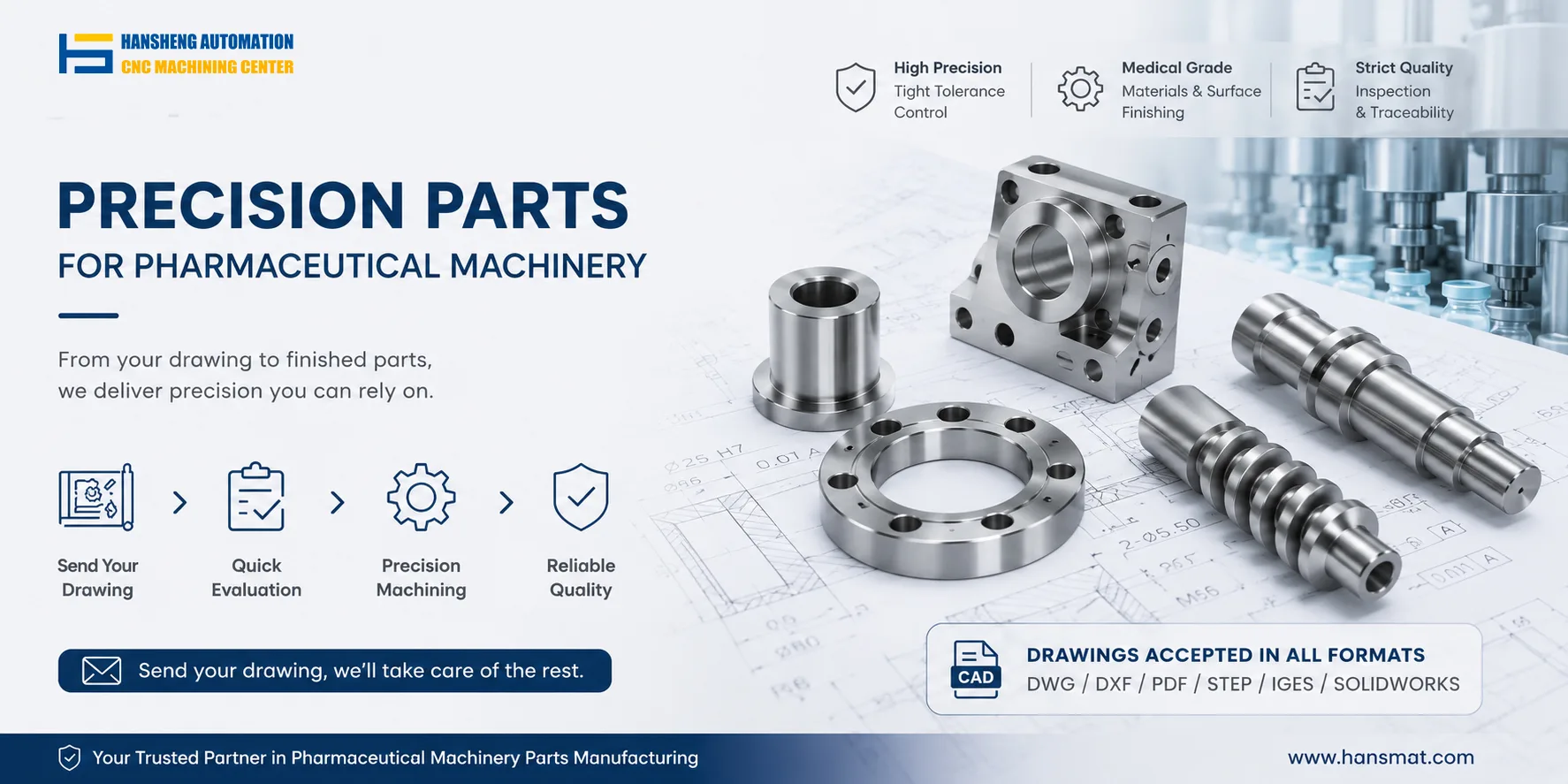
For either type of mixing equipment, component quality can directly affect transmission stability and long-term operation. We provide drawing-based custom machining services for precision components used in pharmaceutical, food, chemical, and other processing equipment. Hansheng Automation can manufacture non-standard shafts, sleeves, gears, couplings, flanges, brackets, and other mechanical parts according to customer drawings, material specifications, dimensional tolerances, surface-finishing requirements, and assembly conditions.
In practical selection, customers should evaluate the material characteristics, required mixing uniformity, batch capacity, cleaning requirements, production conditions, and budget together. The most suitable mixer is the one that matches the actual process rather than simply the one with the higher mixing capability or lower purchase cost.