A slitting machine is built to slit wide rolls into narrow strips along the length direction. Its structure and main advantages are below.
Structure
A slitting machine has four core modules: unwind unit, web guiding and positioning system, slitting and longitudinal shear unit, and rewind unit.
The unwind unit opens the wide roll smoothly. The web guiding and positioning system uses high-precision sensors and guide rolls to keep the material path accurate. The slitting and longitudinal shear unit uses circular blades or straight blades in combination to make longitudinal cuts. The rewind unit winds the slit narrow rolls evenly at the set tension. Some models also include automatic web guiding and tension control to improve processing stability.
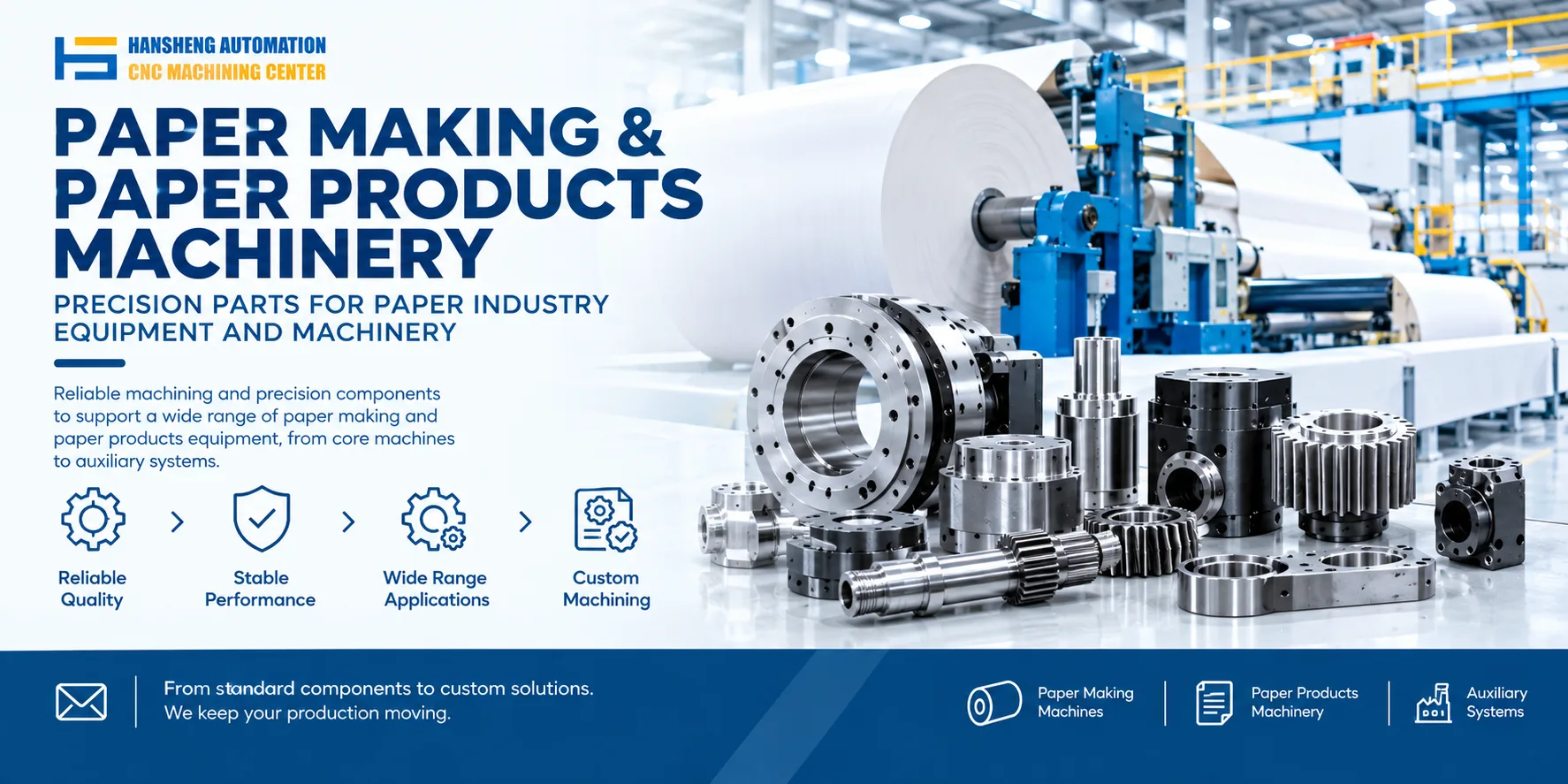
Hansheng Automation can machine custom slitting blades, tension shafts, guide rolls, and wear parts from customer drawings, in single pieces or small batches.
Five main advantages
Flexible operation modes and excellent precision
The machine offers manual and automatic modes for different production needs. In automatic mode, a PLC control system runs parameter-based operation. Cutting width error can be held within ±0.1 mm. This suits high-precision work such as electronic materials and optical films. Manual mode is useful for setup and troubleshooting. The interface has a digital display that shows tension, speed, and other key parameters in real time.
Multiple rewind methods for different materials
The machine supports surface winding and center winding.
Surface winding: A friction roll contacts the roll surface and drives rewinding by friction. It suits thin, easy-to-deform materials such as paper and plastic film.
Center winding: The shaft passes through the center of the roll and drives it directly. It suits thick rolls or applications that need high concentricity, such as metal coils and composite materials.
The two methods can be switched quickly, which improves machine versatility.
Automatic tension control for cut quality
The slitter uses a closed-loop tension control system. Magnetic powder brakes or servo motors adjust unwind and rewind tension in real time. This keeps tension constant during high-speed running. For example, when cutting 0.02 mm ultra-thin metal foil, the system can compensate for elastic deformation automatically. This avoids slanted cuts or wrinkles from tension fluctuation. Product qualification rate can rise above 99.5%. The circular blade shear structure with high-hardness blades produces smooth edges without burrs and reduces later processing steps.
Center winding for better roll uniformity
The rewind shaft uses a center take-up design at the middle of the face. The roll is loaded evenly during rotation. This avoids the trumpet shape that can occur with edge take-up, where the roll edge diameter is larger than the center diameter. For a 500 mm wide roll, center winding can keep end face flatness error within 0.5 mm. This improves later slitting and rewinding and suits roll storage that requires multiple layers stacked together.
Smart functions that simplify production management
The slitter integrates automatic length counting and stop protection.
The automatic length counting system uses an encoder to monitor roll length in real time. Accuracy reaches ±0.1 m. It can preset cut length and stop automatically to avoid material waste.
Stop modes include emergency stop and planned stop. In emergency stop, the machine stops within 0.2 seconds to prevent blade damage. Planned stop uses deceleration and buffering to reduce mechanical shock and extend equipment life. Some high-end models include a remote monitoring module. Users can check machine status through a mobile app and move toward predictive maintenance.
Application value
With modular structure and smart functions, a slitting machine performs well in cutting precision, material adaptability, and production efficiency. Its value comes not only from advanced hardware but also from its fit with different industry processes. Paper mills can run large-diameter, high-speed slitting. Electronics can process ultra-thin materials with precision. Metal processing can handle thick rolls with high tension control. In each case, the slitter supports efficient, stable production.
Beyond slitting equipment, Hansheng Automation also machines precision components for packaging machinery, printing equipment, medical devices, yacht systems, RC cars, food processing equipment, and tobacco packaging lines. We work from customer drawings and deliver one-off or batch parts to the required material, tolerance, and surface finish. Our scope is precision components, not complete machines.