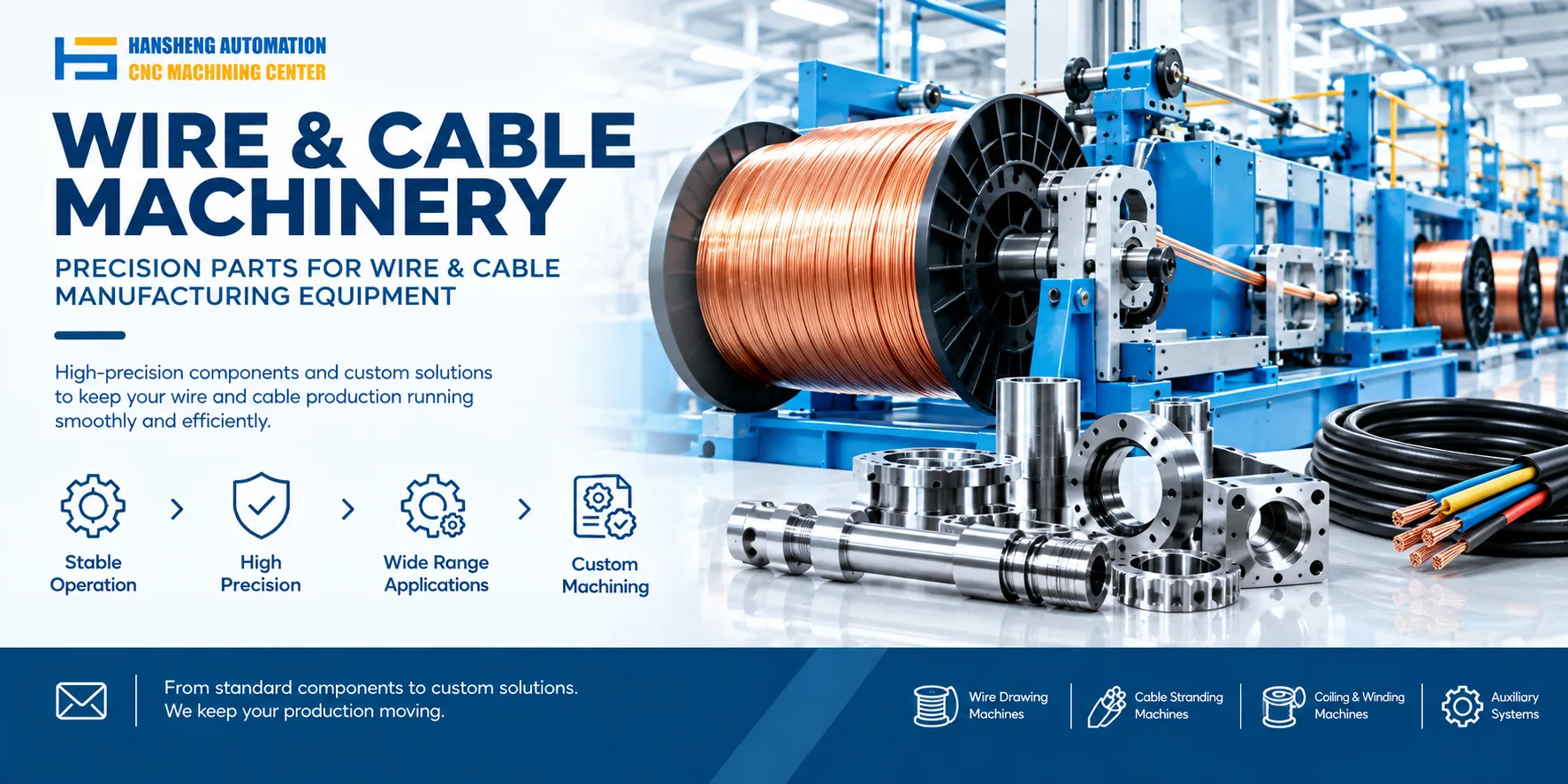
Cable manufacturing relies on different machines for conductor production, insulation processing, cable assembly, and quality inspection. Each type of equipment performs a specific function and affects the quality and efficiency of the production line.
1. What equipment is used for conductor processing?
Wire drawing machine
A wire drawing machine reduces copper, aluminum, and other metal rods to wires of different diameters. It is usually one of the first machines in conductor manufacturing.
The drawing process improves the wire's mechanical strength and surface finish while producing the required wire dimensions for subsequent conductor manufacturing.
2. What machines are used to apply cable insulation?
Extrusion machine
An extrusion machine uses a screw-driven system to apply plastic, rubber, or other insulating materials evenly around a conductor.
The main function is to control insulation thickness and material consistency so that the finished cable meets the required voltage resistance and durability specifications.
3. Which machines form the cable structure?
Cabling machine
A cabling machine combines multiple insulated cores into a cable core. Depending on the cable design, the cores may be arranged in concentric layers or twisted together using bunch stranding.
This process helps maintain structural stability and can improve the cable's resistance to electromagnetic interference, depending on its construction.
Braiding machine
A braiding machine weaves copper wire, tinned copper wire, or similar conductive materials into a shielding layer around the cable.
This equipment is commonly used for signal cables. The metal braid helps reduce the effects of external electromagnetic interference.
Armoring machine
An armoring machine applies a protective layer by wrapping steel tape around the cable or stranding steel wires over its outer structure.
Armoring is commonly used for cables exposed to demanding conditions, including mining and subsea applications. The protective layer helps improve resistance to mechanical compression and tensile loads.
4. What auxiliary equipment is used in cable production?
Spark tester
A spark tester applies high voltage to check cable insulation for defects such as pinholes and cracks.
Online testing can inspect the insulation along the cable's length, with detected defects marked for identification and further handling.
Haul-off machine
A haul-off machine uses a caterpillar track or roller drive system to pull the cable through the production line at a controlled speed.
Its pulling force and speed affect coordination between production stages and the accuracy of tension control.
Take-up machine
A take-up machine uses a torque motor or variable frequency drive system to wind finished cable onto a reel under controlled tension.
Proper winding helps prevent uneven layering, excessive compression, and deformation of the cable on the reel.
Custom precision machining for cable manufacturing equipment
Cable manufacturing equipment also requires accurately machined mechanical components, such as shafts, brackets, supports, and mounting parts. These components must meet the dimensional and assembly requirements of the equipment in which they are installed.
Hansheng Automation provides custom precision machining based on customer drawings. We review component geometry, material specifications, and dimensional tolerances to determine suitable manufacturing processes for prototypes and small batch orders.
Our machining services also cover parts for packaging machinery, yacht equipment, RC racing cars, and tobacco processing machinery. Customers can submit drawings and technical requirements for evaluation, with manufacturing arrangements tailored to the needs of each component.