Edible oil refining equipment falls into three groups by working method: batch, semi-continuous, and fully continuous.
Batch refining equipment: The process runs in steps and batches. Capacity is relatively limited. It suits small oil mills.
Semi-continuous equipment: Some stages, such as degumming, deacidification, and decolorization, run in batches and require waiting. Deodorization runs continuously and does not require waiting. It suits medium-sized oil mills.
Fully continuous refining equipment: The whole process runs continuously. Automation is high, capacity is high, and labor cost is low. It suits medium and large oil mills.
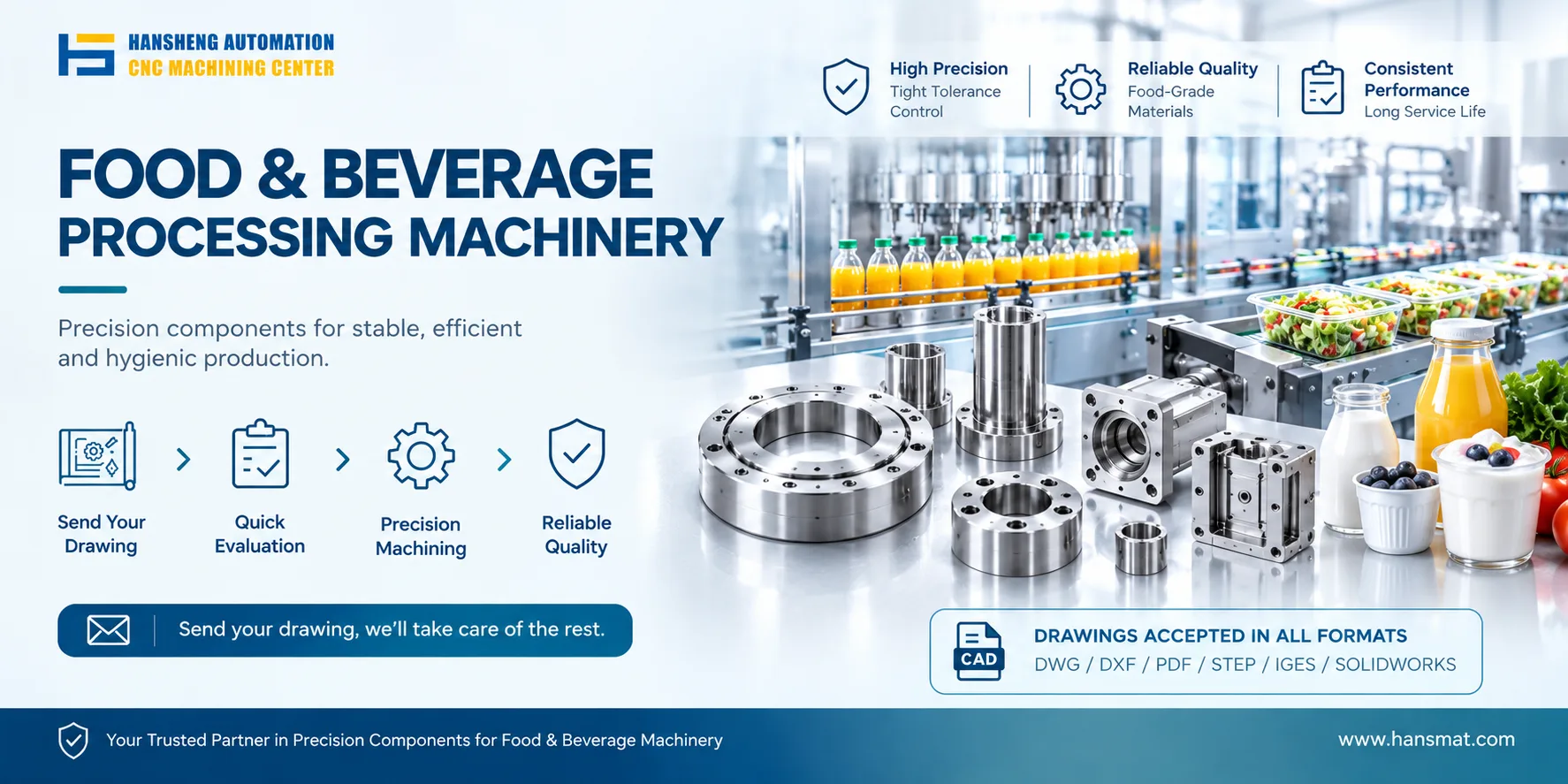
For these equipment types, Hansheng Automation can machine custom valve bodies, filter housings, heat exchanger plates, pump parts, and food-contact components from customer drawings, in single pieces or small batches.
Process flow
Crude oil → alkali refining and degumming → decolorization → filtration → deodorization → filtration → finished oil.
Hydration degumming
This method uses the hydrophilic nature of phospholipids and other gum impurities. Water or a dilute electrolyte solution is added to crude oil while stirring. The gum impurities absorb water, swell, agglomerate, and separate. During hydration degumming, proteins, mucus, and trace metal ions may combine with phospholipids. Phospholipids are the main substance that coagulates and settles.
Alkali refining deacidification
Every unrefined crude oil contains a certain amount of free fatty acids. Removing free fatty acids from oil is called deacidification. Methods include alkali refining, distillation, solvent extraction, and esterification. Alkali refining and steam distillation, also called physical refining, are widely used in industrial production.
Adsorption decolorization
Oil adsorption decolorization uses materials such as bleaching earth, activated clay, and activated carbon. These materials selectively adsorb pigments and other impurities under controlled conditions. After adsorbent treatment, oil color improves and gums are removed. The process also effectively removes some trace metal ions and substances that can poison hydrogenation catalysts. This prepares the oil for further refining, including hydrogenation and deodorization.
High-temperature deodorization
This process uses the volatility difference between odor compounds and triglycerides. Under high temperature and high vacuum, steam distillation removes substances with abnormal odors. Steam distillation deodorization, also called stripping, works when steam passes through oil containing odor components. The vapor and liquid surfaces contact each other. The steam becomes saturated with volatile odor components, which escape according to their partial pressure ratio. This removes the odor components.
Beyond oil refining equipment, our precision component customization serves more than one industry. We machine filling machinery parts, food machinery components, medical device parts, yacht precision components, RC car precision components, printing machinery parts, and tobacco packaging machinery parts. Hansheng Automation works from customer drawings and delivers one-off or batch parts to the required material, tolerance, and surface finish. Our scope is precision components, not complete machines.