A soybean oil refining line turns crude soybean oil into high-quality edible oil. The process runs through pretreatment, pressing, refining, and post-treatment. Each stage has its own equipment and parameters.
Pretreatment
Pretreatment removes impurities and adjusts the physical state of the soybeans for pressing.
Cleaning: Vibrating screens or water washing remove soil, sand, straw, and other impurities from the soybean surface. This reduces equipment wear and oil contamination in later steps.
Soaking: Cleaned soybeans soak in water and absorb moisture to about 12% to 14%. This softens the cell structure and makes crushing and oil release easier.
Crushing: A double-roller crusher breaks soybeans into 6 to 8 pieces. This breaks cell walls. Over-crushing is avoided because too much powder lowers pressing efficiency.
Pressing
Pressing uses mechanical force to separate oil from the oilseed. There are two routes: hot pressing and cold pressing.
Hot pressing: After crushing, soybeans are heated in a steam cooker to 110 to 120°C. Protein denatures and the cell structure breaks down further. Oil yield can exceed 85%. Hot-pressed oil has a stronger flavor, but some heat-sensitive nutrients may be lost.
Cold pressing: Soybeans are pressed directly below 60°C. More vitamin E and sterols are retained. Oil yield is lower, about 70% to 75%, and the oil color is lighter.
Pressing equipment: A screw press is commonly used for continuous pressing and separation of oil and cake. Crude oil contains 10% to 15% solid impurities and 2% to 5% free fatty acids.
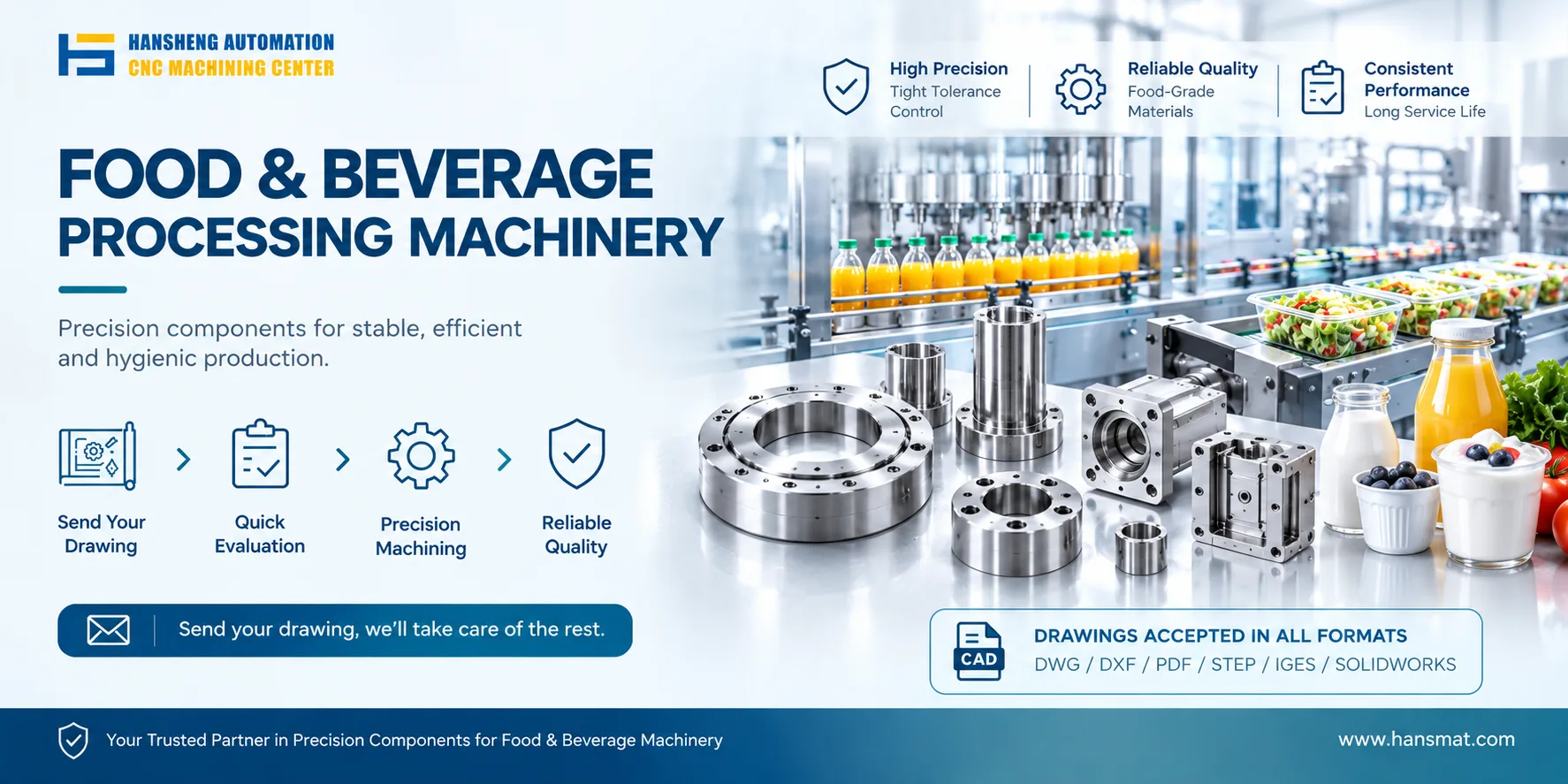
For oil press and refining equipment builders, Hansheng Automation can machine custom press worms, filter housings, heat exchanger plates, valve parts, and food-contact components from customer drawings, in single pieces or small batches.
Refining
Refining deeply purifies crude oil through degumming, deacidification, decolorization, and deodorization.
Degumming: Add 0.05% to 0.2% of oil weight phosphoric acid at 85% concentration or citric acid. Phospholipids and other gums absorb water and swell. Heat to 60 to 70°C, then separate with a centrifuge. Gum removal can reach over 90%. Acid value of degummed oil drops by 30% to 50%.
Deacidification: Use alkali refining. Slowly add 20°Be' sodium hydroxide solution at 1.1 to 1.3 times the free fatty acid amount. Neutralization forms soap particles. Hold at 80 to 85°C for 30 minutes, then centrifuge. Acid value of deacidified oil is ≤0.5 mgKOH/g.
Decolorization: Heat deacidified oil to 105 to 110°C. Add 2% to 5% activated clay by oil weight, with surface area ≥200 m2/g. Stir under vacuum for 20 to 30 minutes. Pigments such as chlorophyll and carotenoids are adsorbed. Color in a Lovibond cell at 133.4 mm is ≤Y10R1.0.
Deodorization: At 240 to 260°C and ≤266 Pa vacuum, inject direct steam at 3% to 5% of oil weight for stripping. Volatile off-flavor compounds such as aldehydes, ketones, and hydrocarbons are removed. Peroxide value of deodorized oil is ≤5 mmol/kg, and smoke point is ≥210°C.
Post-treatment
Refined oil needs post-treatment to ensure stability.
Cooling: A spiral plate heat exchanger cools oil from deodorization temperature to 40 to 50°C. This reduces thermal oxidation.
Filtration: Precision filter bags with pore size ≤5 μm or a plate-and-frame filter remove trace clay residue. Turbidity after filtration is ≤1 NTU.
Storage: A nitrogen-blanketed tank is filled with 99.9% pure nitrogen to isolate oxygen and prevent oxidation. Storage temperature is kept at 15 to 20°C.
Technology trends
Modern lines are moving toward smarter and greener operation.
Energy saving: A heat recovery system uses steam condensate heat from the deodorizer to preheat crude oil. Energy consumption drops by 15% to 20%.
Automation: A PLC system monitors acid value, color, and other indicators in real time. It automatically adjusts alkali dose, clay dose, and other parameters.
Byproduct use: Deodorizer distillate can be processed by molecular distillation to extract natural vitamin E at ≥70% and plant sterols at ≥90%.
Our precision component customization is not limited to oil refining equipment. We also machine parts for filling machinery, food machinery, tobacco packaging machinery, yacht precision components, RC car precision components, printing machinery, and medical devices. Hansheng Automation works from customer drawings and delivers one-off or batch parts to the required material, tolerance, and surface finish. Our scope is precision components, not complete machines.