Embossing marks in papermaking usually come from three groups of causes: abnormal equipment pressure, improper raw material mix, and process parameters out of range. The symptoms and fixes are below.
Equipment and mechanical factors
Uneven calender roll pressure: Roll surface wear or bearing damage can create local overpressure and periodic embossing marks. Check the gap between rolls with a feeler gauge. Tolerance should be within ±0.02 mm.
Abnormal felt dewatering: Blocked felt holes or unbalanced tension cause uneven dewatering of the wet sheet and watermark-like embossing marks. Rinse the felt with high-pressure water every 8 hours. Keep tension at 3.5 to 4.5 kN/m.
Vacuum press roll fault: When vacuum fluctuation exceeds ±5 kPa or the suction opening is blocked, sheet pickup becomes uneven and cloud-like embossing marks appear. Clean the vacuum suction opening daily and check the seal strip.
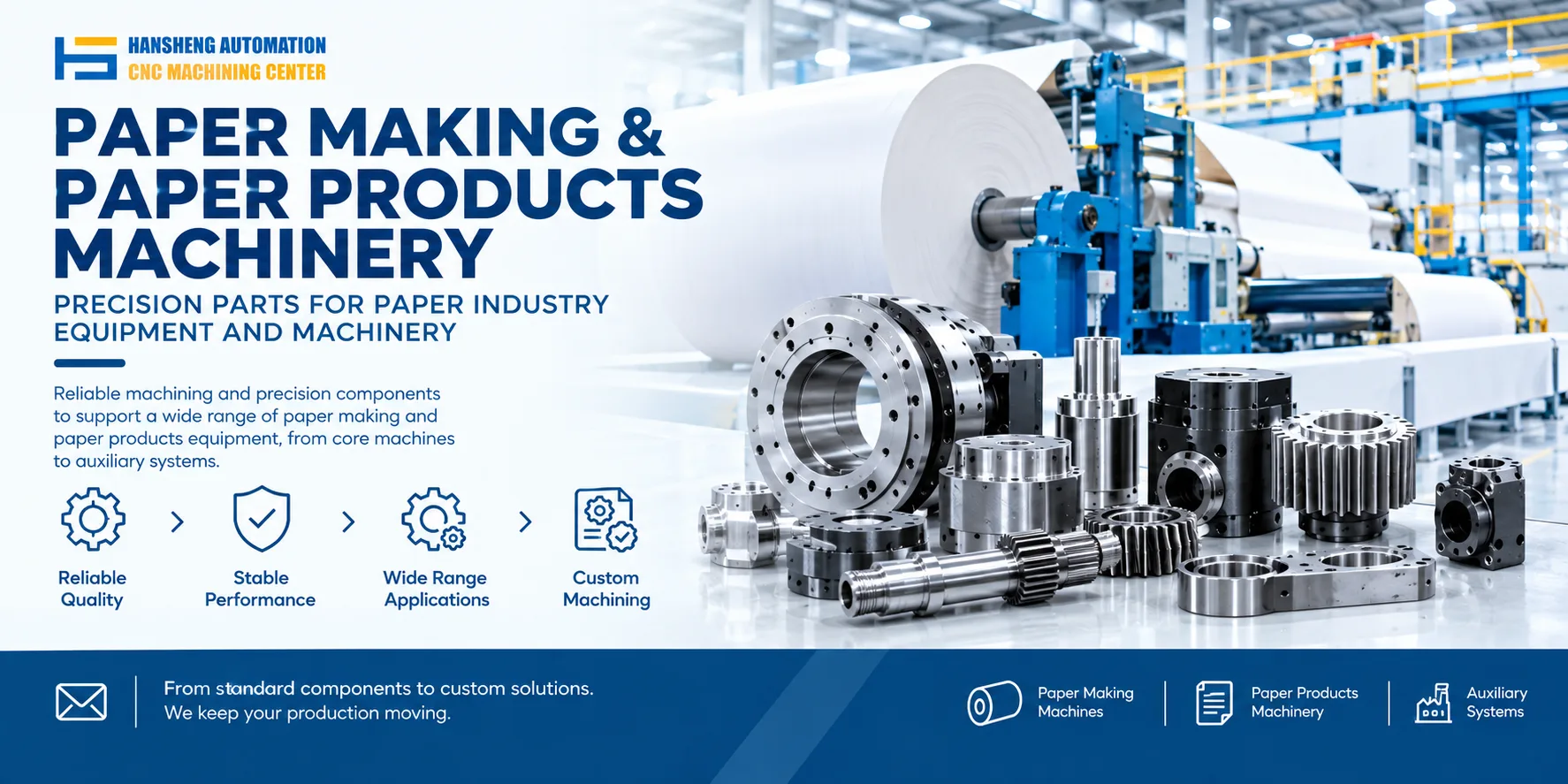
Hansheng Automation can machine custom calender roll components, vacuum roll seals, doctor blade holders, and felt guide parts from customer drawings, in single pieces or small batches.
Raw material and stock problems
Fiber ratio imbalance: When long fiber pulp is below 15%, sheet stiffness is too low and the sheet can be crushed. Keep softwood pulp at 15% to 25%.
Uneven filler distribution: Filler such as calcium carbonate can cluster and cause local hardness changes. Keep filler addition below 28%. Add it in three steps at the blending pump.
Insufficient size curing: When AKD sizing agent cures less than 4 hours, local hydrophobicity differs and halo-like embossing marks form.
Process parameters out of control
Too low dryness entering the press nip: Dryness below 38% makes embossing marks more likely. Raise dryer cylinder temperature or adjust vacuum box pressure. Keep dryness entering the press nip at 40% to 45%.
Excessive linear pressure: Calender linear pressure above 180 kN/m can crush fibers. Adjust pressure by basis weight. For 60 g/m² cultural paper, use 110 to 130 kN/m.
Abnormal speed matching: When the speed difference between the calender and dryer sections exceeds 15 m/min, shear embossing marks form. Keep speed difference between sections within ±5 m/min.
Sudden abnormal handling
When sudden full-width embossing marks appear, check the steam condensate system first. Insufficient flash evaporation can cause a sudden dryness change. Then check the starch spray system. A blocked nozzle can lower local strength. Check the sheet dryness curve every 15 minutes. Keep fluctuation within ±1.5%.
Beyond papermaking components, our precision component customization covers more than one industry. We machine medical device parts, printing machinery parts, yacht precision components, filling machinery parts, RC car precision components, food machinery parts, and tobacco packaging machinery parts. Hansheng Automation works from customer drawings and delivers one-off or batch parts to the required material, tolerance, and surface finish. Our scope is precision components, not complete machines.