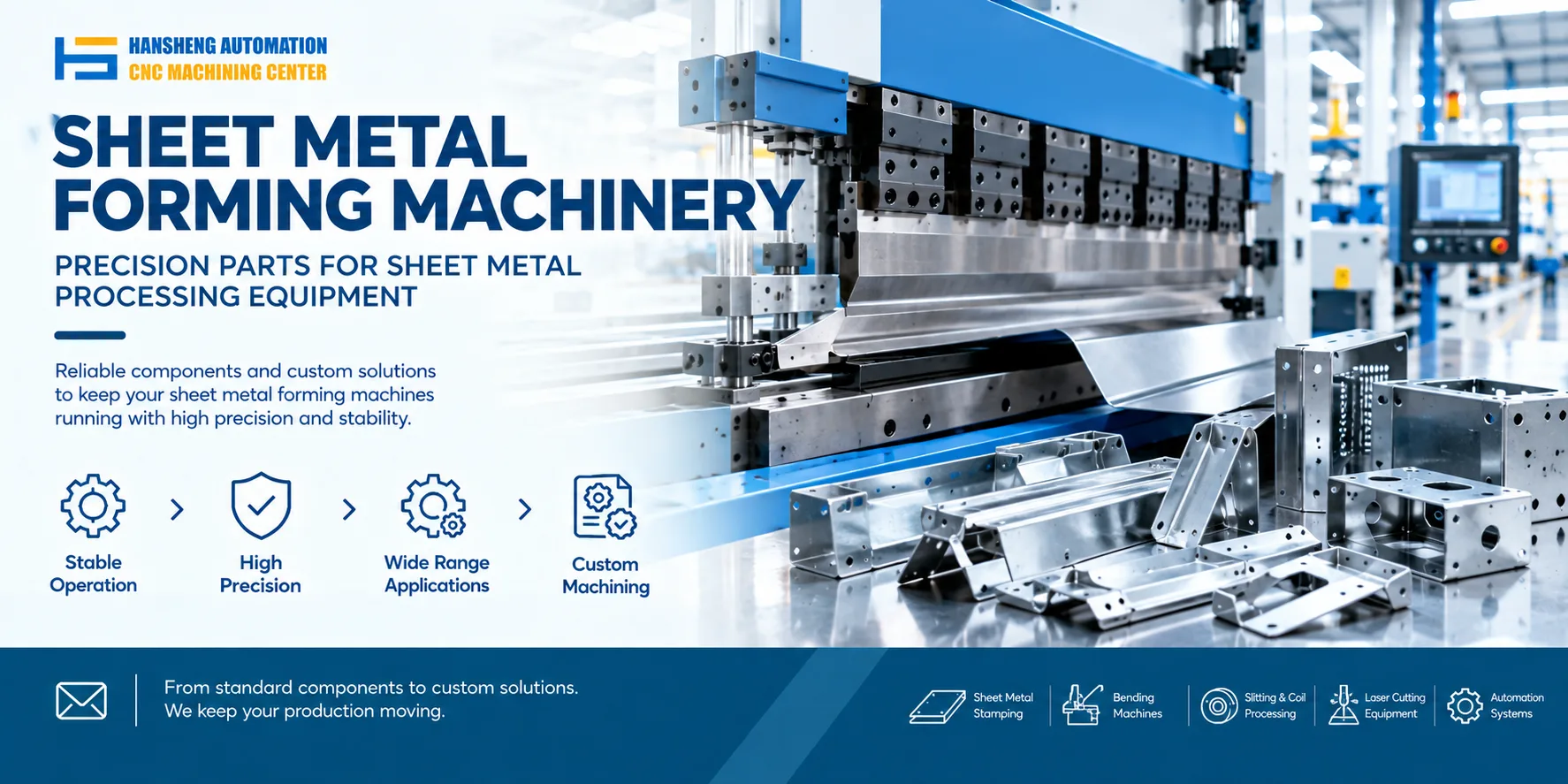
Mechanical and hydraulic compensation are two methods used on CNC press brakes to counteract deflection of the ram and worktable during bending. They differ in their compensation mechanisms, control methods, accuracy, maintenance requirements, and operating characteristics. The appropriate system depends on the required bending accuracy, production volume, and operating conditions.
Compensation principles and operating methods
Mechanical compensation
Mechanical compensation uses a series of inclined wedge blocks with sloped surfaces. The wedges are designed through finite element analysis based on the deflection curves of the ram and worktable side plates.
The CNC controller calculates the required compensation according to the applied load and automatically controls the relative movement of the wedge blocks. This compensates for deflection in the ram and worktable side plates during bending.
A motor drives the mechanical compensation system as a CNC controlled axis. This allows the controller to adjust the wedge positions accurately and provide compensation along the full length of the worktable.
Hydraulic compensation
Hydraulic compensation uses a group of cylinders installed beneath the lower worktable. Their positions and dimensions are designed according to the ram's deflection compensation curve and finite element analysis of the worktable.
The system creates a convex compensation profile in the center plate through relative displacement among the front, middle, and rear vertical plates. This arrangement relies on the elastic deformation of the steel plate itself.
The CNC controller calculates the required compensation value and sends it to a compensation amplifier. The amplifier then controls the small hydraulic cylinders beneath the worktable, raising the relevant areas to reduce deflection during bending.
Compensation performance and accuracy
Mechanical compensation
Mechanical compensation provides stable performance over time and avoids hydraulic maintenance issues such as oil leakage. Its multiple wedge blocks provide numerous compensation points, allowing the system to adjust the compensation profile more continuously along the worktable.
Compared with conventional hydraulic compensation systems that use three compensation points, mechanical compensation has more adjustment points and can reduce areas where compensation is insufficient. This helps maintain bending accuracy across the workpiece.
Hydraulic compensation
Hydraulic compensation is generally straightforward to operate and can achieve high bending accuracy. However, the actual compensation value can be affected by hydraulic system conditions. Oil leakage, loose connections, and related faults may change the compensation applied during each bending cycle, resulting in inconsistent workpieces.
Hydraulic compensation can provide accurate results, but a conventional system with only three compensation points offers fewer adjustment positions than a mechanical system with multiple wedge blocks. Depending on the system design and workpiece requirements, this may leave areas where compensation is less effective.
Maintenance and operation
Mechanical compensation
Mechanical compensation has a relatively simple structure and does not involve hydraulic oil, eliminating oil leakage as a maintenance concern. It generally requires less maintenance associated with hydraulic components and avoids the related risk of hydraulic fluid leakage.
However, the inclined wedge surfaces can wear after prolonged use. This wear may affect compensation performance and requires inspection.
The system also places greater demands on operator skill. When a workpiece requires multiple bending operations, operators may need to make real time adjustments to achieve the required results.
Hydraulic compensation
Hydraulic compensation has a more complex hydraulic system. Oil leakage, loose fittings, and seal problems can occur, so the hydraulic circuit and related components require regular inspection and maintenance.
Machine operation is generally straightforward because the CNC controller calculates the compensation value and controls the hydraulic cylinders. Operators must still monitor hydraulic oil quality and overall system stability to maintain consistent compensation.
Which compensation method is suitable for your application?
Mechanical compensation is suitable for applications requiring high bending accuracy and batch or mass production, particularly where operators have the technical skills needed to adjust and monitor the process.
Hydraulic compensation can be appropriate for production that requires a certain level of bending accuracy while placing greater emphasis on ease of operation and equipment serviceability. Its suitability depends on the machine design, hydraulic system condition, and workpiece requirements.
Before selecting a CNC press brake, consider the required bending accuracy, workpiece dimensions, production volume, operating procedures, and maintenance requirements. The compensation system should match the actual forming conditions rather than being selected on the basis of its mechanism alone.
Beyond components used in sheet metal equipment, Hansheng Automation provides custom precision machining based on customer supplied drawings. Our work covers precision components for yacht equipment and RC racing cars, as well as nonstandard parts for tobacco packaging and filling machinery. Each component is machined according to the customer's drawings and specific requirements.