Ointment manufacturing equipment runs in three stages: pre-production preparation, compounding, and post-processing.
1. Pre-production preparation
Check whether the operating room, tools, containers, and equipment have a line clearance certificate and whether it is within its validity period. If not, clear the line according to the standard clearance procedure, and after QA inspection, fill in the line clearance certificate.
Select ointment compounding equipment labeled Qualified and Cleaned, and confirm it runs normally.
Check water and power supply. Open the purified water valve and let it run for 10 minutes.
Confirm the compounding containers and tools are clean and dry. If needed, disinfect the emulsifying tank, oil phase tank, compounding containers, and tools with 75% ethanol.
Fill in the material requisition based on the production order. Collect raw and auxiliary materials from the weighing room, and check name, batch number, specification, quantity, and quality.
Check that heating, stirring, and vacuum functions work. Close the bottom valves of the oil phase tank and emulsifying tank. Open the cooling water valve for the vacuum pump.
Hang the current operation status label and move to compounding.
2. Compounding
Choose the compounding method according to the drug and base properties, batch size, and equipment conditions.
Trituration method
Suited to oil-based semisolid bases, small batch preparation, and drugs that do not dissolve in the base.
Grind the solid drug fine. Add part of the base or liquid first and grind into a smooth paste. Then add the remaining base in equal increments and grind until no grit is felt on the back of the hand.
Fusion method
Melt the base in a water bath first. Add other bases and liquid components and stir until fully melted. Add the finely ground drug and stir, then cool to an ointment consistency.
Do not cool too quickly, or high-melting-point components will precipitate. Stop stirring once the mass reaches ointment consistency to avoid entraining air. Add volatile components only after the base has cooled to room temperature. For large batches of insoluble drug ointment, an extra homogenization pass can improve smoothness.
Emulsification method
Used to prepare creams.
Separate phase heating. Heat oil-soluble components in a container in a water bath to 70-80°C to melt as the oil phase. Heat water-soluble components in another container to the same temperature or slightly above the oil phase as the water phase.
Mix and emulsify. Add the water phase slowly and continuously to the oil phase, or the reverse, stirring vigorously in one direction. A high-speed homogenizer can also be used for strong shear, making the dispersed phase droplets more uniform and finer.
Cool and add drugs. Heat-stable drugs can be added to the corresponding phase before emulsification. Heat-labile or volatile drugs should be added and mixed in once the cream has cooled to 40-50°C.
Stir to congealing. Continue stirring until the mass has fully cooled and set, yielding a smooth, fine cream.
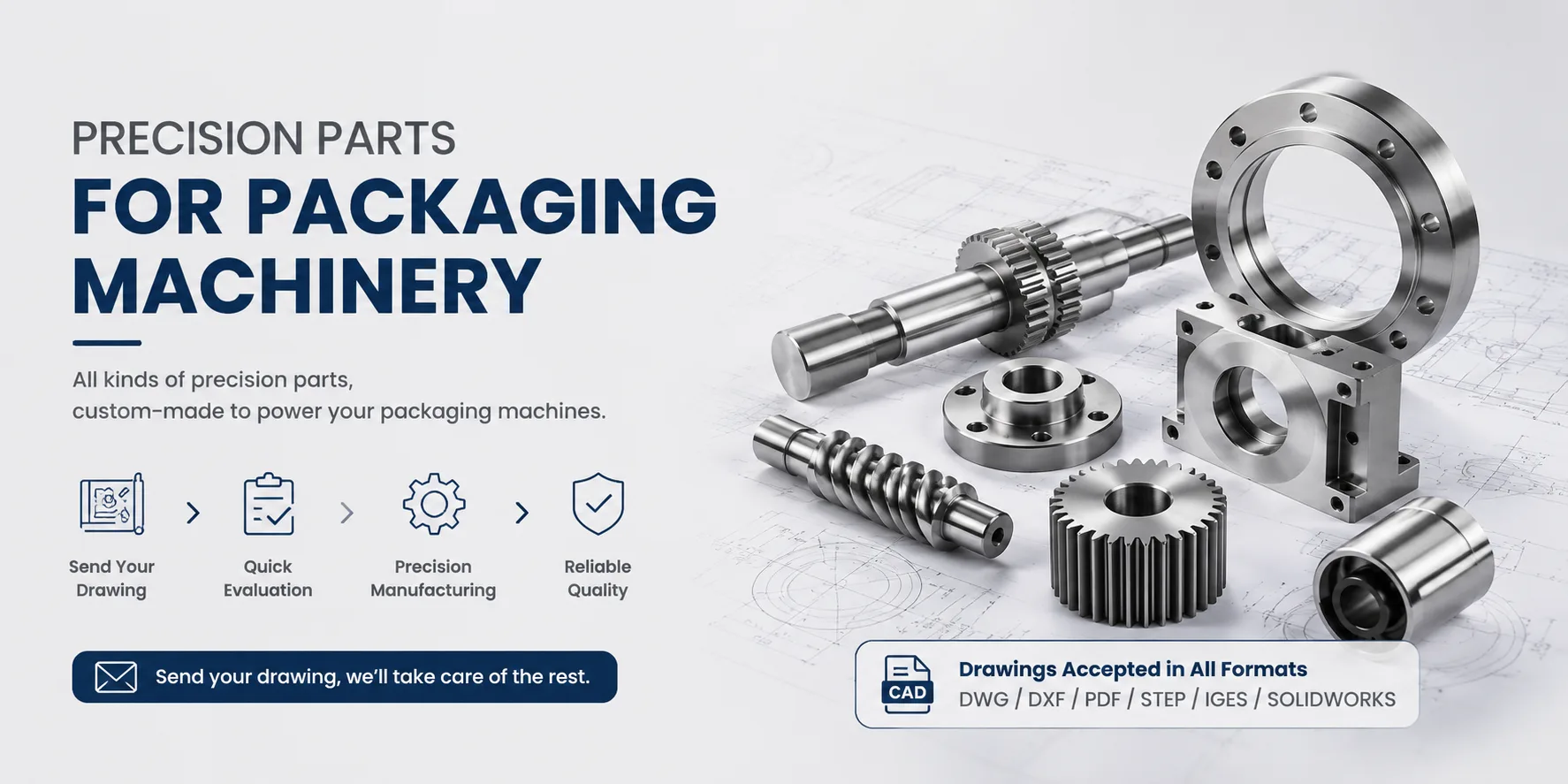
For emulsifying tanks, oil phase tanks, stirring paddles, and homogenizing heads, we can machine to customer drawings, for single pieces or small batches, in 316L stainless steel, with contact surfaces polished or passivated to drawing.
3. Post-processing
Perform a quality check on the finished ointment. Confirm the viscosity is suitable, the texture is uniform and fine, the product is stable, and it is non-irritating.
Fill the ointment as required by production, and keep the corresponding production records.
Beyond ointment manufacturing equipment parts, our precision component machining capability also covers non-standard parts for pharmaceutical packaging machinery, food packaging machinery, and daily chemical filling equipment, as well as precision structural parts for yachts and RC race cars. Hansheng Automation machines single pieces or small batches to customer drawings, with material, tolerance, and surface finish specified by the drawing.