Common industrial waste gas treatment equipment includes absorption systems, adsorption systems, oxidation equipment, and low-temperature plasma systems. These technologies remove or decompose pollutants through different physical and chemical processes.
The appropriate treatment method depends on the type of pollutants, inlet concentration, airflow, temperature, humidity, and required emission limits. Some applications require a single treatment unit, while others use several processes in sequence to achieve the required treatment performance.
Waste Gas Absorption Equipment
Absorption equipment uses a liquid absorbent to remove gaseous pollutants from an exhaust stream. During operation, the gas comes into contact with the liquid, allowing soluble pollutants to transfer from the gas phase into the liquid phase. In some applications, chemical reactions between the pollutant and absorbent further improve removal.
Common absorption equipment includes spray towers, packed-bed scrubbers, and other wet scrubbing systems.
For example, an alkaline scrubbing solution can neutralize acidic gases, while an acidic solution can be used to remove certain alkaline pollutants. Depending on the chemical composition of the exhaust, the process may also allow the recovery of some useful substances for further treatment or reuse.
Absorption systems are commonly used to control water-soluble gases, including hydrogen chloride (HCl), sulfur dioxide (SO2), hydrogen sulfide (H2S), and ammonia (NH3). Their performance depends on gas solubility, liquid-to-gas ratio, contact time, absorbent concentration, and operating temperature.
Typical applications include chemical processing, electroplating, and other industrial operations that generate acidic or alkaline exhaust gases.
Waste Gas Adsorption Equipment
Adsorption equipment removes gaseous pollutants by transferring them from the exhaust stream onto the surface of a solid adsorbent. Common adsorbents include activated carbon, molecular sieves, and zeolites.
Activated carbon is widely used because of its porous structure and large internal surface area, which provide sites for capturing many organic compounds. Depending on the adsorbent and pollutant, removal can occur through physical adsorption or chemical adsorption.
During operation, exhaust gas passes through an adsorption bed, where pollutants are retained on the adsorbent. As the adsorption capacity is gradually consumed, the adsorbent eventually approaches saturation and must be replaced or regenerated.
For reusable systems, regeneration may involve heating, steam, vacuum, or other suitable desorption methods. The desorbed pollutants can then be recovered or sent to a separate treatment unit, such as a thermal or catalytic oxidizer.
Activated carbon adsorption is commonly used for low-concentration VOC emissions, particularly in painting, printing, and chemical processing operations. The actual treatment performance depends on the VOC composition, inlet concentration, gas temperature, humidity, and adsorbent properties.
Waste Gas Oxidation Equipment
Oxidation equipment uses chemical reactions to convert pollutants into less harmful compounds. Common industrial approaches include thermal oxidation, catalytic oxidation, and ozone oxidation. These methods operate under different conditions and are selected according to the pollutants being treated.
Catalytic Oxidation Equipment
Catalytic oxidation equipment uses a catalyst to accelerate the reaction between organic pollutants and oxygen. The catalyst lowers the activation energy required for oxidation, allowing VOCs to be treated at lower temperatures than conventional thermal oxidation.
During operation, the exhaust gas is heated to the required reaction temperature and passes through a catalytic bed. Suitable organic compounds are oxidized primarily into carbon dioxide and water.
Catalytic oxidation is commonly used for certain VOC-containing exhaust streams from painting, printing, chemical manufacturing, and pharmaceutical production.
The catalyst must be compatible with the exhaust composition. Sulfur compounds, halogenated substances, heavy metals, and particulate matter may deactivate or contaminate certain catalysts. Pretreatment may therefore be required before the exhaust enters the catalytic reactor.
Ozone Oxidation Equipment
Ozone oxidation equipment uses an ozone generator to produce ozone (O3), a strong oxidizing agent. The ozone is introduced into the exhaust stream or a reaction chamber, where it reacts with selected pollutants.
This process can oxidize certain odorous compounds and other substances that are difficult to remove through conventional physical treatment. Applications include the treatment of sulfur-containing odor compounds and selected industrial exhaust pollutants.
Ozone oxidation can also be used in certain NOx treatment processes. However, ozone alone does not guarantee complete conversion of all pollutants into carbon dioxide and water. Some reactions produce intermediate compounds, and additional treatment may be necessary to remove the resulting products.
The required ozone dosage, gas-liquid or gas-phase contact conditions, and reaction time depend on the pollutant composition and treatment objectives. Residual ozone should also be controlled before discharge.
Low-Temperature Plasma Waste Gas Treatment Equipment
Low-temperature plasma equipment uses a high-voltage electric field to generate energetic electrons, ions, free radicals, and other reactive species without heating the entire gas stream to a high temperature.
When the exhaust passes through the plasma reactor, these reactive species collide with pollutant molecules and initiate chemical reactions that break down or transform certain organic and odorous compounds.
The process can operate without a conventional high-temperature combustion chamber and generally requires relatively little additional heating. Its equipment arrangement can also be compact compared with some conventional treatment systems.
Low-temperature plasma technology has been investigated and applied for treating VOC-containing exhaust and odorous gases in industrial and municipal applications, including wastewater treatment facilities and certain food-processing operations.
However, its performance depends on pollutant composition, inlet concentration, humidity, gas flow rate, and residence time. Incomplete oxidation can produce intermediate organic compounds, while plasma discharge may generate residual ozone and nitrogen oxides. These by-products must be considered when designing the complete treatment process.
For exhaust streams with complex compositions or demanding emission requirements, plasma treatment may need to be combined with adsorption, catalytic oxidation, or other downstream treatment methods.
Custom Machining for Industrial Equipment Components
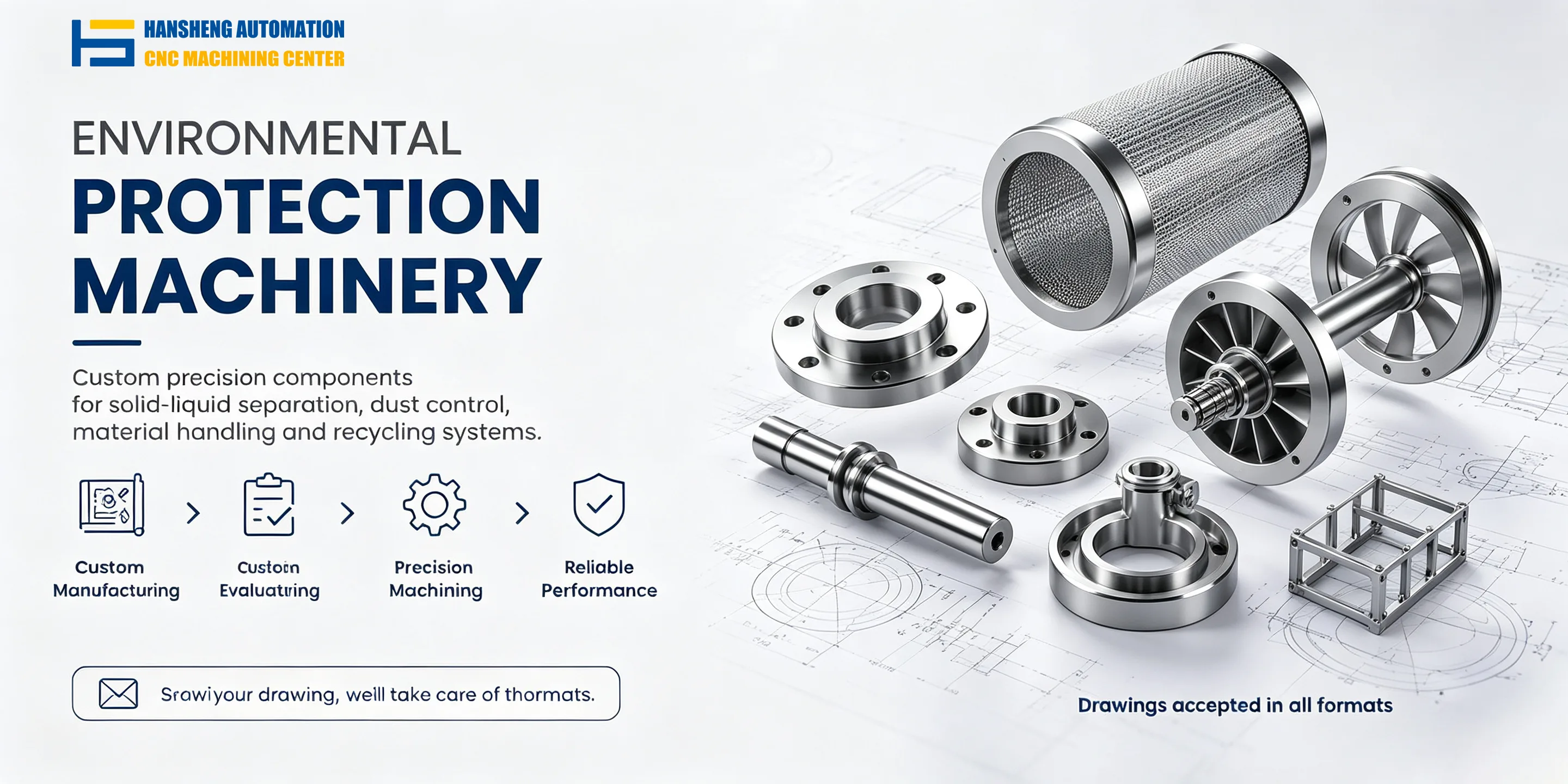
In addition to components used in environmental protection and waste gas treatment equipment, Hansheng Automation provides drawing-based precision machining for non-standard industrial parts. Our machining services also cover components for tobacco and packaging machinery, filling equipment, yacht equipment, and remote-controlled racing cars.
We support single-piece and small-batch manufacturing according to customer drawings and component specifications, providing custom precision machining services for different industrial applications.