Selecting a regenerative thermal oxidizer (RTO) requires an assessment of exhaust airflow, VOC concentration, pollutant composition, and operating conditions. RTO systems are commonly used for large-volume exhaust streams with low to moderate VOC concentrations. They can also treat certain medium- to high-concentration exhaust streams when the thermal load and safety conditions are properly controlled.
The main operating principle is thermal oxidation combined with regenerative heat recovery. VOCs are oxidized at high temperatures, while ceramic heat storage beds recover heat from the treated gas and use it to preheat incoming exhaust. This reduces auxiliary fuel consumption and helps maintain stable operating temperatures.
Key Factors in RTO System Selection
Compatibility with Exhaust Gas Characteristics
RTO systems are commonly selected for exhaust streams with relatively large airflow rates and low to moderate VOC concentrations. They are used in applications where the exhaust contains multiple organic compounds and requires thermal treatment.
Medium- to high-concentration VOC streams may also be treated directly, provided that the VOC heating value, thermal load, and concentration remain within the equipment's design and safety limits. The lower explosive limit (LEL) must be considered when determining the maximum allowable inlet concentration.
For low-concentration, high-volume exhaust streams, an adsorption concentration system can be installed upstream of the RTO. Activated carbon or a zeolite rotor captures and concentrates VOCs before the smaller, concentrated gas stream enters the oxidation unit.
Acidic components and halogenated organic compounds require additional attention. Thermal oxidation does not eliminate all inorganic acid gases. For example, oxidation of chlorinated VOCs can generate hydrogen chloride (HCl), which may require downstream scrubbing. Corrosion-resistant materials and suitable pretreatment should be considered according to the exhaust composition.
Process Flow Design
A typical RTO treatment line includes exhaust collection, pretreatment, thermal oxidation, heat recovery, and final exhaust discharge.
A washing-RTO-washing arrangement may be used for certain exhaust streams:
Pre-treatment washing: A scrubber removes suitable water-soluble pollutants and some particulate matter before the exhaust enters the RTO.
Thermal oxidation: The pretreated exhaust enters the RTO, where VOCs are oxidized at high temperatures.
Post-treatment washing: A downstream scrubber removes acid gases and other pollutants that remain after oxidation, where required by the exhaust composition.
This arrangement is not suitable for every application. The need for upstream and downstream washing depends on the pollutants present before and after oxidation.
The process design should also consider heat recovery from the treated exhaust. Recovered thermal energy can be used to preheat incoming exhaust or support other suitable heating requirements in the production process.
Application Requirements
RTO systems are used in a range of industrial applications.
Painting and coating: Exhaust gas from automotive, shipbuilding, household appliance, and piano coating operations may contain VOCs released during spraying and curing.
Industrial manufacturing: Semiconductor production, LCD manufacturing, plastic injection molding, ink printing, and cable production can generate organic exhaust that requires treatment.
Complex exhaust streams: RTO systems can be considered for exhaust containing multiple organic compounds, fluctuating VOC concentrations, or substances that may deactivate catalysts used in catalytic oxidation systems.
The actual treatment configuration must be matched to the gas composition, airflow, and operating conditions of each production process.
Working Principle of an RTO System
Thermal Oxidation of VOCs
The RTO uses a combustion chamber to oxidize VOCs at elevated temperatures. The exhaust is typically heated to approximately 760-820°C, although some applications require higher temperatures depending on the compounds being treated and the required destruction performance.
Under suitable conditions, organic compounds react with oxygen and are converted primarily into carbon dioxide and water.
VOC destruction efficiency depends on several operating factors, including combustion temperature, residence time, oxygen availability, and gas mixing. Typical RTO design efficiencies range from 95% to 99%, although actual performance varies with the equipment design and exhaust characteristics.
During startup, an auxiliary burner supplies the heat needed to bring the combustion chamber and ceramic media to operating temperature.
When the incoming VOC concentration and heating value are sufficient, the heat released during oxidation can help maintain the required temperature. Under these conditions, the system may reach autothermal operation and require little or no additional fuel during stable operation. This depends on the VOC loading, airflow, heat recovery efficiency, and operating schedule.
Heat Recovery Through Ceramic Media Beds
Ceramic heat storage media are installed in two or more regenerative chambers. These beds alternately store heat from the treated exhaust and transfer that heat to incoming gas.
The operating sequence is as follows:
Incoming exhaust first passes through a hot ceramic bed, where it is preheated before entering the combustion chamber. After oxidation, the hot treated gas passes through another ceramic bed, transferring heat to the ceramic material before being discharged.
The gas flow direction is periodically switched by an automatic valve system. The previously heated bed then preheats incoming exhaust, while the other bed absorbs heat from the treated gas.
This alternating process allows the system to recover and reuse a large proportion of the heat generated during oxidation.
Depending on the system design, thermal recovery efficiency can exceed 90% and approach 95%. Some equipment designs specify an exhaust outlet temperature approximately 30-40°C above the incoming gas temperature. This temperature difference is a system-specific design target rather than a universal RTO performance value.
High heat recovery reduces the amount of auxiliary fuel required to maintain the combustion temperature.
PLC-Based Automatic Control and Monitoring
An RTO system generally uses a programmable logic controller (PLC) to coordinate the oxidation process and regenerative heat exchange.
The control system manages burner operation, combustion chamber temperature, valve switching, and other equipment functions. It also monitors operating conditions and activates alarms or safety interlocks when abnormal conditions occur.
Automatic control helps maintain stable operating conditions and reduces the need for continuous manual intervention. Regular inspection of valves, burners, ceramic media, and control components is still necessary to maintain system performance.
Applicable Conditions and Main Advantages of RTO Systems
Suitable Exhaust Conditions
RTO systems can be used in two main treatment arrangements:
Direct treatment: Exhaust containing medium- to high-concentration VOCs can be sent directly to an RTO when the gas composition, thermal load, and concentration are within the equipment's design limits. The system must also operate below the applicable LEL safety limit.
Combined treatment: Low-concentration, high-volume exhaust can first pass through an adsorption concentration system using activated carbon or a zeolite rotor. The concentrated VOC stream is then sent to the RTO for thermal oxidation.
The second arrangement reduces the volume of gas requiring high-temperature treatment and can improve overall energy efficiency.
Main Advantages
High VOC destruction efficiency: Properly designed RTO systems can achieve typical VOC destruction efficiencies of 95-99%, depending on the operating conditions and exhaust composition.
Heat recovery: Ceramic media recover thermal energy from treated exhaust. Heat recovery efficiencies can exceed 90% in suitable system designs, reducing auxiliary fuel consumption.
Reduced fuel demand: When the VOC loading provides sufficient oxidation heat, an RTO can operate under autothermal conditions after startup, reducing or eliminating the need for additional fuel during stable operation.
Adaptability to complex exhaust: RTO technology can handle multiple VOC components and fluctuating exhaust conditions when the equipment is designed for the specific gas composition. Unlike catalytic oxidation systems, RTO units do not rely on a catalyst, so catalyst deactivation is not a concern. However, particulate deposits, corrosive compounds, and condensable substances must still be addressed through suitable pretreatment and material selection.
Typical Industries Using RTO Systems
RTO technology is used in several industrial sectors where VOC emissions require thermal treatment.
Painting and coating: Automotive, motorcycle, container, shipbuilding, and other coating operations can use RTO systems to treat solvent-containing exhaust.
Electronics manufacturing: Semiconductor and LCD production processes may generate VOC-containing exhaust that requires centralized treatment.
Chemical and material processing: Plastic injection molding, ink printing, and cable manufacturing are examples of processes that may produce organic exhaust suitable for RTO treatment.
Complex industrial exhaust: Production processes involving multiple VOC compounds, fluctuating pollutant concentrations, or substances unsuitable for catalytic oxidation may also use RTO systems, provided that the exhaust composition is compatible with thermal oxidation.
Custom Machining for Industrial Equipment Components
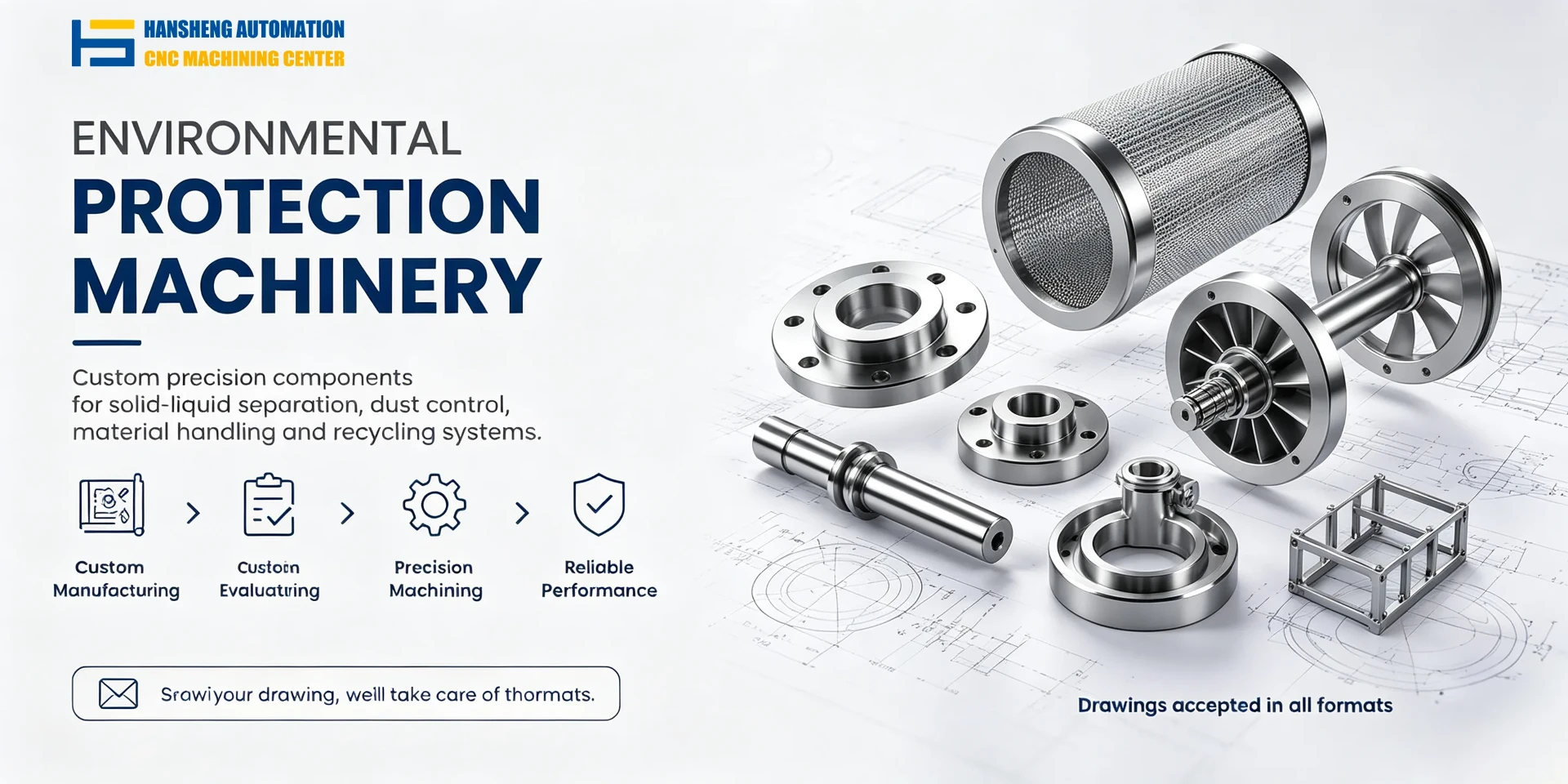
In addition to components used in exhaust gas treatment and environmental protection equipment, Hansheng Automation provides drawing-based precision machining for non-standard industrial parts. Our machining services also cover components for tobacco and packaging machinery, filling equipment, yacht equipment, and remote-controlled racing cars.
We support single-piece and small-batch manufacturing according to customer drawings and component requirements, providing precision machining services for different industrial applications.