A nitric acid yellow fume treatment system using water scrubbing and wet electrostatic precipitation (WESP) combines chemical absorption with electrostatic collection. It is used to control nitrogen oxide (NOx) emissions, acid mist, and fine particulate matter generated during certain chemical and metal processing operations.
Visible yellow or reddish-brown fumes from nitric acid-related processes are generally associated with nitrogen dioxide (NO2). Depending on the process, the exhaust may also contain nitric oxide (NO), nitric acid mist, metal-containing aerosols, and other particles.
The two main treatment stages have different functions. The spray scrubber absorbs suitable gaseous pollutants and removes some entrained particles, while the WESP captures fine droplets, acid mist, and particulate matter that remain in the gas stream. Additional NOx treatment may be required when the exhaust contains significant amounts of NO or when stricter NOx emission limits apply.
Working Principle of the Treatment Process
Water Spray Scrubbing and Pretreatment
The spray scrubber is the first treatment stage. It uses an absorbent solution, commonly an alkaline solution, to bring the exhaust gas into contact with liquid droplets.
Chemical absorption: An alkaline absorbent, such as sodium hydroxide (NaOH), reacts with nitrogen dioxide and other suitable acidic components in the exhaust. Sodium nitrate and sodium nitrite can form during this process.
The original process design specifies a NaOH concentration of 5%-10%. This should be treated as a design reference rather than a universal operating requirement. The appropriate concentration depends on the inlet gas composition, NO2 concentration, liquid-to-gas ratio, and required removal performance.
Typical reactions include:
2NaOH + 3NO2 → 2NaNO3 + NO + H2O
2NaOH + NO + NO2 → 2NaNO2 + H2O
These reactions show that NO2 absorption can produce NO under certain conditions. Since NO is relatively insoluble in water, alkaline scrubbing alone may not achieve the required total NOx removal efficiency. Where NO concentrations are significant, an additional oxidation or dedicated NOx treatment stage may be necessary.
Gas cooling: The spray system also cools the incoming exhaust before it enters the WESP. The referenced process uses an outlet temperature below 60°C as its design target. The actual temperature must be selected according to the wet ESP design, construction materials, and operating conditions.
Droplet and particle removal: Spray droplets capture some entrained metal salts, acid droplets, and other particulate matter. This reduces the pollutant loading on the downstream electrostatic equipment.
Wet Electrostatic Precipitation (WESP)
The wet electrostatic precipitator provides the final removal stage for fine particles and acid mist.
Corona discharge: A high-voltage direct-current power supply energizes the discharge electrodes, producing a corona discharge. The resulting ions transfer electrical charges to particles and liquid droplets in the exhaust stream.
Electrostatic collection: Under the influence of the electric field, charged particles and droplets migrate toward the collecting electrodes, where they are captured.
The WESP primarily removes particulate matter, including fine acid mist and aerosols. It does not directly remove gaseous NO and NO2 simply by charging them. Its contribution to total NOx control must therefore be distinguished from its particle and mist collection performance.
Water film cleaning: A water film forms or is maintained on the collecting electrode surfaces. The circulating wash water removes accumulated droplets and particles, reducing the risk of secondary particle release and buildup on the collecting surfaces.
The collected liquid is drained for further treatment or recovery, depending on its composition.
Main Equipment Components
Spray Scrubber System
The spray scrubber is designed to provide sufficient contact between the exhaust gas and the absorption liquid.
The main components include:
Tower construction: PPH polypropylene or fiberglass-reinforced plastic (FRP) can be considered for the tower body. Material selection must account for the chemical composition, concentration, and temperature of the exhaust and circulating liquid.
Spray nozzles: Spiral full-cone nozzles distribute the absorption solution throughout the tower. Their spray pattern, droplet size, and flow rate should be selected according to the required gas-liquid contact conditions.
Circulation system: Circulation pumps return the absorption liquid to the spray system. An automatic pH monitoring and control system can regulate the alkali dosing to maintain the required absorption conditions.
Liquid collection: The tower sump collects the circulating solution and allows controlled discharge of spent liquid for treatment or replacement.
The scrubber design should also consider liquid circulation, pressure drop, scaling, nozzle blockage, and wastewater handling.
Wet Electrostatic Precipitator Module
The WESP module consists of collecting electrodes, discharge electrodes, a high-voltage power supply, and a washing system.
Collecting electrodes: Conductive fiberglass-reinforced plastic tubes can be arranged in a honeycomb configuration. This structure provides gas passages and collecting surfaces for charged particles and liquid droplets.
Discharge electrode system: Barbed or spiked discharge wires generate the corona discharge required for particle charging. Stainless steel may be used for the electrodes, with the grade selected according to the corrosive conditions inside the equipment.
Power supply: A high-frequency, constant-current power supply can be used to maintain the required electric field. Automatic spark-rate monitoring and control help keep the electrical field stable during operation.
Washing system: A water distribution system maintains the required liquid film on the collecting surfaces and flushes away accumulated contaminants. The washing arrangement should prevent dry areas and excessive deposit buildup.
The construction materials and electrode configuration must be selected according to the gas temperature, acid concentration, operating humidity, and corrosion conditions.
Intelligent Control System
The control system integrates a programmable logic controller (PLC) with a human-machine interface (HMI) to coordinate the operation of the spray scrubber and WESP.
The main control functions include:
Automatic adjustment of liquid circulation and alkali dosing according to operating conditions.
Monitoring and control of the WESP voltage and current.
Monitoring of liquid pH, temperature, pump operation, and system pressure.
Alarm functions and safety interlocks for abnormal operating conditions.
Coordination of the spray system, circulation pumps, high-voltage power supply, and washing equipment.
The PLC system allows operators to monitor equipment conditions and adjust operating parameters through the HMI. Automatic alarms and interlocks help prevent operation under abnormal conditions.
Technical Performance and Operating Considerations
Fine Acid Mist and Particulate Removal
WESPs are particularly suitable for collecting fine droplets, acid mist, and particulate matter that may be difficult to remove using conventional spray washing alone.
According to US EPA technical guidance, typical new wet ESP designs can achieve particulate collection efficiencies of 99%-99.9%. This figure applies to particulate and mist collection, not to the removal of gaseous NOx.
Actual performance depends on equipment size, gas residence time, electric field strength, particle characteristics, temperature, and gas composition.
NOx Removal Performance
The combined treatment system can remove certain NO2 and other absorbable acidic components through alkaline scrubbing. However, its overall NOx removal efficiency depends on the relative proportions of NO and NO2, the absorption conditions, and any additional oxidation or reduction stages.
Where the exhaust contains significant NO, an oxidation-absorption process or a dedicated deNOx system, such as selective catalytic reduction (SCR), may be required.
The overall removal efficiency should be established through inlet and outlet gas measurements rather than inferred from the WESP's particulate collection efficiency.
Corrosion Control and Equipment Reliability
Nitric acid fumes and alkaline absorption liquids create demanding corrosion conditions. The tower body, circulation piping, pumps, nozzles, electrodes, and connecting components must all be compatible with the actual process environment.
PPH and FRP are possible construction materials, but their suitability depends on resin formulation, temperature, acid concentration, and exposure conditions.
Regular inspection of spray nozzles, circulation pumps, electrode surfaces, electrical connections, and washing systems helps maintain stable operation.
Wastewater Treatment and Material Recovery
The spray scrubber produces wastewater containing dissolved nitrate and nitrite salts, along with other substances captured from the exhaust. The WESP washing system may also generate a liquid stream containing collected acid mist and particulate matter.
These liquid streams require appropriate collection and treatment. Evaporation and crystallization may be considered for recovering sodium nitrate or other salts when their composition and purity meet the required specifications.
Similarly, dilute nitric acid collected by the WESP may be considered for reuse in the production process, provided that its acid concentration and impurity levels meet the relevant process requirements.
Neither recovery route should be assumed to be economically or technically feasible without checking the liquid composition, material balance, and downstream process specifications.
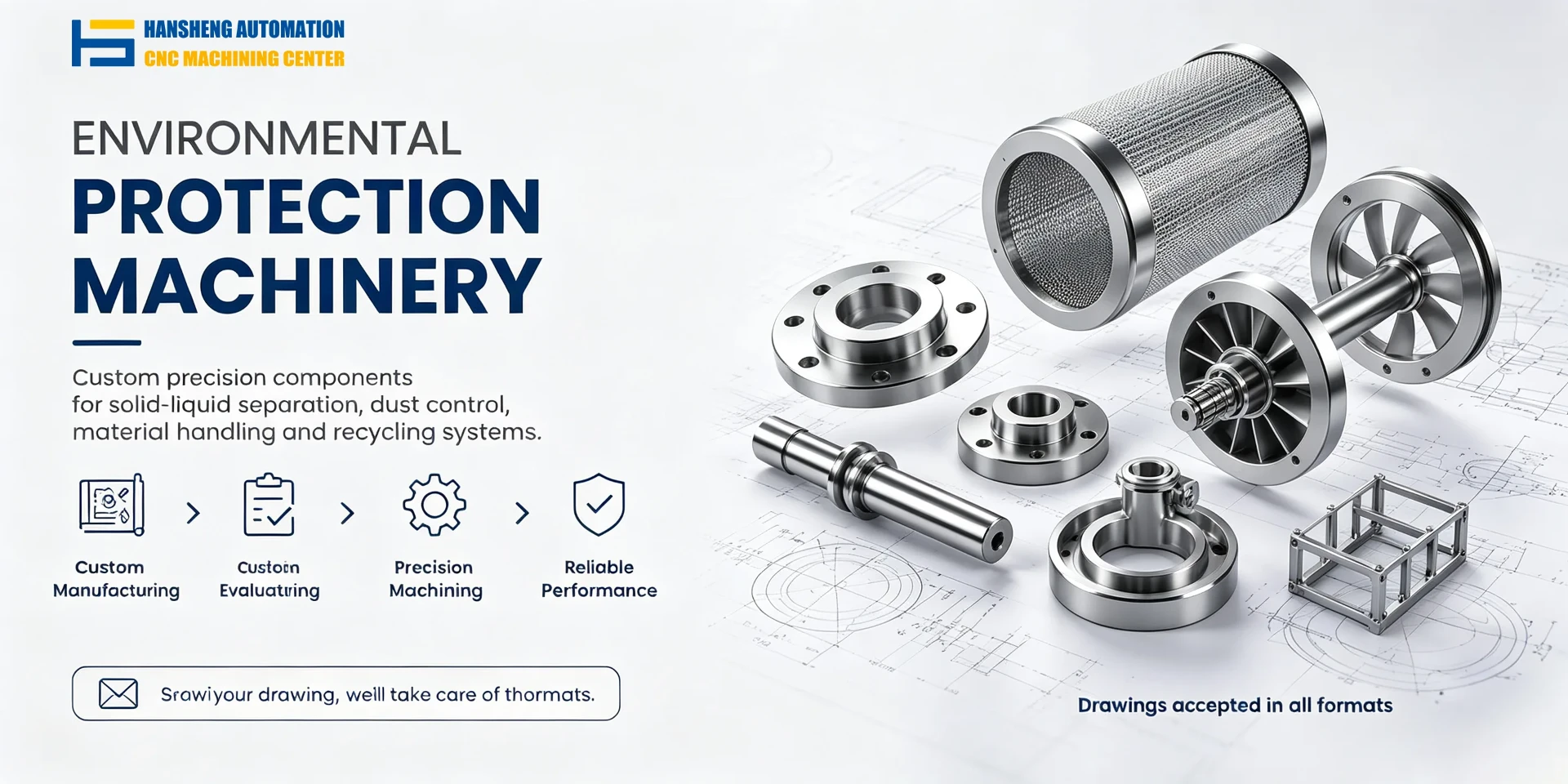
Custom Machining for Environmental Protection Equipment
In addition to components used in exhaust gas treatment and environmental protection equipment, Hansheng Automation provides drawing-based precision machining for non-standard industrial parts.
Our machining services also cover components for tobacco and packaging machinery, filling equipment, yacht equipment, and remote-controlled racing cars. We support single-piece and small-batch production according to customer drawings, dimensions, and machining requirements.