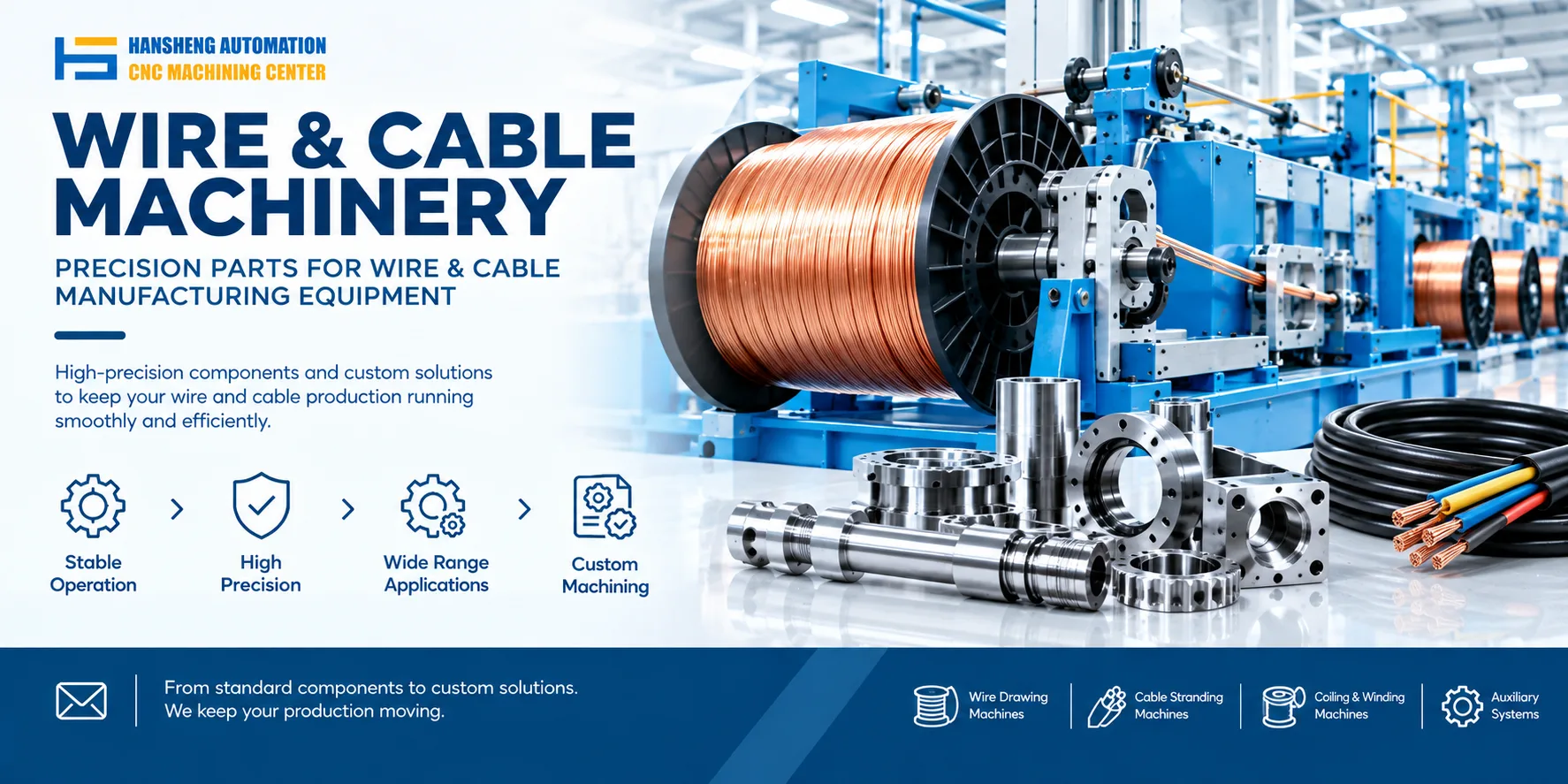
Cable strander brake pads mainly use four materials: asbestos-based, semi-metallic, low-metallic, and ceramic. They differ in heat resistance, friction stability, noise, disc wear, and cost. At Hansheng Automation, we provide build-to-print custom machining for strander braking systems. We make metal parts such as brake discs, mounting bases, and connecting parts from customer drawings, in single pieces or small batches.
1. Asbestos-based
This was common in early machines. It uses asbestos fiber as the base. Cost is low, and heat resistance and friction stability are good. Asbestos is harmful to human health, so this material has been phased out.
2. Semi-metallic
Metal fiber content, such as copper and iron, is about 30% to 70%. Heat dissipation is good. It can handle high temperature and hard braking, and it is very wear resistant. The drawbacks are loud braking noise, faster brake disc wear, and higher price.
3. Low-metallic
Metal content is lower, about 15% to 30%, mixed with ceramic fiber and other materials. Overall performance is balanced. Heat stability is good, noise is low, and wear on the brake disc is small. It is now a common choice for mid-range and high-end equipment.
4. Ceramic
It uses ceramic fiber as the main material and offers the best performance. Heat resistance is excellent. Friction coefficient stays stable during braking, noise is very low, and it barely wears the brake disc. The main drawback is the highest manufacturing cost.
Our precision custom machining capability is not limited to strander braking systems. Hansheng Automation can machine non-standard metal parts for medical devices, printing machinery, and food machinery from customer drawings. We also machine yacht components, RC car components, and specialized parts for tobacco packaging and filling machinery. We focus on build-to-print custom machining and produce single pieces or small batches according to customer drawings. We do not sell complete machines.