The recommended setup uses low-temperature sterilizers and pulsating vacuum pressure steam sterilizers as the core, with low-temperature medical drying cabinets and central sterile supply department (CSSD) pure water systems as support. This forms a complete process from post-cleaning drying and pure water rinse to final sterilization. The configuration should match instrument type, sterilization demand, and throughput.
Core sterilization equipment
1.1 Low-temperature sterilizers
Use low-temperature sterilizers for heat-sensitive and pressure-sensitive precision instruments, such as laparoscopes, arthroscopes, other endoscopes, and high-value surgical instruments. They prevent deformation or damage caused by high temperature, extend instrument service life, shorten turnaround time, raise turnover of high-value instruments, and reduce replacement cost. Sterilization time is usually 30 to 60 minutes, which supports urgent use.
Options include ethylene oxide (EO) sterilization, hydrogen peroxide plasma sterilization, and low-temperature formaldehyde steam sterilization. Selection depends on instrument material and hospital infection control requirements.
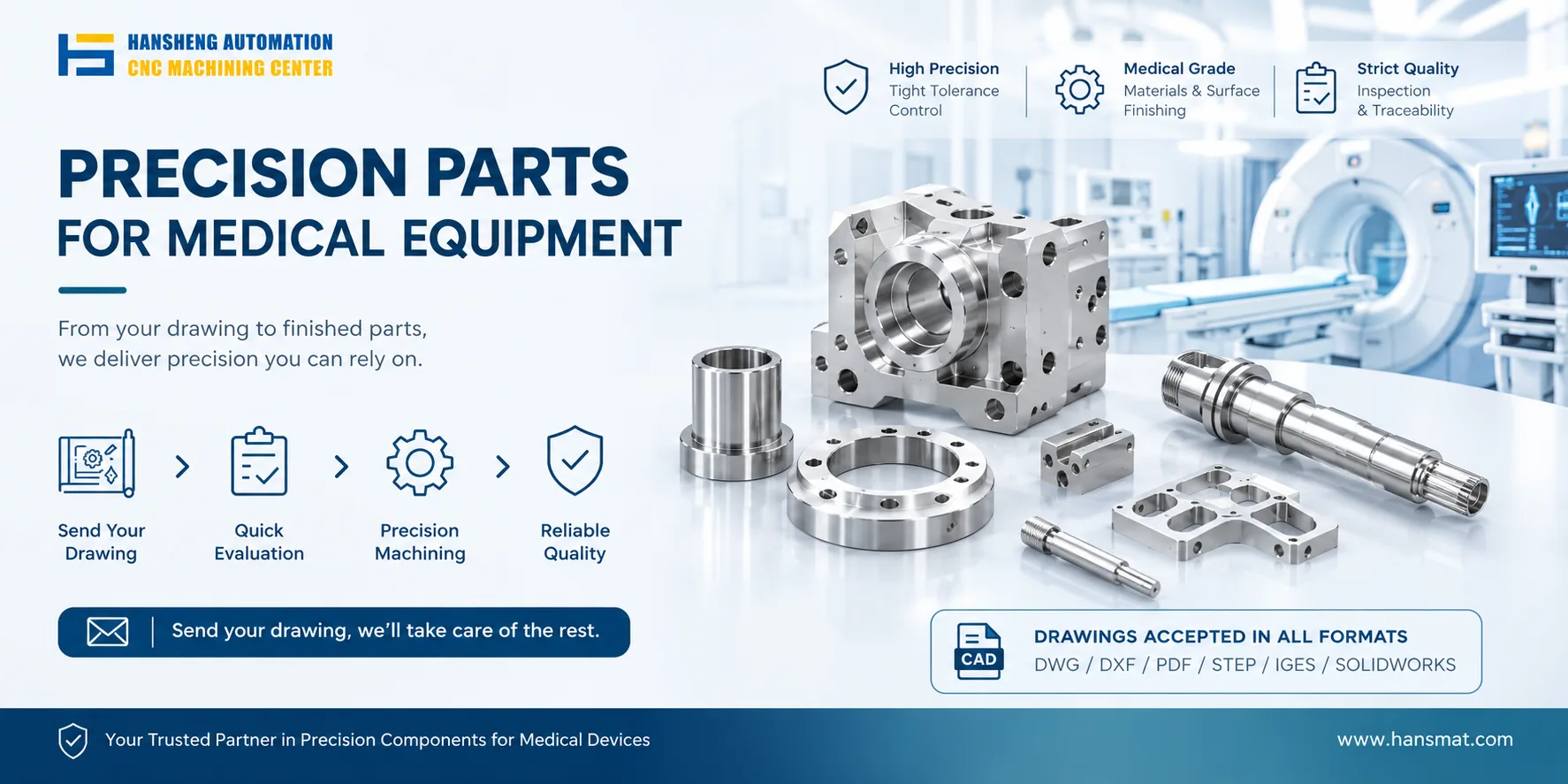
For chamber brackets, sealing flanges, instrument trays, and pipe supports used in these systems, Hansheng Automation can machine non-standard parts to customer drawings in single units or small batches. Materials can include 304/316L stainless steel, aluminum alloy, or engineering plastics. Critical dimensions are controlled to drawing requirements, and surface finishes can include brushing, passivation, or electropolishing.
1.2 Pulsating vacuum pressure steam sterilizers
Use pulsating vacuum pressure steam sterilizers for batch sterilization of heat-resistant and moisture-resistant items, such as surgical instruments, dressings, and glassware.
The double-door design meets current standards and provides physical separation between the contaminated area and the clean area, reducing cross-infection risk. Pulsating vacuum technology removes air through repeated vacuum and steam cycles, improves steam penetration, and supports sterilization effectiveness. A single cycle can handle 200 to 3000 L, which suits centralized processing in the CSSD.
For new projects, choose a double-door pulsating vacuum sterilizer rather than a single-door unit. This avoids layout limits that single-door equipment can create.
Drying equipment
Low-temperature medical drying cabinets
Use low-temperature medical drying cabinets for batch drying of heat-sensitive instruments after manual cleaning, such as plastic catheters and electronic endoscopes.
The drying temperature is controlled at 40 to 70°C, which avoids deformation or function damage from high heat. Drying time is usually 20 to 40 minutes, and a single batch can hold 50 to 200 instruments. Forced hot air circulation reduces incomplete manual drying and lowers the risk of bacterial growth.
If budget is limited, compressed air blow-drying or non-woven wiping can be used, but efficiency and completeness are lower.
Water treatment equipment
CSSD pure water system
Use a CSSD pure water system to supply water that meets national standards for cleaning and sterilization equipment, with conductivity ≤15 μS/cm.
The system removes bacteria, calcium and magnesium ions, and particles from tap water. This prevents scale deposits on instruments and blockages in pipes. It also reduces scale corrosion in sterilizers and washer-disinfectors and lowers maintenance frequency. Pure water helps avoid incomplete instrument cleaning caused by water quality problems and indirectly supports sterilization pass rates.
A reverse osmosis (RO) system is recommended. Capacity should match hospital scale, usually 500 to 2000 L/h.
Integration recommendations
Process
After cleaning, instruments go to the low-temperature medical drying cabinet, then receive a final rinse with pure water, and then go to either low-temperature sterilization or pulsating vacuum sterilization based on instrument type. Heat-resistant items such as dressings can go directly to the pulsating vacuum sterilizer.
Layout
Place the double-door pulsating vacuum sterilizer in the clean area and separate it from the contaminated area with a pass-through window. Low-temperature sterilizers can be installed in a separate zone to avoid interference with high-temperature equipment. The pure water system should be close to the cleaning area for easy pipe connection.
Maintenance
Check the conductivity of the pure water system and the physical and chemical monitoring indicators of sterilization equipment on a regular schedule. Low-temperature sterilizers require biological monitoring according to standards, such as weekly monitoring for EO sterilization and daily monitoring for hydrogen peroxide plasma. Clean the filters of drying cabinets regularly to prevent dust from reducing drying efficiency.
If stainless steel structures, drive parts, or seals in the support equipment need replacement or modification, Hansheng Automation can produce them from customer drawings.
Our precision parts machining service is not limited to sterilization equipment support. We also machine custom components for medical devices, food machinery, printing machinery, filling machinery, tobacco packaging machinery, yacht hardware, and RC car parts. Hansheng Automation works from customer drawings and delivers single units or small batches. The service remains focused on precision parts manufacturing, not complete equipment sales.