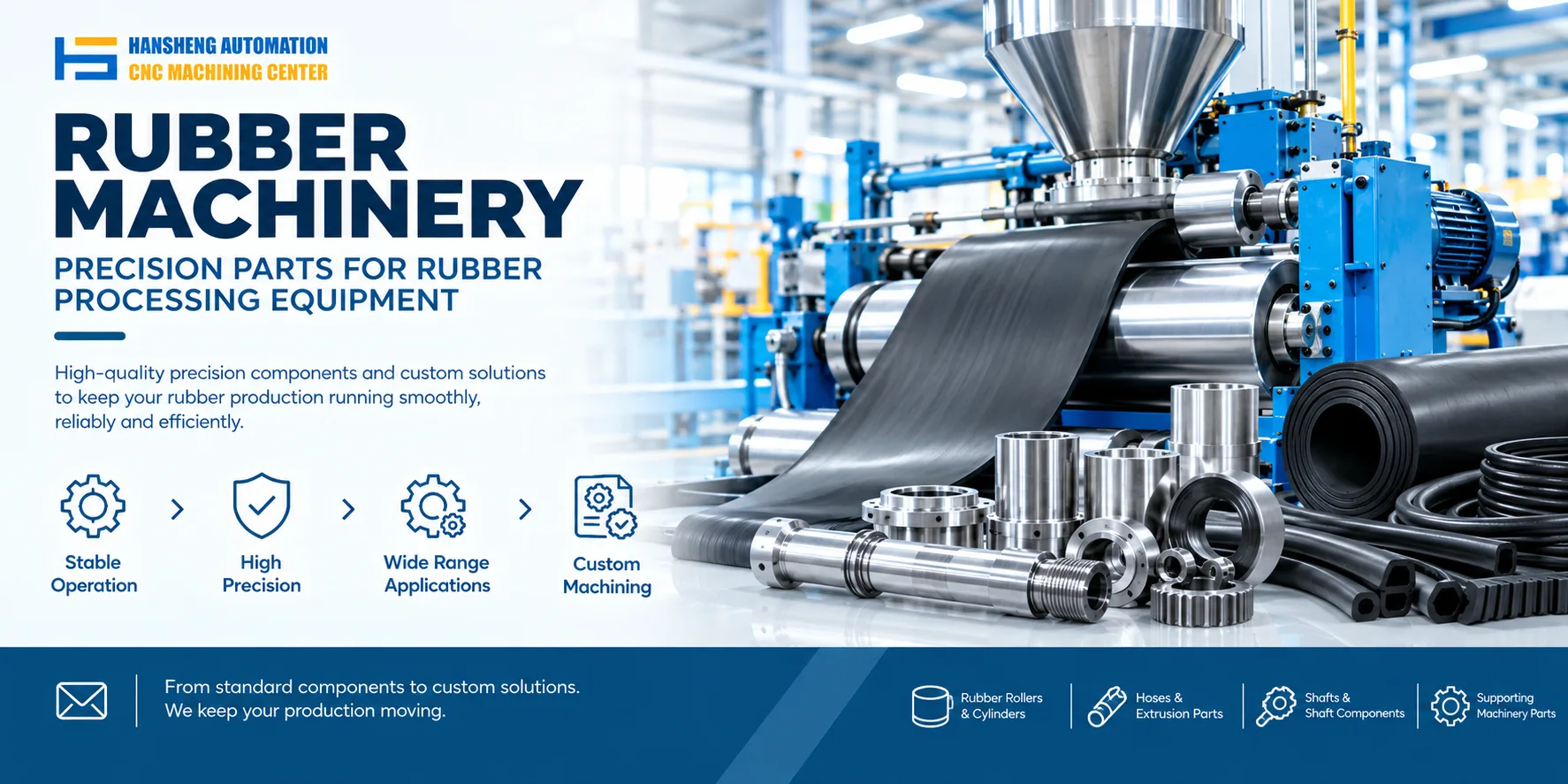
The production of rubber sheet rolls involves several stages, including mastication, mixing, calendering, forming, and vulcanization. Each stage affects the processing characteristics of the rubber compound, sheet dimensions, and final product performance. Manufacturers need to adjust process conditions according to the rubber formulation, sheet specifications, and intended use.
Mastication: improving raw rubber processability
Mastication is an early stage of rubber processing. It reduces the elasticity and viscosity of raw rubber, making the material easier to process during subsequent mixing and forming operations.
Depending on the rubber properties and production requirements, we can use an open mill or an internal mixer for mastication. Mechanical shear, compression, and heat act on the rubber molecular structure, improving its plasticity. Operators need to control the processing temperature and time to avoid excessive mastication, which can affect the compound's performance in later stages.
Mixing: achieving uniform dispersion of additives
After mastication, the rubber is mixed with various compounding ingredients to produce a compound that meets the requirements of the intended application.
During mixing, operators add vulcanizing agents, accelerators, activators, fillers, plasticizers, and other ingredients according to the specified formulation. They adjust the mixing temperature, duration, and intensity to suit the material. Uniform additive dispersion affects the compound's processability and the quality of the vulcanized product, so consistent mixing conditions are important.
Calendering: controlling sheet thickness and width
Calendering is an important stage in rubber sheet roll production. It converts the rubber compound into continuous sheets with specified thickness and width.
The compound passes through the gap between the rolls of a calender, where pressure and rolling action spread the material into a sheet. Operators adjust the roll gap, roll speed, and material feed according to the product specifications to maintain dimensional consistency and surface quality.
Depending on production requirements, calendering can also be used for laminating rubber sheets, shaping the material, and applying rubber coatings to other substrates. For continuous rubber sheet production, thickness consistency during calendering affects the results of subsequent processing.
Forming: shaping the material to product requirements
Forming converts the rubber compound into a semi-finished product with the required geometry. The appropriate method depends on the product's shape, dimensions, and production process.
Compression molding uses pressure and a mold cavity to form the rubber into a specified shape. This method is suitable for rubber products with defined structural features. Extrusion uses an extruder to push the compound through a shaped die, producing a continuous profile with the required cross-section.
For rubber sheet rolls, the forming process needs to work with the preceding calendering stage. Subsequent operations are arranged according to the product specifications to maintain the required dimensions and shape.
Vulcanization: developing a stable crosslinked structure
Vulcanization affects the final properties of rubber. Under suitable temperature and time conditions, the rubber forms crosslinks between its molecular chains. This creates a stable three-dimensional network and changes the material's mechanical properties, heat resistance, and performance in service.
Depending on the product specifications and available equipment, vulcanization can be carried out in a platen vulcanizing press or a vulcanizing autoclave. The temperature, pressure, and processing time must be controlled according to the rubber formulation and product requirements. Insufficient vulcanization can leave the product below its required performance level, while excessive vulcanization may also affect its physical properties.
Equipment requirements and custom precision components
The quality of rubber sheet rolls depends on the rubber formulation, process control, and operating condition of the production equipment. Metal components used for mounting, connecting, and supporting equipment also need to meet the relevant structural and dimensional requirements.
Hansheng Automation provides custom precision machining based on customer-supplied drawings. We can assess non-standard components according to their geometry, material specifications, dimensional tolerances, and other technical requirements before determining the appropriate machining process.
Our drawing-based machining services also cover components for other industries. These include parts for tobacco packaging machinery and filling equipment, as well as precision structural components for yachts and radio-controlled racing cars. We manufacture custom components according to customer drawings and the requirements of each application.