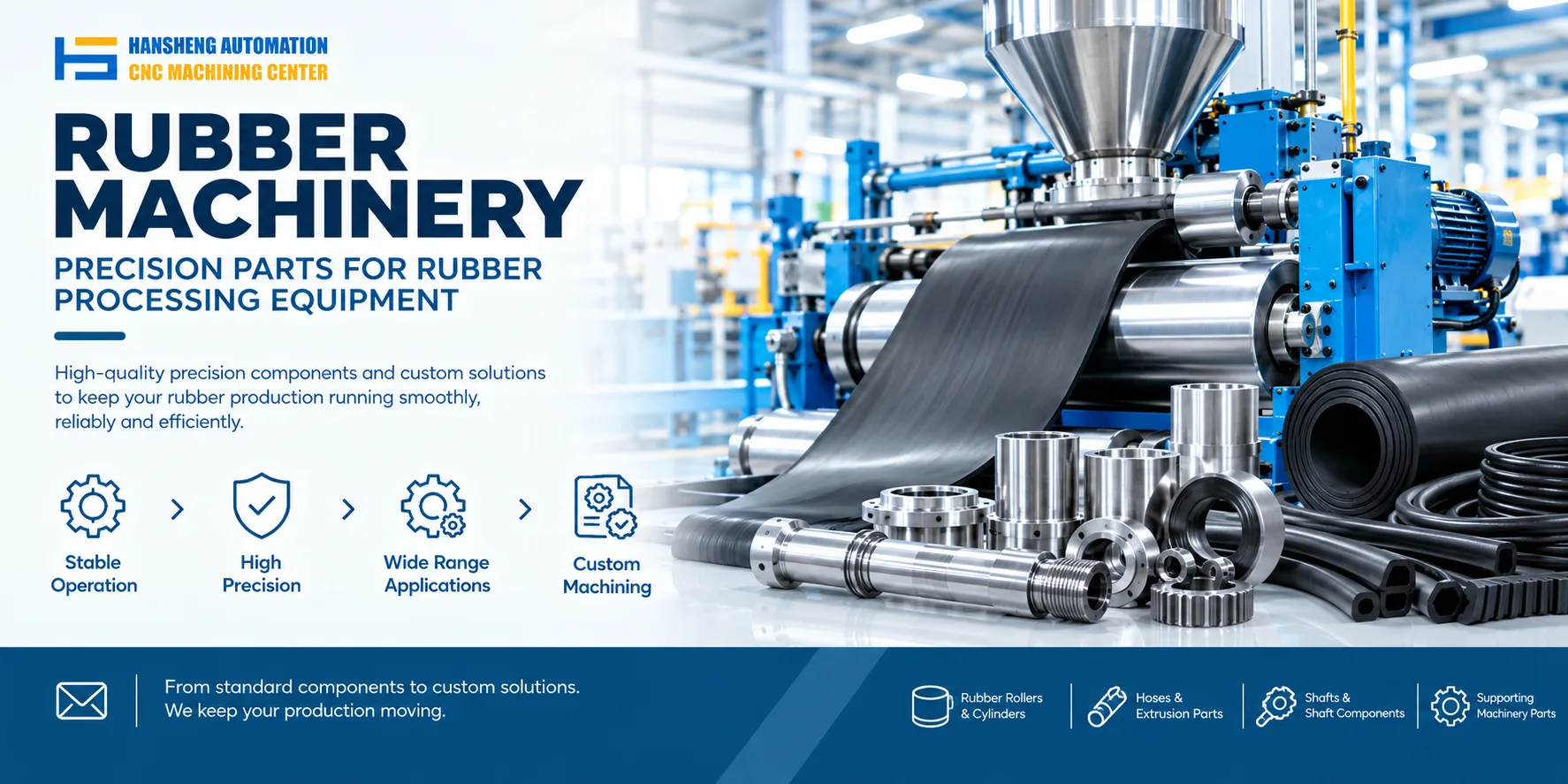
Rubber sleeves can be manufactured using four common methods: compression molding, injection molding, extrusion, and calendering. The appropriate process depends on the sleeve's geometry, dimensional requirements, production volume, and material formulation.
1. Compression molding
In compression molding, a measured quantity of compounded rubber is placed into a preheated mold cavity. The mold is then closed, and heat and pressure are applied to cure the rubber and form the finished part.
This method is suitable for rubber sleeves with complex shapes or tight dimensional requirements. It offers flexibility in product design, but mold costs can be relatively high and production cycles may be longer than those of injection molding. It is commonly used for batch production of molded rubber components.
2. Injection molding
In injection molding, rubber compound is fed into the injection machine's barrel, where a screw prepares the material for injection. The compound is then injected under pressure into a closed mold and vulcanized to obtain the required shape.
Injection molding offers relatively short production cycles, high productivity, and good dimensional consistency. It is suitable for complex rubber sleeves and thin wall components, particularly when automated production is required.
However, the process requires an injection molding machine and a mold designed for the material, product geometry, and curing conditions.
3. Extrusion
In extrusion, a screw pushes the rubber compound through a die with the required cross section. The resulting continuous profile then undergoes vulcanization and any necessary cutting or finishing operations.
Extrusion is suitable for rubber sleeves and related products with a consistent cross section, such as tubular or elongated profiles. It supports continuous production and can be efficient for long products.
Because the die determines the initial profile, extrusion is less suitable for sleeves with complex three dimensional shapes or features that vary along their length.
4. Calendering
Calendering uses rotating rolls to press and spread compounded rubber into sheets with a specified thickness, width, and surface finish. The rubber sheet is then cut, formed, and vulcanized to produce the required component.
This method is useful when a rubber sleeve design can be made from sheet material. Calendering provides good control over sheet thickness and surface quality and is suitable for relatively high volume production.
It is less suitable for directly producing complex three dimensional shapes, which may require additional forming operations or a different molding process.
5. How to choose a manufacturing method
|
Factor |
Compression molding |
Injection molding |
Extrusion |
Calendering |
|---|---|---|---|---|
|
Suitable product geometry |
Molded shapes, including complex parts |
Complex shapes and thin wall parts |
Tubular or continuous profiles |
Products formed from rubber sheets |
|
Production method |
Batch molding |
Molded production, suitable for automation |
Continuous production |
Continuous sheet production |
|
Dimensional control |
Depends on mold design and process control |
Generally good with a suitable mold and process |
Suitable for consistent cross sections |
Good control of sheet thickness |
|
Main consideration |
Mold cost and cycle time |
Equipment and mold complexity |
Die design and subsequent curing |
Additional forming may be required |
For a tubular rubber sleeve with a constant cross section, extrusion may be appropriate. For a sleeve with closed ends, complex geometry, or molded features, compression or injection molding may be more suitable. If the component is made from rubber sheet, calendering may be used as an upstream process.
The final choice should account for the rubber formulation, required tolerances, product design, and production quantity.
6. Custom machining for rubber manufacturing equipment
Rubber sleeve production may require precision metal components for molds, extrusion dies, and related machinery. Hansheng Automation can assess custom machining based on customer drawings, material specifications, and dimensional requirements.
Our precision machining services also cover non-standard components for packaging machinery, tobacco machinery, and filling equipment, as well as precision parts for yacht equipment and RC racing cars. Customers can submit drawings and technical requirements for an assessment of machining feasibility.