Non-thermal plasma waste gas treatment equipment uses high-voltage electrical discharge to generate energetic electrons, ions, free radicals, and other reactive species. These active species interact with pollutant molecules in the exhaust stream, initiating chemical reactions that break down or oxidize certain gaseous pollutants.
The technology can be used for treating selected VOCs, odorous compounds, and airborne particles. Its actual performance depends on the gas composition, pollutant concentration, airflow, humidity, and electrical operating conditions.
Working Principle of Non-Thermal Plasma Technology
Electrical Discharge and Pollutant Decomposition
Non-thermal plasma treatment is based on gas ionization and chemical reactions initiated by energetic electrons.
When a high-voltage electric field is applied inside the reactor, electrons gain kinetic energy and collide with gas molecules. These collisions can cause excitation, ionization, and molecular dissociation, producing ions, free radicals, and other reactive species.
The resulting active species react with pollutant molecules and initiate oxidation or decomposition processes. Reactive oxygen species, including oxygen radicals and ozone, can play an important role in the degradation of organic compounds and odor-causing substances.
Unlike conventional thermal oxidation, non-thermal plasma transfers much of the supplied energy to the electrons rather than heating the entire gas stream. This allows chemical reactions to take place without requiring the high bulk gas temperatures used in thermal oxidation systems.
Electrostatic Collection of Particulate Matter
Some non-thermal plasma systems also provide an electrostatic precipitation function.
During corona discharge, electrons and positive and negative ions are generated. These charge carriers interact with suspended particles and liquid aerosols, transferring electrical charges to them.
Under the applied electric field, charged particles migrate toward collecting electrodes, where they accumulate and can subsequently be removed through cleaning.
This function allows certain integrated plasma systems to control both gaseous pollutants and particulate matter.
In metal processing applications, collected dust may contain recoverable metals. However, metal recovery requires suitable downstream collection, separation, and recycling processes. It is not an automatic function of every plasma treatment unit.
Microbial Inactivation
Reactive species generated during plasma discharge can also damage microorganisms under suitable exposure conditions.
These species may attack cell membranes and cell surface structures, causing loss of membrane integrity and leakage of intracellular components. This can result in microbial inactivation.
However, the disinfection effect depends on plasma intensity, exposure time, gas conditions, and the characteristics of the microorganisms. A waste gas treatment reactor should not be assumed to provide complete sterilization of an entire air stream without specific validation.
Main Performance Characteristics
Dry Treatment Process
Non-thermal plasma equipment generally operates as a dry treatment process. The plasma reaction itself does not normally require continuous addition of liquid absorbents or chemical reagents.
This can simplify the treatment process and avoid generating the spent scrubbing liquid associated with conventional wet scrubbing systems.
However, dry operation does not necessarily mean that no secondary pollutants are generated. Depending on the exhaust composition and discharge conditions, the reactions may produce residual ozone, nitrogen oxides, partially oxidized organic compounds, or secondary aerosols.
Some applications therefore require additional treatment stages, such as activated carbon adsorption or wet scrubbing, to control these substances.
Treatment of Multiple Pollutants
Non-thermal plasma can react with different types of pollutants through electron collisions and radical oxidation.
Potential target pollutants include certain VOCs, odorous compounds, and airborne particles. The technology has been investigated and applied in different industrial sectors.
The treatment response varies with the molecular structure and chemical stability of each pollutant. Stable organic compounds may not be completely decomposed during a single treatment stage, and some reactions can produce intermediate compounds.
For exhaust streams containing multiple pollutants, the treatment process should be evaluated using representative gas samples. Additional filtration, adsorption, or chemical scrubbing may be required to achieve the required outlet quality.
Modular Equipment Configuration
Non-thermal plasma equipment can be manufactured in modular configurations to accommodate different installation conditions and exhaust flow rates.
Depending on the site layout, the reactor can be installed vertically or horizontally. Multiple modules can be connected in series or parallel according to the gas concentration, airflow, and treatment requirements.
A modular arrangement allows the equipment capacity and reactor configuration to be adjusted without relying on a single fixed-size unit.
The final configuration should account for gas distribution, residence time, electrical power requirements, and the pressure drop across the complete treatment system.
Industrial Applications and Operating Experience
Non-thermal plasma technology has progressed from laboratory research to industrial air pollution control applications. Industrial systems have been developed for particulate matter, VOC, and odor treatment.
Its use includes selected applications in metal processing, rubber manufacturing, food production, pharmaceutical manufacturing, plastics processing, and wastewater treatment facilities.
However, industrial maturity does not mean that every pollutant can be treated effectively using the same equipment configuration. The process must be matched to the exhaust characteristics and validated under actual operating conditions.
Equipment Construction and Material Options
The internal structure of a non-thermal plasma reactor may include stainless steel square and round tubes, resin panels, and specialized metal emitter wires.
The reactor configuration depends on the discharge method, electrode arrangement, and required treatment capacity.
The external housing can be manufactured in different configurations according to installation and corrosion protection requirements, including:
Full stainless steel construction.
An acid-pickled and phosphated steel frame with a powder-coated surface and PP panels.
Full cold-rolled steel plate construction.
Material selection should consider the exhaust temperature, humidity, and chemical composition. For acidic or alkaline gas environments, the corrosion resistance of the housing, electrodes, insulators, and internal components must be checked individually.
Energy Consumption and Maintenance
Non-thermal plasma systems do not require the entire exhaust stream to be heated to thermal oxidation temperatures. This can reduce the need for external heating energy.
However, electrical consumption depends on the exhaust volume, pollutant composition, treatment target, and required plasma power. Fan energy and pressure losses in the complete exhaust system must also be included when evaluating total operating costs.
The high-voltage power supply, emitter wires, electrodes, and insulating components require regular inspection. Dust accumulation and deposits can affect the discharge conditions and reduce treatment stability.
Depending on the reactor design, periodic cleaning may also be required to remove collected particles and maintain the condition of the electrode surfaces.
The equipment should be monitored during operation, particularly for abnormal discharge, excessive sparkover, electrical faults, and unexpected changes in outlet pollutant concentrations.
Electrical Safety and Corrosion Protection
Because non-thermal plasma equipment operates with high-voltage electrical components, appropriate insulation, grounding, electrical protection, and safety interlocks are necessary.
The power supply should include suitable protection against abnormal discharge and electrical faults. Access to high-voltage components must be restricted during operation and maintenance.
For applications involving acidic gases, alkaline gases, or humid exhaust, the reactor housing and internal components should use materials compatible with the operating environment.
Corrosion-resistant materials and suitable surface protection can help extend component service life, but actual durability depends on the gas composition, temperature, moisture content, and maintenance conditions.
Custom Machining for Industrial Equipment Components
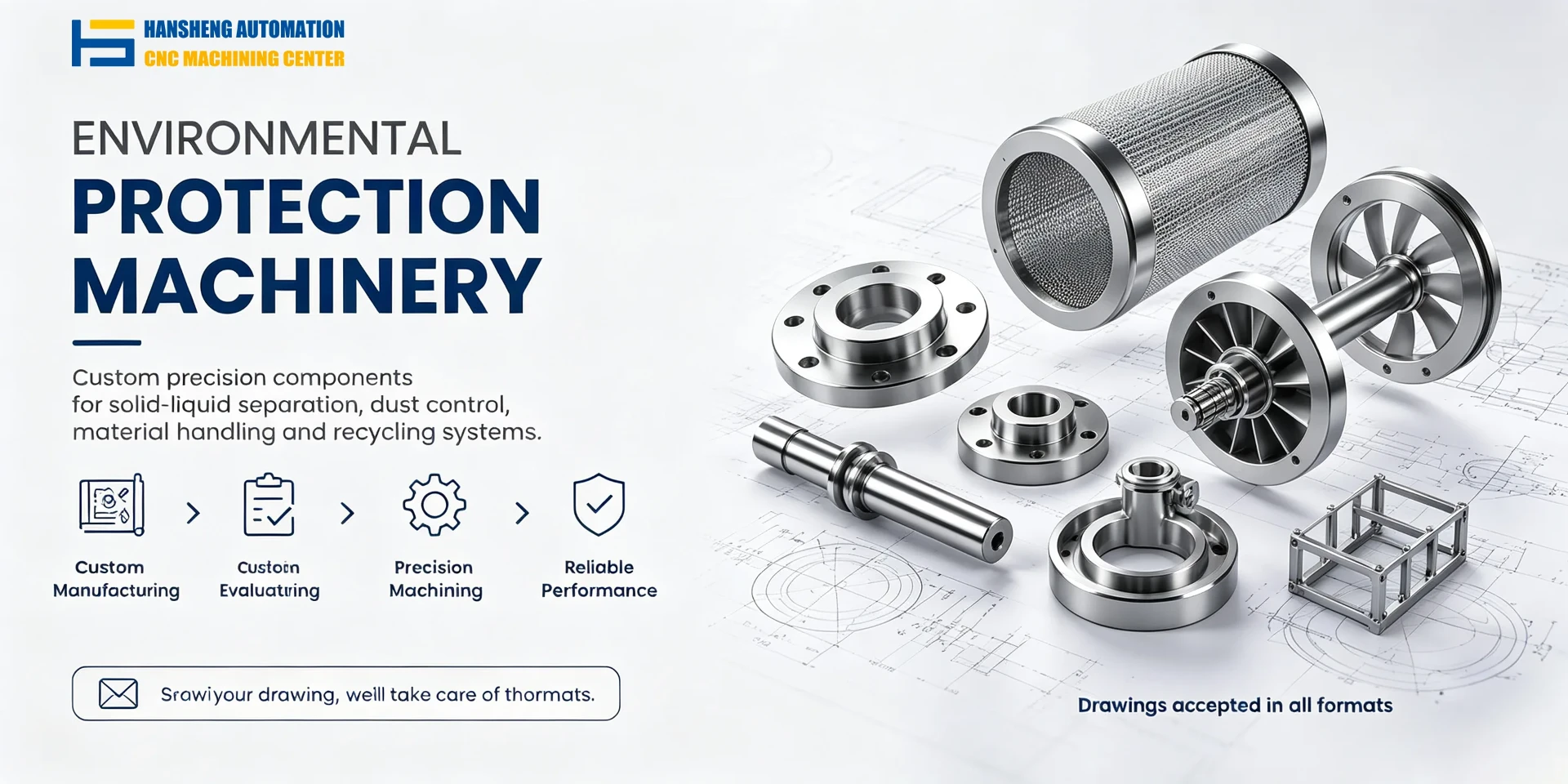
In addition to components used in environmental protection and waste gas treatment equipment, Hansheng Automation provides drawing-based precision machining for non-standard industrial parts.
Our machining services also cover components for yacht equipment, remote-controlled racing cars, tobacco and packaging machinery, and filling equipment. We support single-piece and small-batch manufacturing according to customer drawings, dimensions, and assembly requirements.