The success of the wet granulation process heavily relies on the precise matching of the mixing frequency (impeller speed) and chopping frequency (chopper speed). Typically, the main mixing impeller operates between 20 and 600 rpm. During the dry mixing and pre-wetting stages, medium-to-low speeds (50–600 rpm) provide the mechanical thrust necessary to create an ideal semi-fluid, three-dimensional convective state, ensuring the uniform penetration of the binder among the powders.
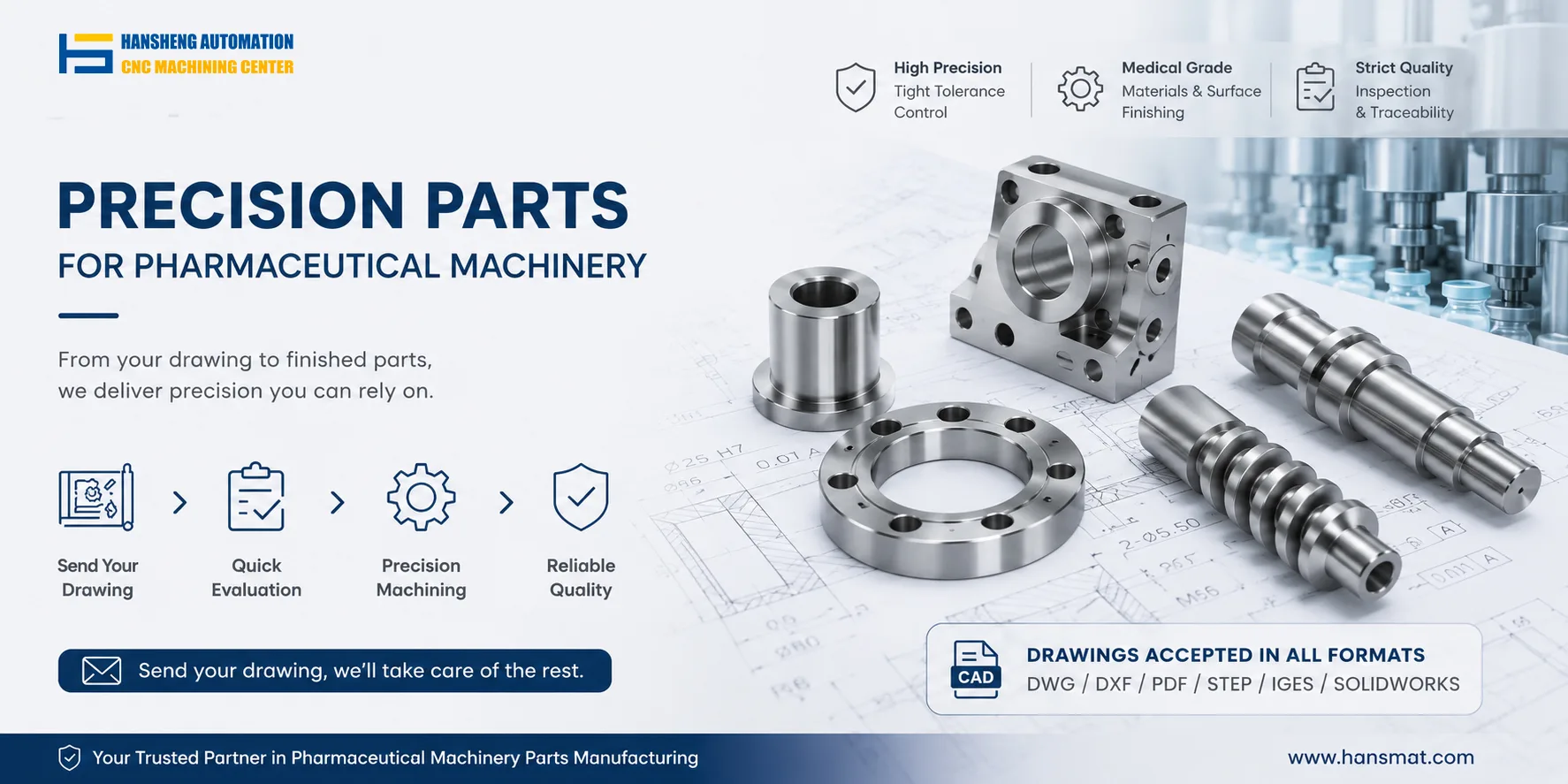
In contrast, the side-mounted chopper operates at significantly higher frequencies, with a baseline speed range spanning from 50 to 3000 rpm. During the fine granulation phase, the chopper often performs high-intensity cutting under extreme conditions of 1000 to 3000 rpm. This continuous high-frequency shearing imposes rigorous demands on the dynamic balance, concentricity, and mechanical strength of the core drive components. To support the stable operation of such equipment under extreme parameters, we can perform single-piece or low-volume precision machining of core granulator components based on customer design drawings. Whether you need drive shafts requiring ultimate rotational precision or special non-standard chopper blade sets built to withstand immense physical impact, Hansheng Automation supports the exact manufacturing of these parts according to your prints.
We understand that modern granulation processes utilize variable frequency drives for stepless speed adjustment to accommodate diverse material characteristics and strict particle size requirements. For instance, highly viscous materials require lower chopping frequencies (500–1500 rpm) to prevent over-massing, while loose materials demand higher speeds (2000–3000 rpm) to ensure dense granule formation. For fine granules under 0.5mm, chopper speeds must often exceed 2000 rpm, whereas regular 0.5–2mm granules typically require 1000–2000 rpm. Furthermore, mechanical tolerance requirements vary widely across equipment scales, from lab-sized machines capable of up to 4000 rpm to production-scale models usually capped at 3000 rpm.
Before actual production, operators generally establish a baseline for process debugging using medium mixing speeds (200–400 rpm) and medium chopping frequencies (1500–2500 rpm). By strictly controlling micron-level geometric tolerances and utilizing high-strength, wear-resistant alloys, Hansheng Automation remains committed to providing reliable hardware assurance for pharmaceutical and chemical machinery manufacturers, ensuring your equipment delivers perfect granulation performance under any complex parameter combination.