Although both marking machines and pad printing machines are used to create identifiers or patterns on product surfaces, they differ fundamentally in operating principles, flexibility, and application scenarios. Understanding these differences helps in selecting the most suitable equipment for specific production needs.
1. Fundamental Difference in Working Principles
Marking machines (typically laser markers or inkjet printers): They are computer‑controlled and can directly receive graphic files from software. The laser beam or inkjet head "prints" the pattern onto the workpiece surface. Graphics can be modified instantly via the software without changing any physical tooling – a "what‑you‑see‑is‑what‑you‑get" process. Laser marking is a non‑contact process that does not physically touch the workpiece.
Pad printing machines: The graphic must first be etched or engraved onto a steel plate (or resin plate) to create an intaglio cavity. During printing, ink fills the cavities, and a silicone pad picks up the ink and transfers it onto the workpiece. Once the plate is made, the pattern is fixed; to change the design, a new plate must be produced – no on‑the‑fly software modification is possible.
2. Flexibility and Changeover Costs
Marking machines offer high flexibility, suitable for multi‑variety, small‑batch production or frequent content changes – e.g., serial numbers, production dates, QR codes, personalised text. Changeover costs are minimal, limited to software setup time.
Pad printing machines have fixed patterns, making them ideal for high‑volume, long‑run production of stable designs – e.g., brand logos, standard decorative graphics. Plate making incurs tooling costs and lead time; pattern changes require new plates, reducing flexibility, but the per‑piece printing cost drops significantly with larger quantities.
3. Workpiece Compatibility and Printing Quality
Marking machines: Suitable for flat or slightly curved surfaces. Laser marking can produce high‑contrast permanent marks (e.g., metal engraving, plastic discolouration), while inkjet can achieve colour or invisible codes. However, laser processing may face challenges with some materials (e.g., transparent plastics, highly reflective metals) and cannot handle deep recesses or complex curvatures.
Pad printing machines: Specialise in complex curved, concave‑convex, or stepped workpieces. The soft silicone pad conforms to irregular surfaces, precisely transferring fine lines and tiny characters. The ink film is relatively thin, but multi‑colour registration is achievable, making it suitable for decorative and identification printing.
4. Consumables and Maintenance
Marking machines mainly consume cooling media, protective lenses (for lasers), or inks (for inkjets). Maintenance focuses on optical systems or printhead cleaning.
Pad printing requires regular replacement of plates, silicone pads, doctor blades/ink cups, and inks. The service life of pads and blades depends on printing frequency and ink corrosiveness.
5. Selection Guidelines
If frequent content changes, small batches, or permanent high‑contrast marks are needed, a marking machine is preferred.
If the product has complex contours and curved surfaces, with a fixed design and high production volume, pad printing offers greater cost‑effectiveness.
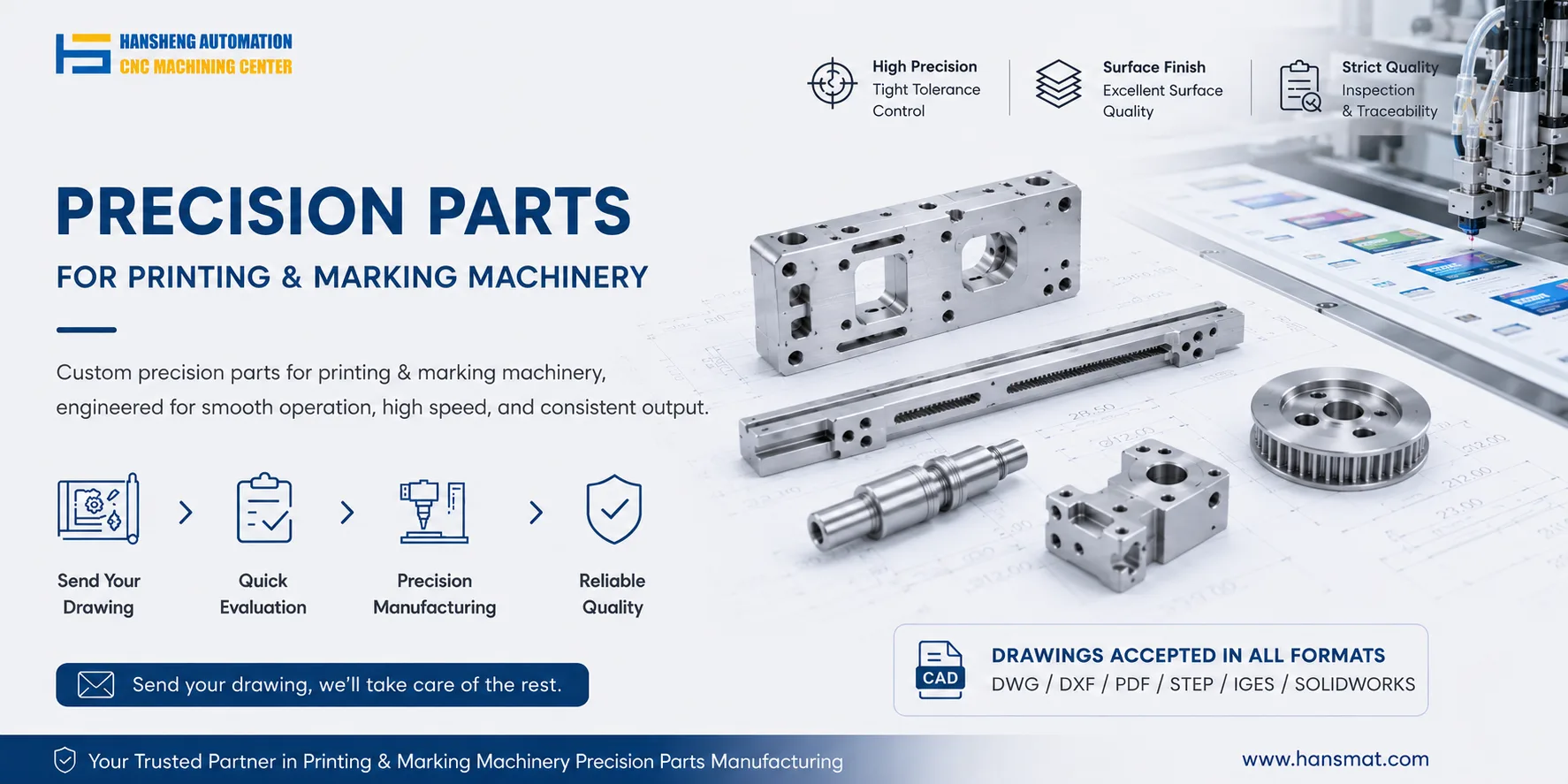
Over prolonged operation, components on both types of equipment – such as galvanometer scanner assemblies and focusing lenses on marking machines, or steel plates, silicone pads, and doctor blades on pad printers – may wear out or degrade. For non‑standard sizes or special material replacement requirements, Hansheng Automation can precision‑machine custom parts according to customer drawings or on‑site measurement data, ensuring that your equipment is restored to optimal performance and minimising downtime caused by spare parts unavailability.