The stroke length of a pad printing machine – typically referring to the maximum horizontal travel distance of the worktable or printing head – directly determines the largest workpiece size the machine can handle. Different models offer varied stroke designs, generally ranging from tens of millimetres to several hundred millimetres or even more, covering applications from miniature precision parts to large decorative panels.
1. Typical Stroke Range and Practical Limitations
Most commercial pad printing machines have standard strokes between 100 mm and 400 mm. Some models designed for larger workpieces can extend strokes to 600–800 mm, and a few custom‑built systems may exceed 1000 mm. However, stroke length cannot be extended indefinitely; it is constrained by several factors:
Structural rigidity: Longer strokes require greater spans for guide rails and frames. If the structure is not properly designed, deflection at the ends of travel can occur, affecting printing pressure uniformity.
Drive system capability: When using stepper or servo motors with leadscrews or timing belts, increased stroke demands higher torsional stiffness and positioning accuracy. Leadscrew critical speed and thermal expansion must also be considered.
Table and workpiece dimensions: The worktable itself limits the maximum workpiece footprint. Even with sufficient stroke, an overly wide workpiece that exceeds the table support area cannot be properly accommodated.
2. Advantages and Challenges of Extended Stroke
Advantages: Longer stroke machines can print large workpieces (e.g., home appliance panels, automotive interior trims, signage) in a single pass, or cover multiple small parts in one cycle, boosting productivity and reducing changeover time.
Challenges: Extended stroke increases moving mass and inertia, which may affect positioning repeatability at high speeds. Additionally, long leadscrews and rails are more difficult and costly to manufacture, and are more sensitive to ambient temperature fluctuations – requiring thermal compensation provisions in design and assembly.
3. Balancing Stroke Length and Printing Accuracy
In general, longer strokes demand higher resolution from the motion control system, faster servo response, and more precise position feedback (e.g., linear encoders). Without corresponding control upgrades, cumulative positioning errors at the far ends of travel may increase, causing misregistration in multi‑colour jobs. Therefore, selection should not blindly favour maximum stroke. Instead, choose a stroke approximately 1.2 to 1.5 times the actual maximum workpiece length, prioritising well‑proven standard models that meet requirements while balancing cost and reliability.
4. Selection Advice and Custom Machining Support
When standard stroke models cannot accommodate unusual workpieces (e.g., extra‑long extrusions, large curved shells), or when extending the working range of existing equipment is needed, consider the following approaches:
Evaluate feasibility of upgrading – replacing with a longer leadscrew, extending guide rails, and adjusting servo parameters.
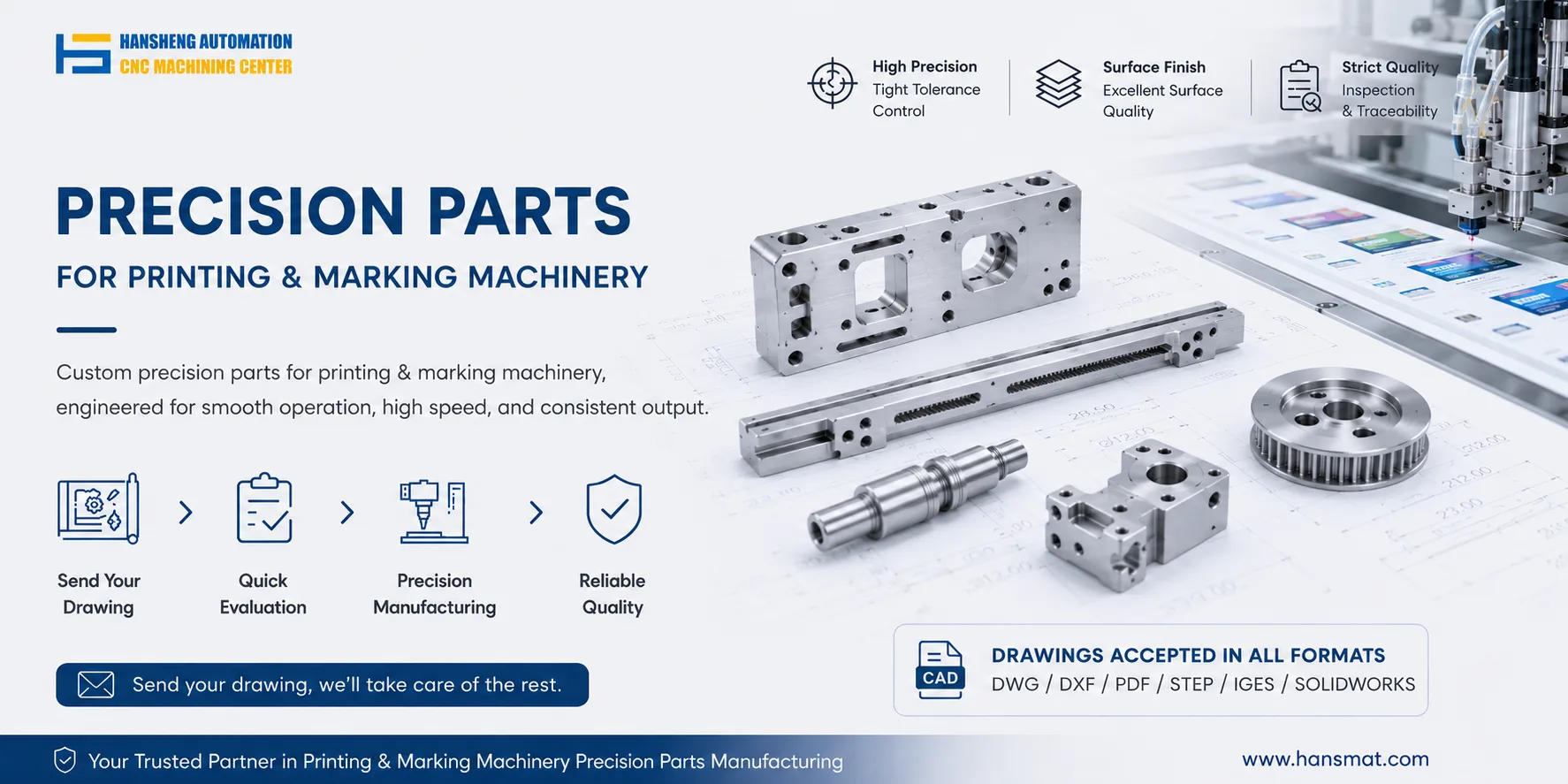
For non‑standard transmission or structural components, we offer precision custom machining based on on‑site measurement data or design drawings. Whether it is extended guide rails, high‑rigidity leadscrews, or reinforced frame connectors, Hansheng Automation can provide custom solutions matched to your original machine, ensuring that system rigidity, positioning accuracy, and stability meet production requirements even with an extended stroke.
With proper selection or targeted customisation, pad printing machines can achieve flexible stroke configurations for diverse printing scenarios, helping customers expand their processing capabilities.