Integrated waste gas deodorization systems use different treatment technologies to remove odorous compounds from industrial exhaust. Common configurations include fiberglass-reinforced plastic (FRP) deodorization units, biological deodorization systems, and activated carbon adsorption units.
These systems are used in wastewater treatment plants, landfills, meat processing facilities, fertilizer production plants, and other industrial operations that generate odorous emissions.
The treatment efficiency depends on the composition and concentration of the odorants, exhaust airflow, operating conditions, and equipment configuration. A removal efficiency of 95% or higher may be achievable under suitable conditions, but it should not be treated as a universal performance value for all deodorization systems.
FRP Deodorization Units
Equipment Structure and Design Features
Fiberglass-reinforced plastic (FRP) is commonly used to manufacture deodorization equipment housings and treatment towers because of its corrosion resistance and suitability for industrial waste gas environments.
An FRP deodorization unit can incorporate a biological filter bed or other treatment components. Its structural design focuses on maintaining suitable operating conditions for the treatment media while providing a sealed enclosure for the exhaust gas.
The main design features include:
Controlled conditions for biological treatment: The filter housing uses composite materials and an enclosed structure to help maintain a relatively stable operating environment for microorganisms. In cold regions, a heating system can be installed to maintain the required temperature. A spray system supplies water to the biological packing material to maintain suitable moisture conditions. Additional media management measures help prevent excessive acidification of the filter bed.
Compact and flexible construction: Standard units use an integrated modular design to reduce installation space. The structure can be modified according to site conditions and available space. Options may include buried installations, split configurations, and multi-level arrangements.
Material selection: The equipment construction materials can be selected according to the customer's requirements and the chemical characteristics of the exhaust and circulating liquid.
Typical Applications and Treatment Process
FRP deodorization units are commonly used for controlling odors from meat processing facilities, fertilizer production plants, wastewater treatment plants, and landfills.
Typical odor-causing pollutants include ammonia (NH3), hydrogen sulfide (H2S), and other sulfur-containing compounds.
The exhaust is collected from odor-generating process areas through a ductwork system and conveyed by an exhaust fan to the treatment unit. Depending on the treatment configuration, the gas may first pass through a chemical scrubber to remove certain soluble or reactive compounds before entering the biological filter.
Chemical scrubbing uses a suitable liquid absorbent to capture or neutralize pollutants. The biological filter then treats the remaining biodegradable odorants through microbial activity.
The treatment stages must be designed according to the actual gas composition. Chemical neutralization and biological degradation are separate processes and should not be treated as interchangeable methods.
Biological Deodorization Equipment
Working Principle
Biological deodorization uses microorganisms attached to filter media to break down odorous compounds in the exhaust gas.
The collected gas passes through a packed bed containing a biological film formed by selected microorganisms. Odorous compounds first transfer from the gas phase into the moisture surrounding the packing material. They are then absorbed or transferred into the biofilm, where microorganisms metabolize suitable pollutants.
Depending on the pollutant, biological reactions can produce carbon dioxide, water, biomass, sulfate, and other oxidation products.
The operating conditions must support microbial activity. Moisture content, temperature, pH, oxygen availability, nutrient supply, and gas contact time all affect the treatment performance.
Soil Biofilter Systems
A soil biofilter uses soil or other organic filter media to support microbial growth and distribute the exhaust gas through the treatment bed.
A typical gas distribution layer contains coarse and fine stones and sand. This arrangement helps distribute the incoming gas more evenly across the filter bed before it passes through the biological media.
The main advantages include:
Relatively simple equipment construction.
Low energy demand during normal operation.
No continuous chemical absorbent addition is generally required for the biological treatment stage.
Suitable for treating certain biodegradable odorants in large-volume exhaust streams.
However, the filter media can compact over time, increasing airflow resistance and reducing gas distribution uniformity. Regular inspection and media replacement or replenishment may therefore be necessary.
Packed-Bed Biological Deodorization Systems
A packed-bed biological deodorization system uses solid filter media to support microbial growth and biofilm formation.
The exhaust passes through the packing, bringing odorous compounds into contact with the microorganisms attached to its surface. The microorganisms then degrade suitable compounds through biological reactions.
Some systems use organic materials such as compost or soil, while others use structured inorganic or synthetic packing materials.
A related configuration is the biotrickling filter. In this system, a liquid nutrient solution or water is continuously or intermittently distributed over the packing to maintain moisture and provide conditions for microbial activity.
Compared with conventional soil biofilters, packed biological systems can offer more controlled operating conditions. However, their performance still depends on packing characteristics, irrigation, pH, temperature, and gas residence time.
Applications and Operating Conditions
Biological deodorization is commonly used in wastewater treatment plants to control emissions from sludge processing areas, tanks, channels, and other odor-generating units.
It can also be applied to suitable exhaust streams from waste treatment, composting, and food processing operations.
When the exhaust contains high concentrations of ammonia or sulfur compounds, pretreatment may be necessary to control the loading on the biological filter and maintain suitable media conditions. For example, ammonia absorption or sulfur compound removal may require a separate chemical scrubbing stage.
Biological treatment should be selected according to the biodegradability of the target pollutants and the required operating conditions.
Activated Carbon Adsorption Units
Working Principle
Activated carbon adsorption units use porous carbon materials to capture odorous compounds and organic pollutants from the exhaust gas.
Activated carbon has a developed pore structure and a large internal surface area. When exhaust passes through the adsorption bed, suitable gas molecules are retained on the carbon surface through intermolecular attraction and other surface interactions.
This process is known as adsorption. It separates the adsorbed pollutants from the main gas stream without requiring a high-temperature reaction.
Activated carbon can capture many organic compounds, including aromatic hydrocarbons, larger organic molecules, and certain halogenated organic compounds. Its effectiveness depends on the molecular properties of the pollutants and the characteristics of the carbon.
Different activated carbon grades are available for different applications. Impregnated activated carbon can also be used for certain inorganic odorants, including hydrogen sulfide and ammonia, depending on the impregnation formulation.
Equipment Features and Applications
Activated carbon adsorption units have a relatively simple structure and can be installed in an exhaust duct system or used as a polishing stage after other deodorization processes.
They are suitable for certain low-concentration odor and VOC streams when the target compounds have adequate adsorption characteristics.
In addition to industrial exhaust treatment, activated carbon is widely used in water treatment to remove dissolved organic compounds, taste and odor compounds, and trace contaminants. However, gas-phase adsorption and water treatment involve different equipment arrangements and operating conditions.
The adsorption capacity of the carbon bed is limited. As the adsorbent accumulates pollutants, it gradually approaches saturation. Once breakthrough occurs, the outlet concentration begins to increase.
The activated carbon must therefore be monitored and replaced or regenerated according to its operating condition. Gas humidity, temperature, pollutant concentration, and airflow also affect adsorption performance.
Used activated carbon requires appropriate handling and disposal or regeneration based on the contaminants it contains.
Custom Machining for Environmental Protection Equipment
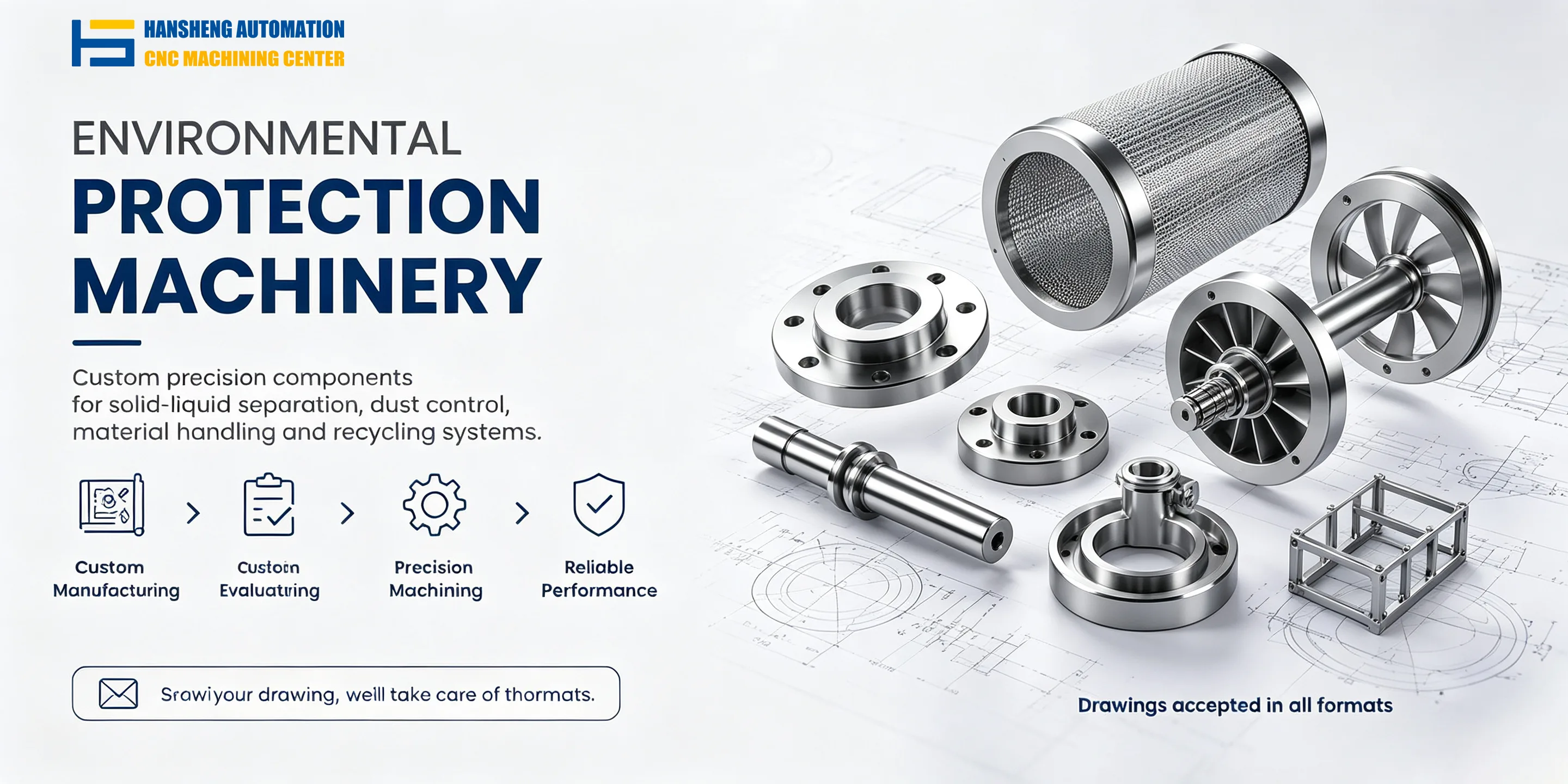
In addition to components used in deodorization and environmental protection equipment, Hansheng Automation provides drawing-based precision machining for non-standard industrial parts.
Our machining services also cover components for yacht equipment, tobacco and packaging machinery, remote-controlled racing cars, and filling equipment. We support single-piece and small-batch manufacturing according to customer drawings, dimensions, and assembly requirements.