Safe operation of a conductor pay-off stand is essential for efficient power line construction. The main requirements are proper equipment setup, stable conductor payout, and coordinated control throughout the operation.
1. How to Select and Inspect a Pay-Off Stand
Conductor pay-off stands generally fall into two categories: hydraulic tension pay-off stands and standard support stands. Hydraulic tension stands are used in important crossing sections where conductor tension must be maintained, while standard support stands are suitable for general conductor payout on ordinary terrain.
Before work begins, carry out the following checks:
Inspect all components for damage, paying particular attention to the hydraulic system and braking mechanism.
Check the stability of the support frame. The ground should be level and firm. Place timber sleepers under the supports if necessary.
Verify that the reel dimensions and total weight are compatible with the pay-off stand. Do not operate the equipment beyond its rated capacity.
2. How to Set Up and Secure the Stand
Correct positioning and anchoring help prevent the stand from shifting or tipping during conductor payout.
Position the pay-off stand directly beneath the shaft holes on both sides of the conductor reel. Keep the supports symmetrically aligned with the reel centerline.
Secure the support legs with ground anchors or counterweights. In mountainous areas, install additional temporary guy wires where necessary to improve stability.
Raise the reel approximately 10 to 15 cm above the ground. Check that it can rotate freely without contacting the ground or surrounding obstacles.
Before starting the operation, confirm that the support shaft, retaining devices, and anchoring arrangements are secure.
3. How to Control Conductor Payout
Stable conductor payout requires coordinated pulling, tension control, and monitoring of the remaining conductor on the reel.
Maintain a steady pulling speed
During payout, maintain a steady pulling speed. The source guidance specifies a typical speed of 3 to 5 km/h. Avoid sudden acceleration or abrupt changes in pulling force.
When using a tension pay-off stand, adjust the tension according to the conductor type. For aluminum conductors reinforced with a steel core, the source guidance specifies a tension of 15% to 20% of the rated breaking force.
Assign an operator to monitor the remaining conductor on the reel and adjust the braking torque as needed. This helps prevent the conductor from becoming loose or unwinding irregularly.
4. What Safety Measures Should Operators Follow?
Before and during conductor payout, operators should maintain a safe working area and monitor the equipment continuously.
Keep a safe distance: Operators should remain at least 1 meter away from rotating components.
Monitor hydraulic pressure: The maximum hydraulic working pressure should not exceed 80% of the rated value, according to the source guidance.
Stop when the conductor becomes obstructed: If the conductor catches or the pulling process is interrupted, stop the pulling equipment immediately. Resume work only after the cause has been identified and resolved.
Reduce friction in mountainous areas: Install suitable redirecting sheaves along the route to reduce friction where the conductor changes direction.
Operators should also follow the applicable equipment manual and site-specific safety procedures when determining operating limits and protective measures.
5. How to Handle Special Working Conditions
Certain site conditions require additional precautions during conductor payout.
Large elevation differences
On sections with a significant elevation difference, an inverted or suspended pay-off stand arrangement may be used to help prevent uncontrolled reel movement. The setup must suit the site conditions and the equipment design.
Road crossings
When the conductor route crosses a road, install suitable protective netting and warning signs for traffic approaching from both directions. The crossing arrangement should meet the applicable construction and traffic safety requirements.
Rain, fog, and reduced visibility
Rain and fog can affect visibility, ground conditions, and braking performance. The source guidance recommends reducing the operating speed by 30% in these conditions and strengthening braking and anti-slip measures. Operators should also assess whether the weather permits work to continue safely.
6. Custom Machining for Wire Handling Equipment
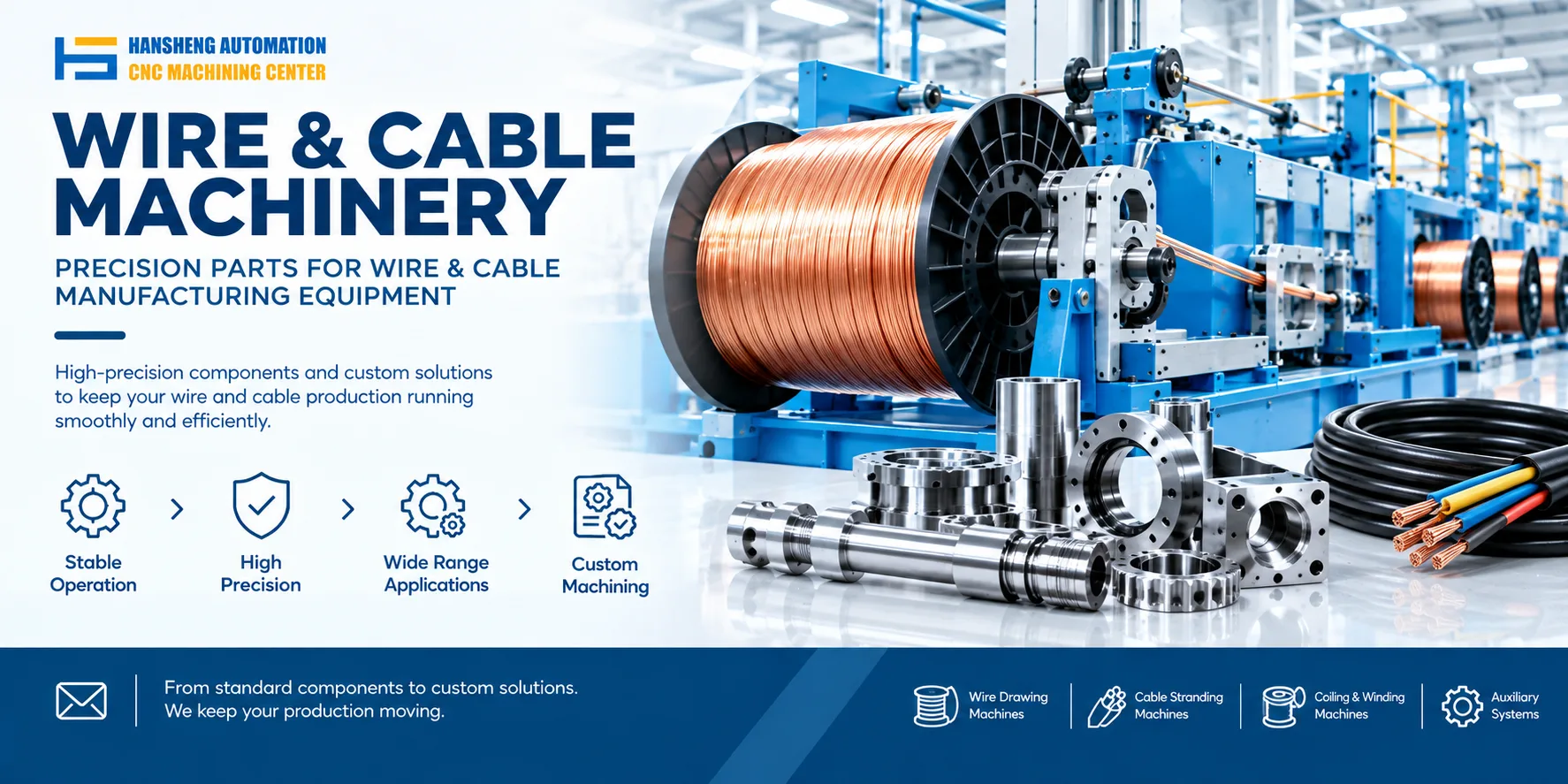
Pay-off stands and related wire handling equipment rely on mechanical components that must fit the intended assembly and operating conditions. Shafts, mounting brackets, supports, and connecting parts may require specific dimensions, material properties, and tolerances.
Hansheng Automation provides custom precision machining based on customer drawings. We evaluate component geometry, material specifications, and dimensional requirements to determine a suitable manufacturing process for prototypes and small batch orders.
Our drawing-based machining services also cover precision components for packaging and filling machinery, tobacco equipment, yacht systems, and RC racing cars. Each component is assessed according to its design and application before the appropriate machining process is selected.