Exhaust gas from paint spray booths and curing ovens may contain volatile organic compounds (VOCs), paint mist, particulate matter, and odorous substances. Common VOCs associated with coating operations include benzene, toluene, and xylene, depending on the coating formulation and solvents used. The exhaust characteristics also vary with the spraying process, oven temperature, airflow, and production schedule.
Different treatment technologies target different pollutants. Spray booths generally require paint mist removal before VOC treatment, while curing oven exhaust often requires a dedicated VOC oxidation system. The equipment selection should be based on the actual exhaust composition, concentration, airflow, and emission control requirements.
Main exhaust gas treatment equipment
Water spray scrubbers
Water spray scrubbers, including water curtain booths and spray towers, use contact between the exhaust gas and water to capture paint droplets and particulate matter.
In a water curtain booth, the exhaust air passes through the water curtain, where a portion of the airborne paint mist is captured. A spray tower uses water droplets to contact the gas stream and remove entrained particles. The contaminated water is collected for treatment or disposal.
Water spray systems are mainly used for paint mist removal and as pretreatment before downstream VOC treatment. They can also absorb certain water-soluble pollutants, but their ability to remove solvent vapors such as toluene and xylene is limited.
For this reason, a water spray scrubber alone is generally insufficient for controlling the VOC emissions from solvent-based painting operations.
Activated carbon adsorption systems
Activated carbon adsorption systems use the porous structure and large surface area of activated carbon to capture VOC molecules from the exhaust gas.
As the exhaust passes through the carbon bed, organic compounds are retained on the carbon surface. Once the carbon approaches its adsorption capacity, it must be replaced or regenerated.
In systems equipped with on-site regeneration, hot air, steam, or another suitable regeneration method is used to desorb the accumulated VOCs. The resulting concentrated gas can then be sent to a catalytic oxidation unit for further treatment. Some systems use off-site regeneration or carbon replacement instead.
Activated carbon adsorption is commonly considered for exhaust streams with relatively low VOC concentrations and suitable airflow rates. Its performance depends on the type of activated carbon, VOC composition, gas temperature, humidity, and inlet concentration.
Paint mist and other particulate matter should be removed before the exhaust enters the carbon bed. Otherwise, deposits can block the adsorption surface and reduce the service life of the carbon.
Catalytic oxidation systems (RCO)
Catalytic oxidation uses a catalyst, often based on precious metals, to promote the oxidation of VOCs at a lower temperature than conventional thermal oxidation.
In a regenerative catalytic oxidizer (RCO), the exhaust gas passes through a heat recovery system before entering the catalytic reaction chamber. The catalyst promotes the oxidation of organic compounds, converting them primarily into carbon dioxide and water. The heat recovery section captures thermal energy from the treated gas and uses it to preheat incoming exhaust.
The operating temperature depends on the catalyst formulation, VOC composition, and system design. It should not be assigned a single fixed value for all catalytic oxidation systems.
RCO systems can achieve high VOC removal efficiency when the exhaust composition and operating conditions are suitable. However, particulate matter, paint mist, and certain catalyst poisons must be controlled through pretreatment to prevent catalyst contamination and loss of activity.
This technology is suitable for coating operations where the exhaust characteristics, VOC concentration, and operating schedule are compatible with catalytic oxidation.
Regenerative thermal oxidizers (RTO)
A regenerative thermal oxidizer uses high-temperature oxidation to decompose VOCs in the exhaust gas.
The exhaust passes through heat storage chambers containing ceramic media. The system uses alternating airflow cycles to transfer heat from the treated gas to incoming exhaust, reducing the amount of additional fuel needed to maintain the oxidation temperature.
The combustion chamber typically operates at approximately 760-820°C, although the actual temperature depends on the VOC composition, required residence time, and equipment design.
RTO systems can achieve high VOC destruction efficiency. EPA technical guidance reports typical design efficiency ranges of 95-99% for RTO systems. Actual performance depends on inlet concentration, gas composition, temperature, residence time, and mixing conditions.
RTO equipment is commonly used for relatively high airflow and low VOC concentration applications, including industrial coating and curing oven exhaust. High VOC concentrations require additional assessment of the thermal load and lower explosive limit (LEL) to ensure safe operation. They do not automatically make RTO the preferred option.
UV and photocatalytic oxidation equipment
UV oxidation and photocatalytic oxidation systems use ultraviolet radiation to break down or oxidize certain pollutants in the exhaust gas.
In photocatalytic systems, titanium dioxide (TiO2) is commonly used as the catalyst. When activated by UV radiation, the catalyst promotes the formation of reactive species, including hydroxyl radicals and superoxide ions. These reactive species can oxidize some organic compounds and odorous substances.
The treatment performance depends on VOC composition, inlet concentration, gas temperature, humidity, airflow, and contact time.
These systems are generally more suitable for selected low-concentration exhaust applications than for high-concentration or heavily contaminated paint exhaust. Residual ozone and incomplete oxidation products may also need to be considered in system design.
UV and photocatalytic equipment is sometimes used alongside other treatment technologies, but its actual removal performance should be verified through testing. It should not be selected as the sole treatment stage for a substantial VOC emission source without supporting performance data.
Combined exhaust gas treatment processes
Different treatment stages can be combined to handle particulate matter and gaseous pollutants in the same exhaust stream. The process arrangement depends on whether the exhaust comes from a spray booth, a curing oven, or both.
Water spray scrubbing and catalytic oxidation
A water spray scrubber first removes paint mist and some particulate matter from the exhaust. After suitable mist removal and gas conditioning, the pretreated exhaust enters a catalytic oxidation system for VOC treatment.
This arrangement separates paint mist removal from gaseous pollutant control. Additional filtration may be required to protect the catalyst from residual paint particles and other contaminants.
Activated carbon adsorption and catalytic oxidation
This process combines VOC adsorption and thermal regeneration with catalytic oxidation.
Activated carbon captures VOCs from the exhaust and concentrates them on the adsorbent. During regeneration, the concentrated VOC stream is released and sent to the catalytic oxidation unit for destruction.
The arrangement is suitable for certain intermittent production processes or exhaust streams where adsorption and concentration provide an advantage over direct oxidation. The system requires appropriate control of adsorption capacity, regeneration temperature, airflow, and safety conditions.
Spray booth pretreatment and VOC concentration followed by oxidation
Spray booth exhaust often contains substantial amounts of paint overspray and has a relatively large airflow. A typical treatment arrangement may include a water wash or dry filtration stage, followed by additional fine-particle removal.
A carbon or zeolite concentration rotor can then reduce the exhaust volume and increase the VOC concentration before the concentrated stream enters an RTO or RCO system.
This arrangement is used in some industrial coating operations to reduce the volume of gas requiring oxidation. Pretreatment is necessary to prevent paint particles from contaminating the concentration media and downstream equipment.
Factors to consider when selecting treatment equipment
Exhaust composition and concentration
The first step is to identify the pollutants in the exhaust stream. Paint spray booths mainly generate paint mist and solvent vapors, while curing ovens can release VOCs from the heated coating and residual solvents.
The concentrations of individual VOCs, particulate matter, and other pollutants should be measured or estimated from the production process. Different compounds have different adsorption and oxidation characteristics, so equipment selection should reflect the actual exhaust composition.
Airflow and production capacity
The exhaust airflow determines the required treatment equipment capacity. Spray booths often require large ventilation volumes to maintain suitable working conditions, while curing ovens may produce different airflow rates and VOC concentrations.
An exhaust flow rate of 40,000 m3/h should not be treated as a universal dividing line between standard and customized equipment. Equipment sizing requires consideration of the actual airflow, inlet pollutant concentration, operating hours, and required emission limits.
For installations with larger or variable exhaust volumes, customized system design may be necessary.
Operating temperature and humidity
Exhaust temperature and humidity affect the performance of activated carbon, catalytic oxidation, and UV treatment systems.
High temperatures may require cooling or heat recovery before adsorption. Excessive humidity can reduce the effective adsorption capacity of some activated carbons. Paint mist and condensable substances can also block filters or contaminate catalyst surfaces.
The pretreatment arrangement should therefore match the temperature, humidity, and particulate characteristics of the exhaust.
Operating costs and maintenance
Equipment selection should account for initial investment as well as long-term operating costs.
Activated carbon systems require periodic replacement or regeneration of the adsorbent. RTO and RCO systems consume energy to maintain the required oxidation conditions, although heat recovery can reduce fuel consumption. Water spray scrubbers require water circulation, cleaning, and wastewater management.
Maintenance requirements should also be considered, including filter replacement, carbon activity checks, catalyst inspection, burner maintenance, and pressure drop monitoring.
A treatment system with low initial investment may have higher long-term operating costs if it requires frequent consumable replacement or has high energy demand.
Exhaust treatment system selection and configuration
The appropriate treatment process depends on the source and characteristics of the exhaust.
For paint spray booths, water washing or dry filtration is commonly used to remove paint overspray before the VOC treatment stage. Activated carbon adsorption or a concentration system followed by oxidation may be considered according to the airflow and VOC concentration.
For curing ovens, RTO or catalytic oxidation may be suitable depending on the VOC concentration, exhaust volume, operating temperature, and process conditions.
For installations that include both spray booths and curing ovens, the exhaust streams should be evaluated separately before deciding whether to combine them into one treatment system.
The final configuration should meet the applicable emission requirements while accounting for operating safety, energy consumption, maintenance, and overall treatment costs.
Custom Machining for Industrial Equipment Components
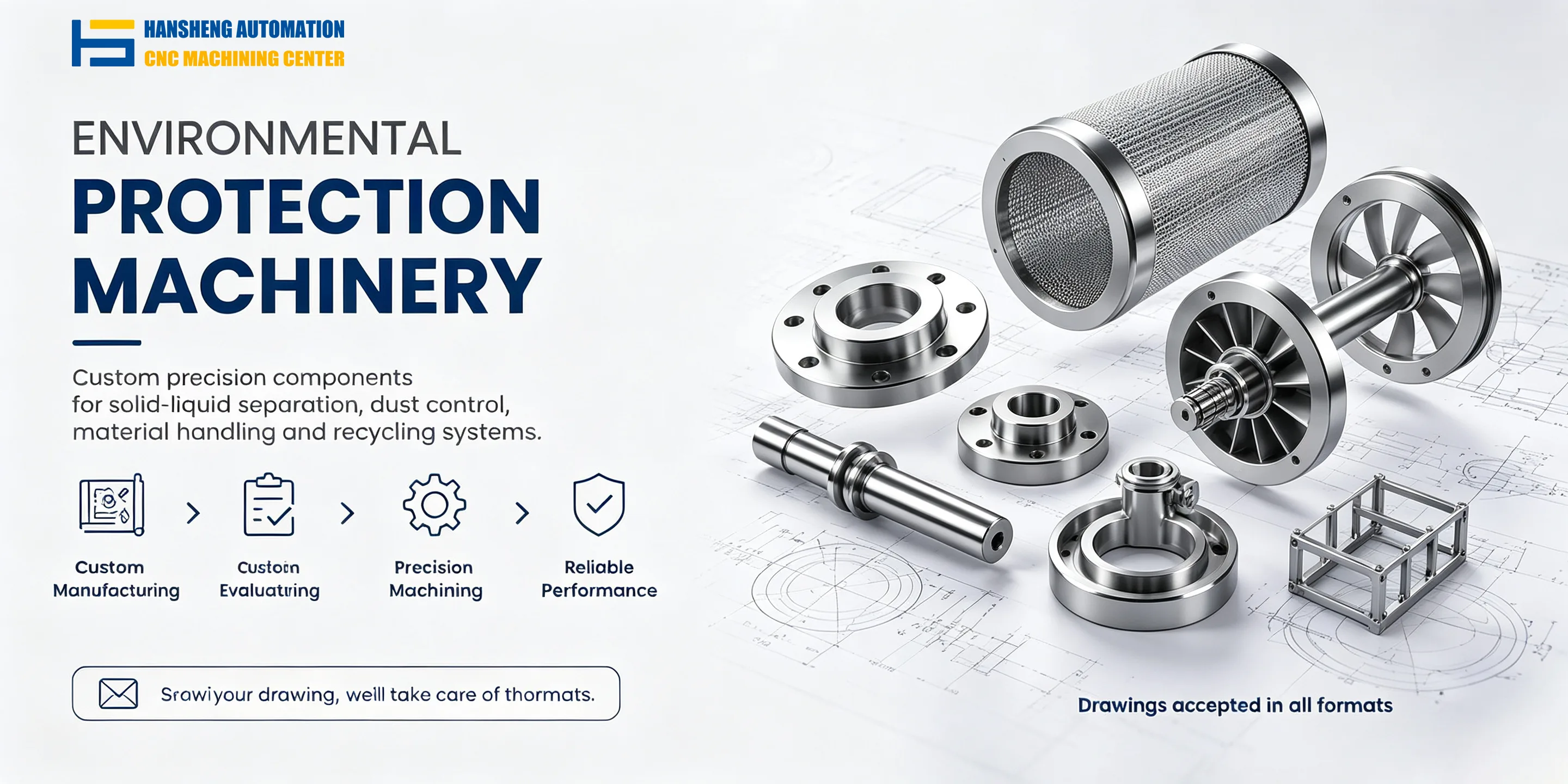
In addition to components used in exhaust treatment and environmental protection equipment, Hansheng Automation provides drawing-based precision machining for non-standard industrial parts. Our machining services also cover components for tobacco and packaging machinery, filling equipment, yacht equipment, and remote-controlled racing cars.
We support single-piece and small-batch production according to customer drawings and component specifications, providing machining services for different industrial applications.