Overflow on an automatic jelly pouch packaging machine usually traces back to three areas: inaccurate fill volume, mismatched sealing temperature and pressure, and conveyor synchronization error. Working through them in the order below resolves most cases without stopping production.
1. Filling
Check the metering pump first. Jelly is a high-viscosity gel, and once the plunger or gear in the metering pump wears, the volume delivered per stroke starts to drift. Fill accuracy should stay within ±1% (per GB/T 10004-2023 for flexible packaging). If the pump itself is sound, check the product temperature. The gel flows most consistently at 60±5°C, with a recommended flow rate of 8 to 12 m/s. A temperature that runs low lets gel cling to the pipe walls, which cuts the volume that actually reaches the pouch. A temperature that runs high pushes the flow faster than the pouch mouth can close, and overflow tends to happen on that side.
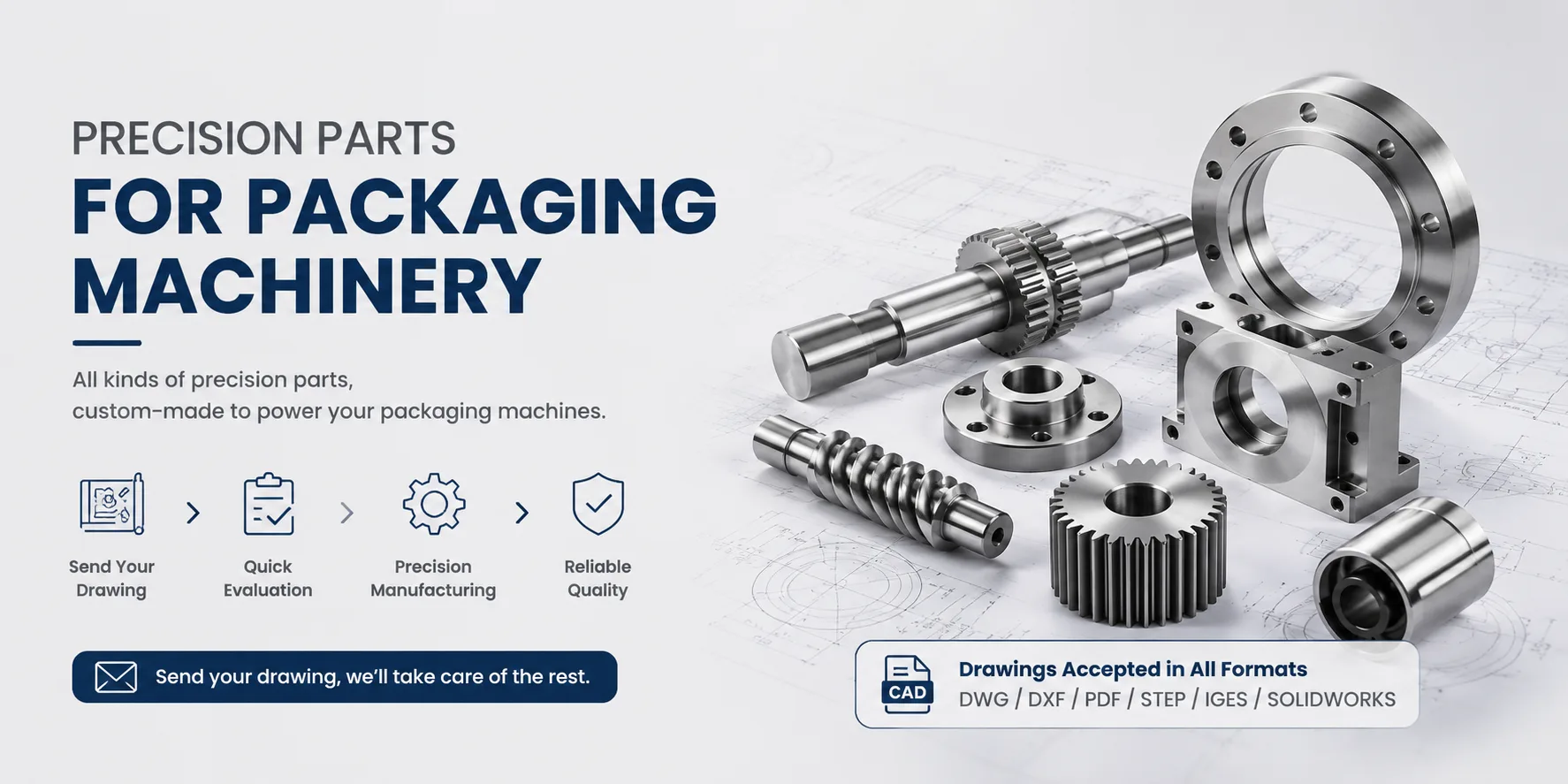
Exact settings depend on the viscosity coefficient of the formulation. We can machine metering pump plungers, filling heads, and other gel-contact parts to match a customer's recipe and cycle time, in 316L stainless steel or food-grade POM, with polished contact surfaces to reduce product buildup.
2. Sealing
For PP/PE laminated film, seal temperature should sit between 180 and 200°C with 0.3 to 0.5 MPa of pressure. Heat seal time runs 0.8 to 1.2 seconds, followed by roughly 2 seconds of cooling to set the seam. Below that temperature or pressure range, the seam stays weak and gel squeezed inside the pouch seeps through the seal during transport. Above it, the film burns through and leaks the same way.
Flatness of the heat seal bar matters as much as the settings. Once warpage exceeds 0.1 mm, the bar has to be replaced, because uneven pressure leaves weak points along the seam.
3. Conveyor Synchronization
Keep the speed ratio between the filling station and the sealing station at about 1:1.05. The extra 5% compensates for film shrinkage after heat sealing. If the ratio runs low, the pouch sits slack at the sealing station, drifts out of position, and the seal lands crooked. Pouch-mouth clamping cylinders should run at 0.15 to 0.2 MPa. Too little pressure and the clamp loses its grip; too much and it deforms the pouch mouth.
4. Routine Maintenance
Clean residual gel from the filling heads after each shift. Once it sets, it blocks the flow channels.
Check heat seal bar flatness weekly. Replace the bar if warpage exceeds 0.1 mm.
Verify photoelectric sensor positioning accuracy monthly to keep pouch location consistent.
Beyond these parts, our custom machining capability also covers non-standard components for tobacco packaging machinery and filling machinery, along with precision structural parts for yachts and RC race cars. We work from customer drawings for single pieces or small batches, with material, tolerance, and surface finish specified to the drawing.