Printing machinery includes printing presses, binding machines, plate-making equipment, and other auxiliary devices. A modern printing press generally consists of plate mounting, inking, impression, and sheet feeding mechanisms. To keep the equipment running reliably, routine maintenance is essential. This article discusses both static and dynamic maintenance, as well as the proper selection of lubricants and related materials.
Static Maintenance
Static maintenance refers to work carried out while the machine is not running.
First, a maintenance schedule should be established based on the machine manual. This includes regular oil changes, filter cleaning, and periodic checks of machine accuracy.
Second, key components require special attention. Gears, cams, chain wheels, cylinders, and bearings are the most important parts of a printing press. Their precision directly affects print quality, so their maintenance must be more rigorous than that of other components. Springs are also widely used in force-balancing mechanisms. They must retain proper elasticity; if a spring shows hysteresis or permanent plastic deformation, it should be replaced immediately.
Third, technical improvements may be made to simplify maintenance where possible. Because printing machines are complex and operating environments vary, certain structures that are difficult to maintain can be modified as long as normal operation is not affected.
Dynamic Maintenance
Dynamic maintenance is performed while the machine is running or being prepared for operation.
Before starting, the machine condition should be checked by jogging or manual rotation. This helps identify whether tools or foreign objects are caught inside, whether the printing plate is positioned correctly, and whether the blanket is installed properly. Incorrect installation can damage the plate, cause registration problems, or even lead to machine failure.
Lubrication status must also be monitored. Oil sight gauges should be checked to confirm that oil is flowing properly. If the gauge shows no oil or is unclear, the machine should be stopped immediately to inspect for leaks. For machines with sliding bearings, low-speed operation-especially jogging-does not provide adequate lubrication. Therefore, it is advisable to run the machine idle for lubrication before normal operation, preferably at the start of each shift. Some oil pumps are driven by the main motor, so reverse rotation should be avoided because it can draw oil back into the tank. In critical areas, local temperature can be used as an indicator; abnormally high temperature often signals a lubrication problem.
Impact during operation should be minimized. Lower printing pressure helps the machine run smoothly and extends its service life. As long as print quality is acceptable, the printing pressure should be kept as low as possible. Similarly, reducing machine speed lowers rotational inertia, so the machine should not be run continuously at maximum speed.
Maintenance Materials and Their Importance
When a machine fails, it is often assumed that the cause is normal wear. However, modern printing machines are built from high-quality alloy steel and should have a long service life if properly maintained. In practice, many breakdowns are related to the wrong selection or neglect of maintenance materials, particularly lubricants and related chemical products. These materials are often overlooked because incorrect use does not cause immediate damage to the printed product.
A reliable supplier of maintenance materials should provide products that reduce breakdown frequency and extend machine life, offer multi-functional product lines to reduce unnecessary inventory, help customers avoid misuse, simplify procurement procedures, maintain adequate stock to prevent downtime, and ensure a stable supply channel.
Common maintenance materials for printing machines include lubricants such as grease, chain oil, and gear oil; cleaning agents such as blanket cleaners, roller cleaners, and oil line cleaners; and rust preventives for cutter tables and blades.
Characteristics and Applications of Grease
Grease can be classified according to hardness, pumpability, dropping point, water resistance, and stability.
Hardness, or penetration, is a measurable property that must be considered when selecting the right grease. The hardness of grease is graded by a number from 0 (softest) to 6 (hardest). Printing machinery must use grease with the hardness specified by the equipment manufacturer; otherwise, lubrication may be insufficient or resistance may increase.
Pumpability refers to how easily grease can be delivered under pressure. In central lubrication systems, two greases that pump equally well at room temperature may behave very differently at lower temperatures. This difference comes from the type and proportion of base oil and soap in the grease.
The dropping point is the temperature at which grease changes from a semi-solid to a liquid. Calcium soap greases typically melt at 160–210°F, sodium soap greases at 350–400°F, and lithium soap greases at 350–400°F. For high-speed motor bearings, where temperatures are higher, a grease with a higher dropping point provides better protection.
Water resistance is important because some greases must continue to lubricate even when exposed to water. Calcium and lithium soap greases are insoluble in water, while sodium soap grease dissolves in water and therefore cannot be used in areas likely to come into contact with water. Since the printing process involves water, water-resistant grease is required for certain bearings.
Stability refers to a grease's ability to maintain its original hardness after being packed into a bearing. Some greases soften after working in anti-friction bearings for a period; without good sealing, they may leak out. In printing, powder spray is continuous and widespread. If the grease has poor stability, contaminants can more easily enter bearings and other components, causing significant damage.
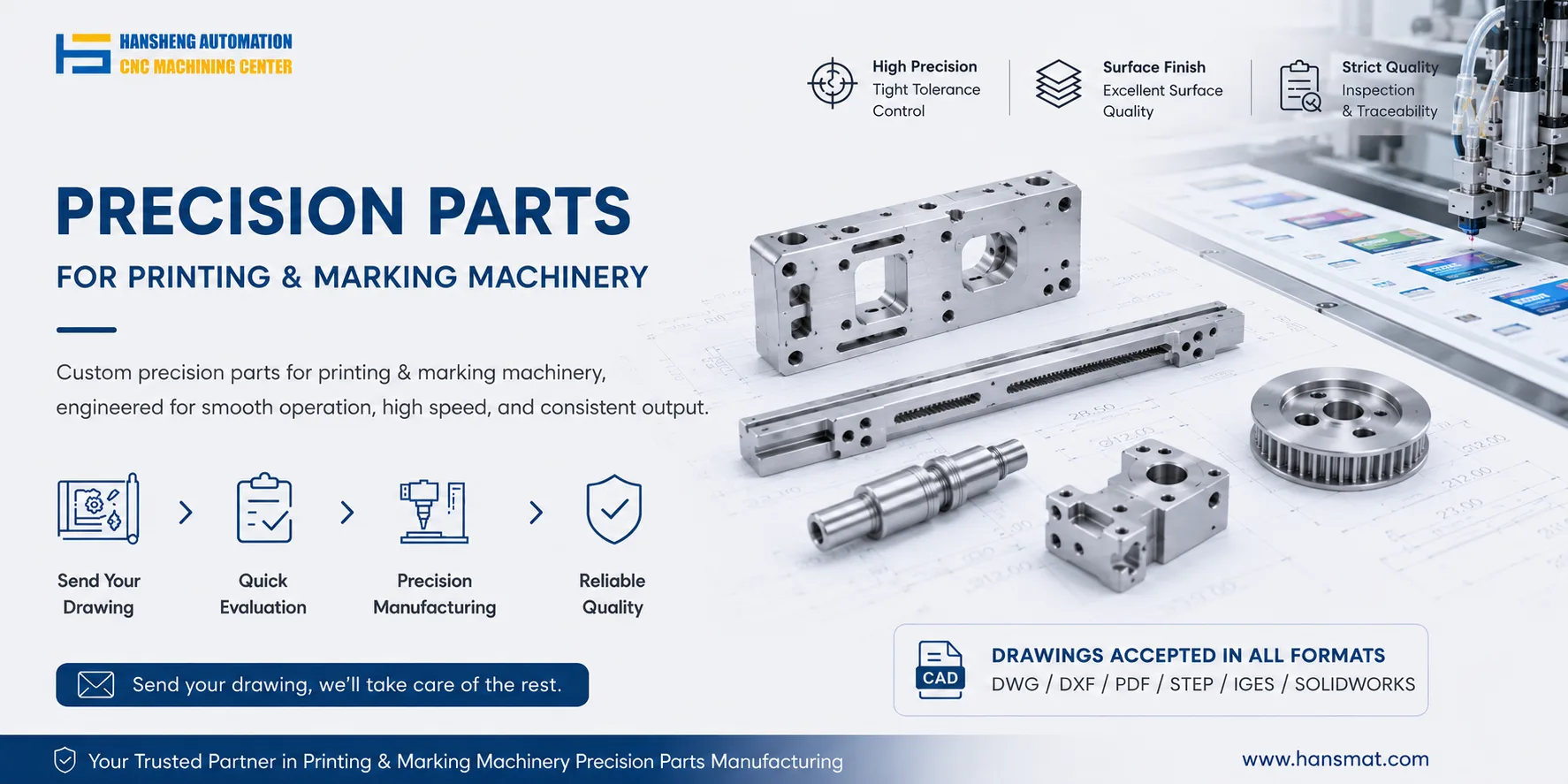
For replacement of worn mechanical parts such as gears, cams, shafts, or other precision components in printing machinery, Hansheng Automation provides custom machining based on customer drawings or samples, including single-piece and small-batch orders.