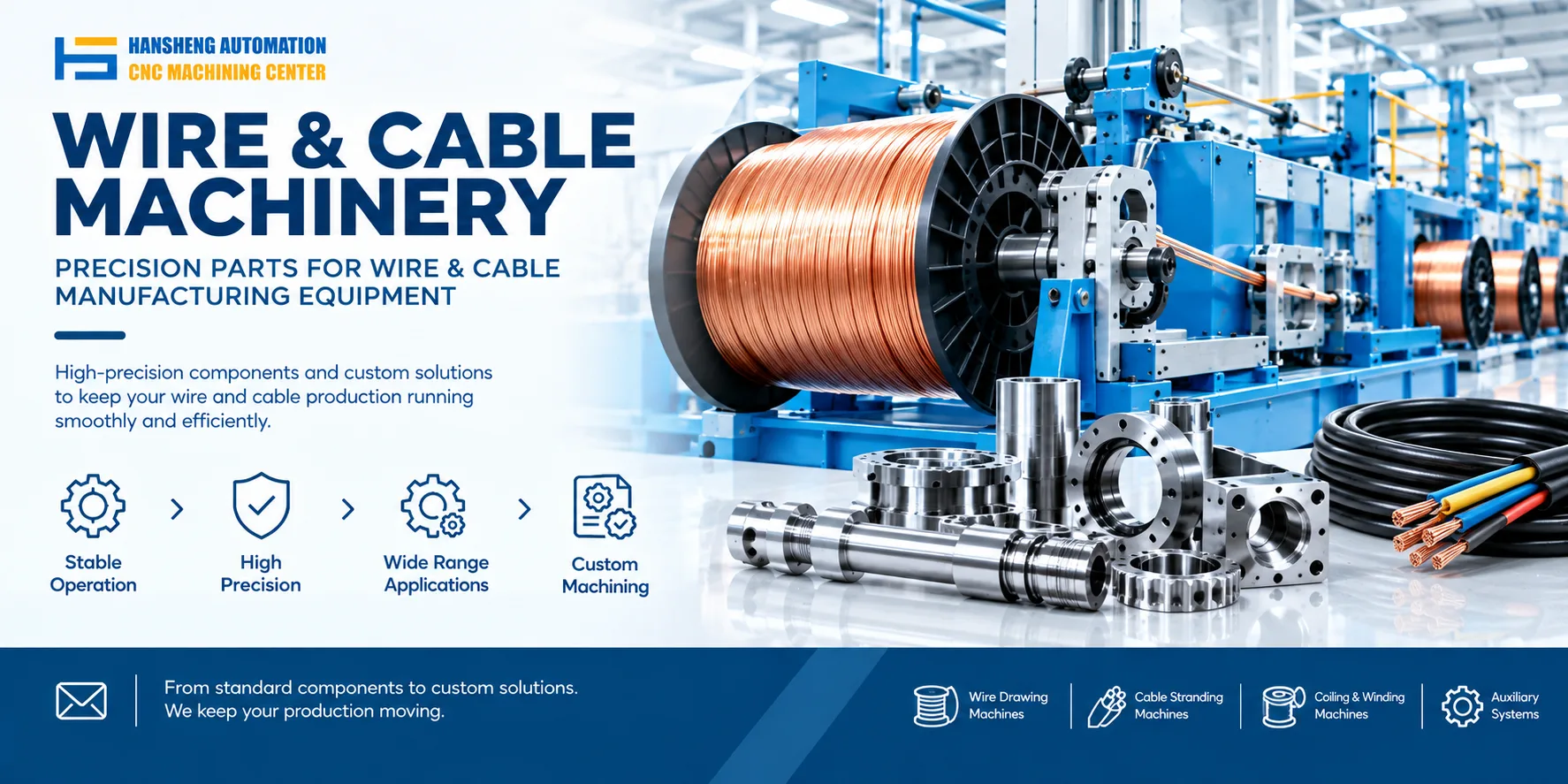
Cable wrapping is a process that wraps tape or wire material around a cable core or cable bundle in a spiral. Hansheng Automation provides build-to-print custom machining for wrapping machines. We make precision parts such as guide wheels, tension wheels, drive shafts, and mounting bases from customer drawings, in single pieces or small batches.
1. Material preparation
Choose suitable wrapping material, such as metal tape, plastic tape, or non-woven fabric. These materials need good insulation, mechanical strength, and weather resistance. Determine the width, thickness, and type of wrapping material according to cable use and specification.
2. Equipment setup
Before using a wrapping machine, set up the equipment to make sure the wrapping angle, tension, and speed meet process requirements. The wrapping angle is usually controlled between 30° and 40° to balance covering force and production speed. We can machine key transmission and guide parts for wrapping machines from customer drawings to help the equipment run steadily.
3. Wrapping operation
Place the prepared wrapping material on the feeding device of the wrapping machine and start the equipment. During wrapping, the material covers the cable core or cable bundle tightly in a spiral. Depending on the wrapping method, there are three forms: butt wrapping, overlap wrapping, and gap wrapping. Overlap wrapping is the most common. It uses the overlap between the tape and the previous spiral to form tight covering. The overlap rate is usually adjusted according to specific needs.
4. Quality control
Control quality strictly during wrapping. Make sure the wrapping is uniform and tight, with no wrinkles or damage. Also pay attention to adhesion between the wrapping material and the cable core or cable bundle to keep the wrapping layer stable and durable.
Role of wrapping
Wrapping increases the mechanical strength of the cable and improves compression and tensile resistance. The wrapping layer also provides insulation and protects the inner conductor from the outside environment. In special cases, such as fire-resistant cables, the wrapping layer can also provide flame retardant and fire-resistant properties, improving cable safety.
Cable wrapping is a key production process. It matters for improving cable performance and quality. In actual operation, choose suitable wrapping material and method according to cable use and specification, and strictly control process parameters and quality requirements.
Beyond wrapping machines, our precision custom machining capability is not limited to one industry. Hansheng Automation can machine non-standard metal parts for medical devices, food machinery, and printing equipment from customer drawings. We also machine yacht components, RC car components, and specialized parts for tobacco packaging and filling machinery. We focus on build-to-print custom machining and produce single pieces or small batches according to customer drawings. We do not sell complete machines.