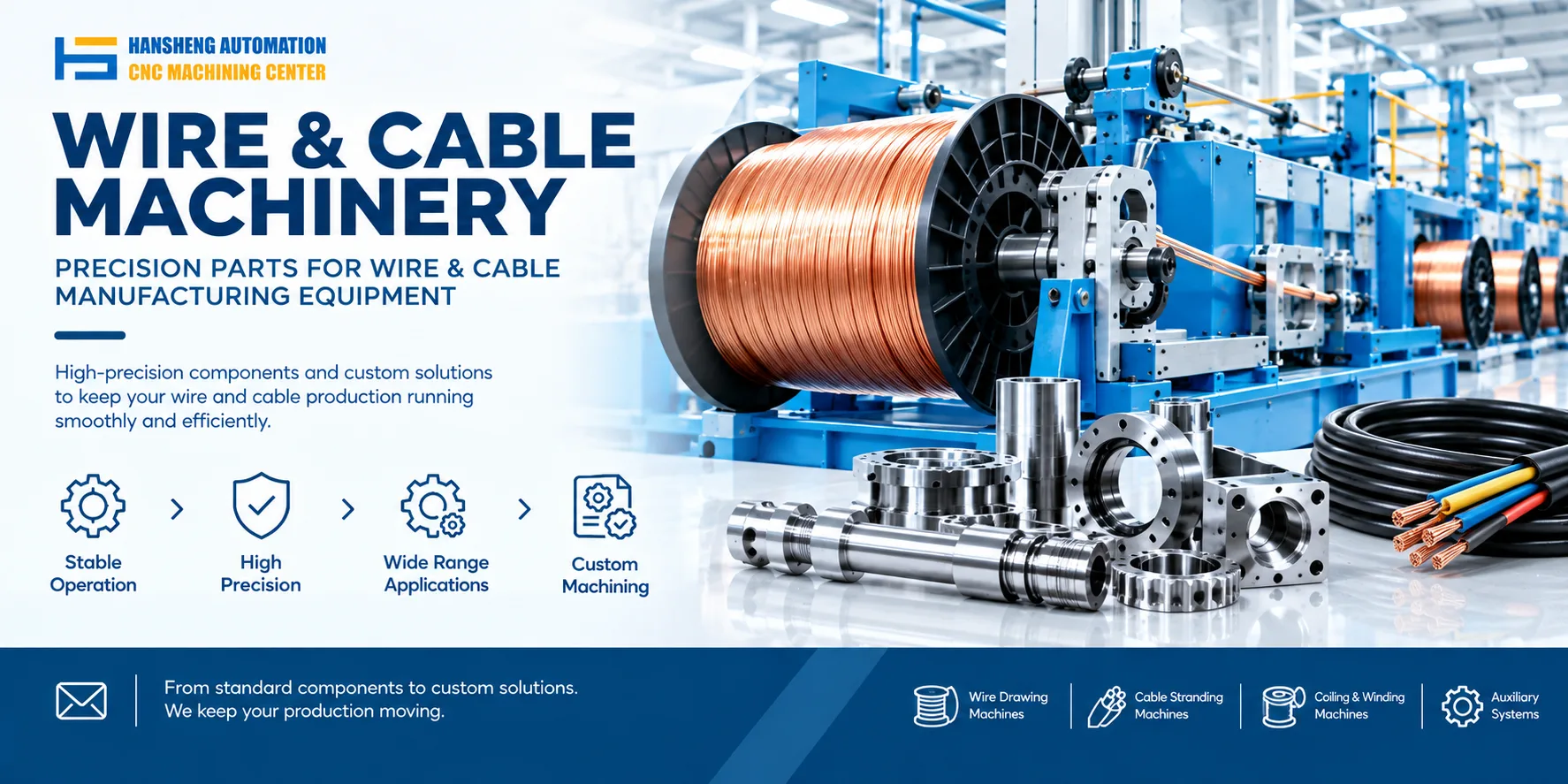
Spindle rotor stranding includes three stages: preparation, stranding, and follow-up processing. Hansheng Automation provides build-to-print custom machining for stranding equipment. We make precision parts such as spindles, rotors, guide wheels, main shafts, and traverse plates from customer drawings, in single pieces or small batches.
1. Preparation
Material preparation: Select metal wire that meets specifications, such as copper wire and aluminum wire. Inspect it strictly and remove defective material. Prepare auxiliary materials such as iron cores and magnetic powder.
Equipment check: Check strander parts including the frame, main shaft, motor, steel wheel, and control panel. Confirm that power and air connections are normal. Check safety valves, automatic power cut-off, and overheat safety devices. According to the stranding type, such as concentric layer stranding or compound stranding, adjust the number and size of pay-off reels. Determine the stranding direction and lay length.
Process parameter setup: Set lay length, wire diameter, current, speed, and tension according to product requirements.
Other preparation: Remove the outer packaging of semi-finished products and keep material labels. Pull and route the wire. Route it from inside to outside according to the engineering drawing, and pass it through the traverse plate.
2. Stranding operation
Install diagonal-wrapped aluminum foil: This applies only to shielded products. Take out the aluminum foil tube counterclockwise and align it with the center hole of the diagonal wrapping frame. Set the conductive surface direction and the rotating disc movement direction. Lock the foil to prevent movement.
Install empty take-up shaft: Transport the empty shaft with a cart. Insert the shaft rod and secure the bearing. Use a hoist to install the reel into the machine. Align the bearing groove and tighten the fixing screws.
Thread the lead wire to the take-up shaft: Use at least 10 m of lead wire. Fix one end to the traverse plate. Pass the other end through the guide wheel set and the rotor body. Wrap it around the driving wheel and driven wheel three times, then fix it to the take-up shaft and tie a knot.
Change lay length: Replace the driven gear and driving gear. Select the lay length gear and lay direction according to the manufacturing order.
Adjust traverse position: Adjust the traverse fixing screws according to the empty reel width to keep the traverse flat. If the wire builds up more on the inside, adjust clockwise. If it builds up more on the outside, adjust counterclockwise.
Install die: Select and install the die according to the manufacturing order.
Adjust take-up tension: Start the motor and slowly adjust speed. Feed wire by hand to prevent breakage. After 3 to 5 m of take-up, stop and check the traverse. Adjust tension until it is consistent.
First-piece production: After confirming that the wire position is correct, start the machine formally and begin stranding.
3. Follow-up processing
Quality check: Check strand tightness, appearance, diameter, and lay length against design requirements. The surface should be smooth, with no cracks or burrs.
Post-treatment: Carry out heat treatment or surface treatment to improve strand performance and appearance.
Testing and packaging: Inspect the rotor for appearance and performance. Pack it after it passes inspection.
Equipment maintenance: Shut down the machine, clean it, and carry out maintenance. Check part wear regularly.
Beyond stranding equipment, our precision custom machining capability is not limited to one industry. Hansheng Automation can machine non-standard metal parts for medical devices, printing machinery, and food machinery from customer drawings. We also machine yacht components, RC car components, and specialized parts for tobacco packaging and filling machinery. We focus on build-to-print custom machining and produce single pieces or small batches according to customer drawings. We do not sell complete machines.