A particle flow cooler addresses cooling bottlenecks in grain processing. It uses indirect heat conduction to cool material efficiently, evenly, and with low loss.
Traditional cooling problems
High cost: A traditional rice cooling warehouse needs a large floor area and long-term labor and maintenance. This puts pressure on capital and operating cost.
Low efficiency: Air cooling takes more than 12 hours. Natural cooling takes more than 48 hours. This lengthens the processing cycle and lowers production efficiency.
Poor results: In hot and humid conditions, grain in the warehouse cools slowly and unevenly. Local heating and mold can increase storage and processing losses.
Working principle
The unit uses indirect heat conduction for stepless cooling.
Chilled water loop: A chiller supplies chilled water that circulates inside the plate heat exchanger tubes.
Material path: Granular material flows from top to bottom through the plate heat exchanger and exchanges heat with the cold tube walls.
Technical advantage: The design does not use air cooling. Cooling is efficient and uniform. It is not affected by outside temperature or humidity.
Core advantages
No large infrastructure, flexible production fit
Tower design: It reduces floor space and requires no large construction. It can be installed in existing workshops.
Continuous production: It connects directly to a dryer or the next process stage. After drying, grain enters the cooler without transfer or waiting, then moves to the next step.
Integrated benefits: It reduces grain processing loss and manual handling, lowers production cost, and improves production stability and control.
High cooling efficiency, clear capacity gain
Time comparison: Traditional rice cooling warehouse cooling takes 12 to 48 hours. A particle flow cooler takes as little as 1 to 2 hours per batch. With 24-hour continuous operation, capacity rises by more than 50%.
Technical breakthrough: Indirect heat conduction improves heat transfer efficiency by more than 30%. Efficiency is not affected by outside temperature or humidity, so it stays high year round.
Quality protection: Fast cooling reduces grain residence time and lowers the risk of microbial growth and quality decline.
Good cooling result, precise temperature control, lower loss
Temperature control: Water-cooled jacketed cooling controls the chilled water outlet temperature. At normal pressure, it achieves precise control from 7°C to 15°C.
Quality improvement: Stepless circulating pre-cooling provides fast, stable cooling without affecting material quality. Broken rice rate drops by more than 3%. This gives heat-sensitive materials a low-cost, efficient, high-quality cooling option.
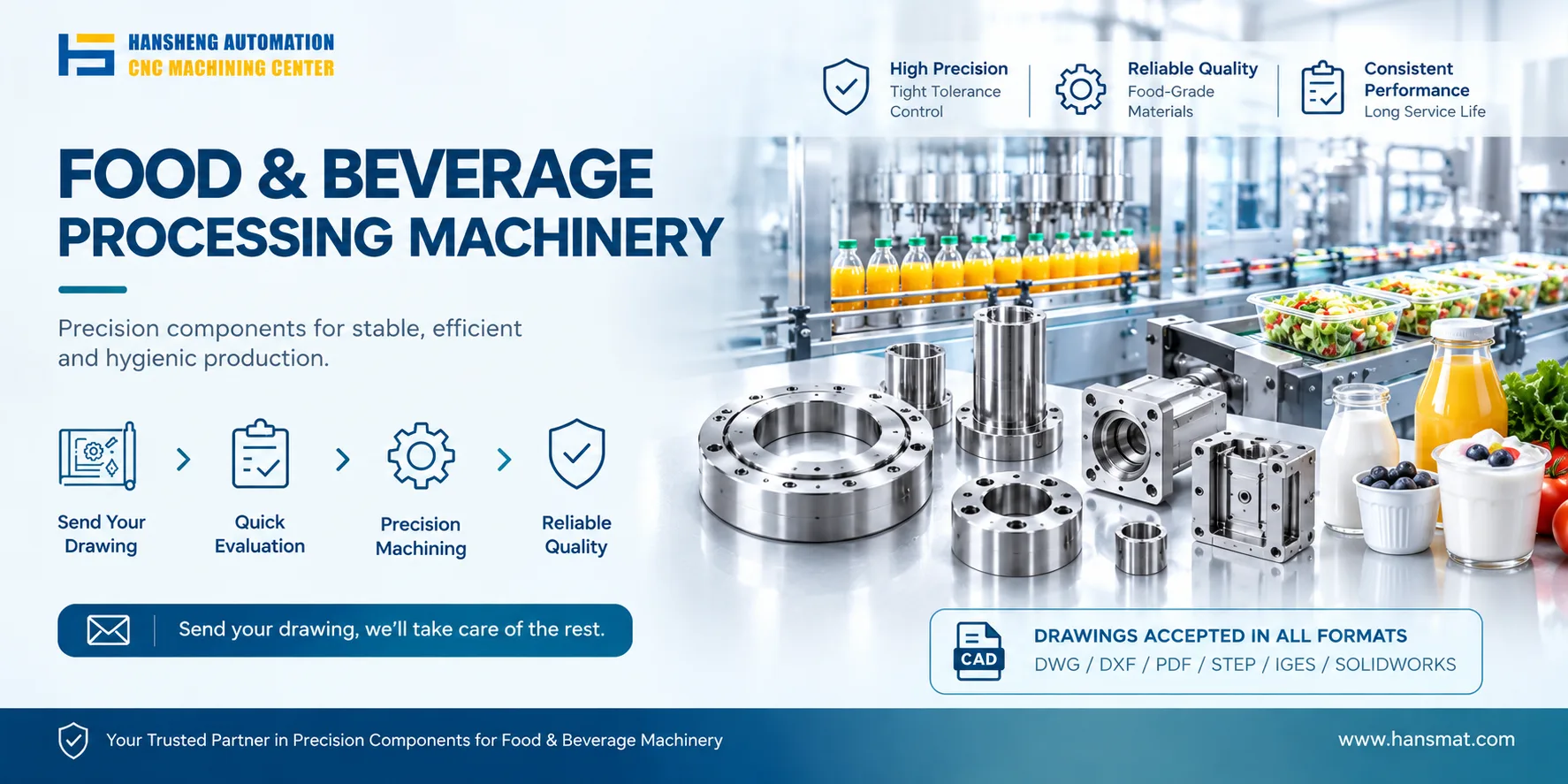
For equipment builders, Hansheng Automation can machine custom heat exchanger plates, tube sheets, and food-contact structural parts from customer drawings, in single pieces or small batches.
Application value
With advanced technology, strong performance, and clear economic benefits, the particle flow cooler helps grain processing companies optimize production, improve product quality, and strengthen market competitiveness. Its continuous production mode helps companies meet market challenges and supports the industry move toward high efficiency, low consumption, and high quality.
Beyond the equipment discussed here, our precision component customization serves more than one industry. We machine yacht precision components, RC car precision components, tobacco packaging machinery parts, and filling machinery parts. Hansheng Automation also produces printing machinery, food machinery, and medical device components from customer drawings. We deliver one-off or batch parts to the required material, tolerance, and surface finish. Our scope is precision components, not complete machines.