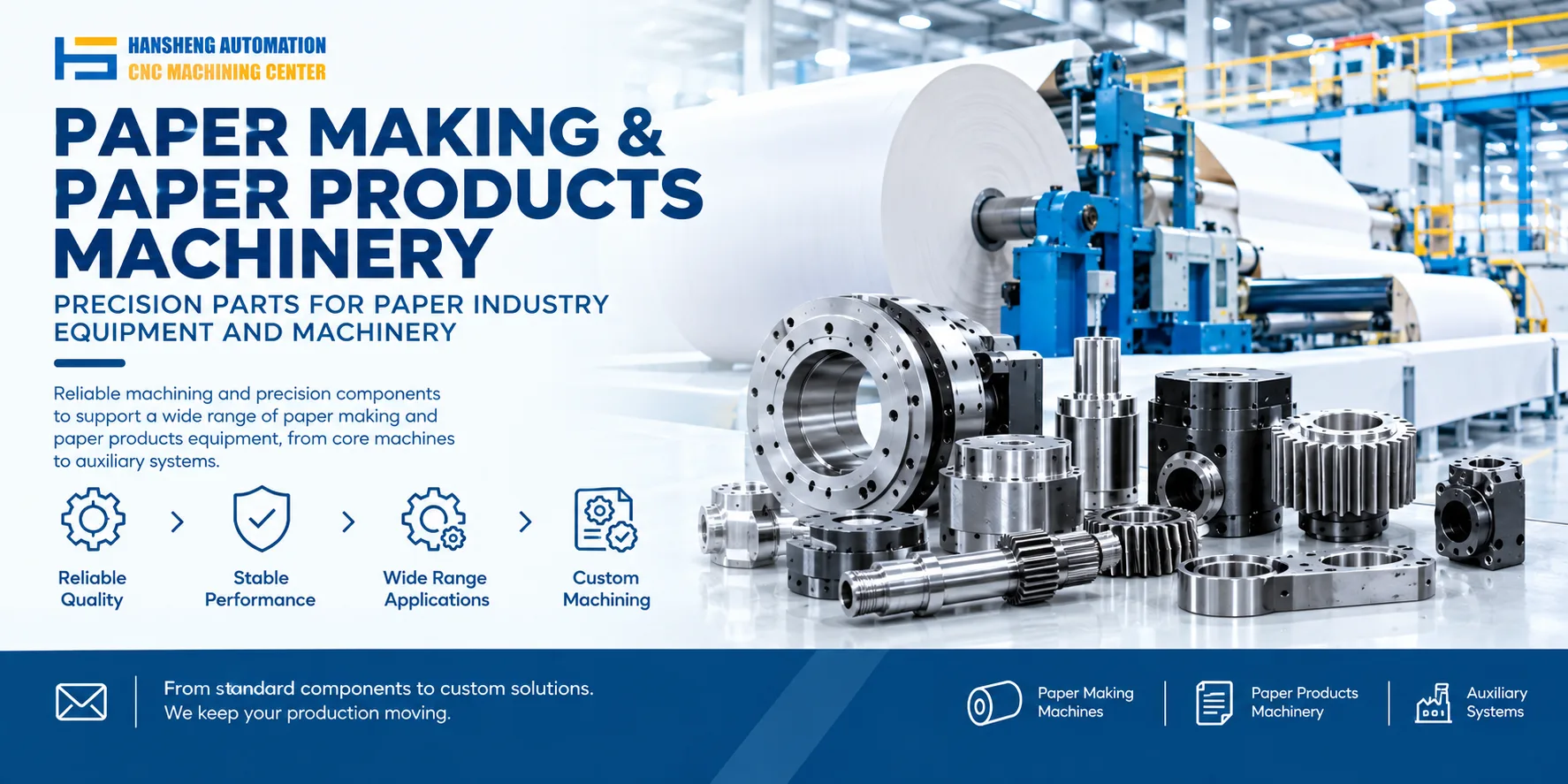
A kilometer-scale paper machine, usually a fourdrinier machine, runs through four main stages: raw material preparation, pulping, papermaking, and finishing. Each stage connects closely and supports continuous production from raw material to finished paper.
Raw material preparation
This is the early preparation stage. It focuses on pretreating the raw material.
Raw material selection: Choose wood such as softwood and hardwood, waste paper, or non-wood fibers such as reed and bamboo based on paper grade.
Raw material handling: Wood goes through debarking and chipping into chips about 2 to 25 mm. Waste paper needs impurity removal, including plastic and metal, and repulping. Non-wood fibers need impurity removal and softening.
Preprocessing: Wood chips may go through chemical pretreatment such as cooking to begin fiber separation. Waste paper needs deinking and screening to remove ink and fine impurities.
Pulping
Pulping turns pretreated raw material into stock suitable for papermaking. This is the key stage for fiber separation and purification.
Chemical pulping for wood pulp: Cooking methods such as kraft or sulfite separate wood chip fibers and produce coarse pulp.
Mechanical pulping for newsprint and similar grades: Mechanical force, such as a grinder, breaks wood into fibers and keeps more lignin.
Waste paper pulping: Repulping, screening, deinking, and bleaching if needed produce recycled pulp.
Stock purification: Coarse pulp goes through screening to remove coarse fibers and impurities, washing to remove cooking liquor or ink, and bleaching to adjust brightness. The result is clean pulp that meets requirements.
Papermaking
This is the core production stage. It forms and dewaters stock on the fourdrinier wire.
Stock delivery: Clean pulp mixes with fillers such as calcium carbonate and additives such as sizing agents and strength agents. After dilution, the stock reaches about 0.5% to 1% consistency.
Wire forming: The stock is jetted evenly from the headbox onto the fourdrinier wire. Under vacuum dewatering, fibers interweave into a wet sheet with about 70% to 80% moisture.
Press dewatering: The wet sheet passes through multiple press groups, such as vacuum presses and grooved presses. Moisture drops to 40% to 50%. For paper machine builders, Hansheng Automation can machine custom forming boards, suction box parts, press rolls, dryer cylinder components, and guide rolls from customer drawings, in single pieces or small batches.
Drying: The wet sheet enters the dryer section, made up of multiple dryer cylinders. Steam heating dries the sheet to 8% to 10% moisture and forms a dry sheet.
Surface treatment: Some papers need sizing for water resistance, coating such as art paper, or calendering for smoothness.
Finishing
This stage handles the dry sheet and produces finished paper.
Reeling: The dry sheet is wound by a reel into large rolls. Roll diameter can reach several meters.
Slitting: Large rolls are cut into small rolls or sheet paper in different specifications based on customer needs.
Quality inspection and packing: Test brightness, strength, smoothness, and other indicators. Qualified products are packed and shipped.
Beyond the paper machine parts discussed above, our precision component customization covers more than one industry. We machine yacht precision components, RC car precision components, tobacco packaging machinery parts, filling machinery parts, printing machinery parts, food machinery parts, and medical device components. Hansheng Automation works from customer drawings and delivers one-off or batch parts to the required material, tolerance, and surface finish. Our scope is precision components, not complete machines.