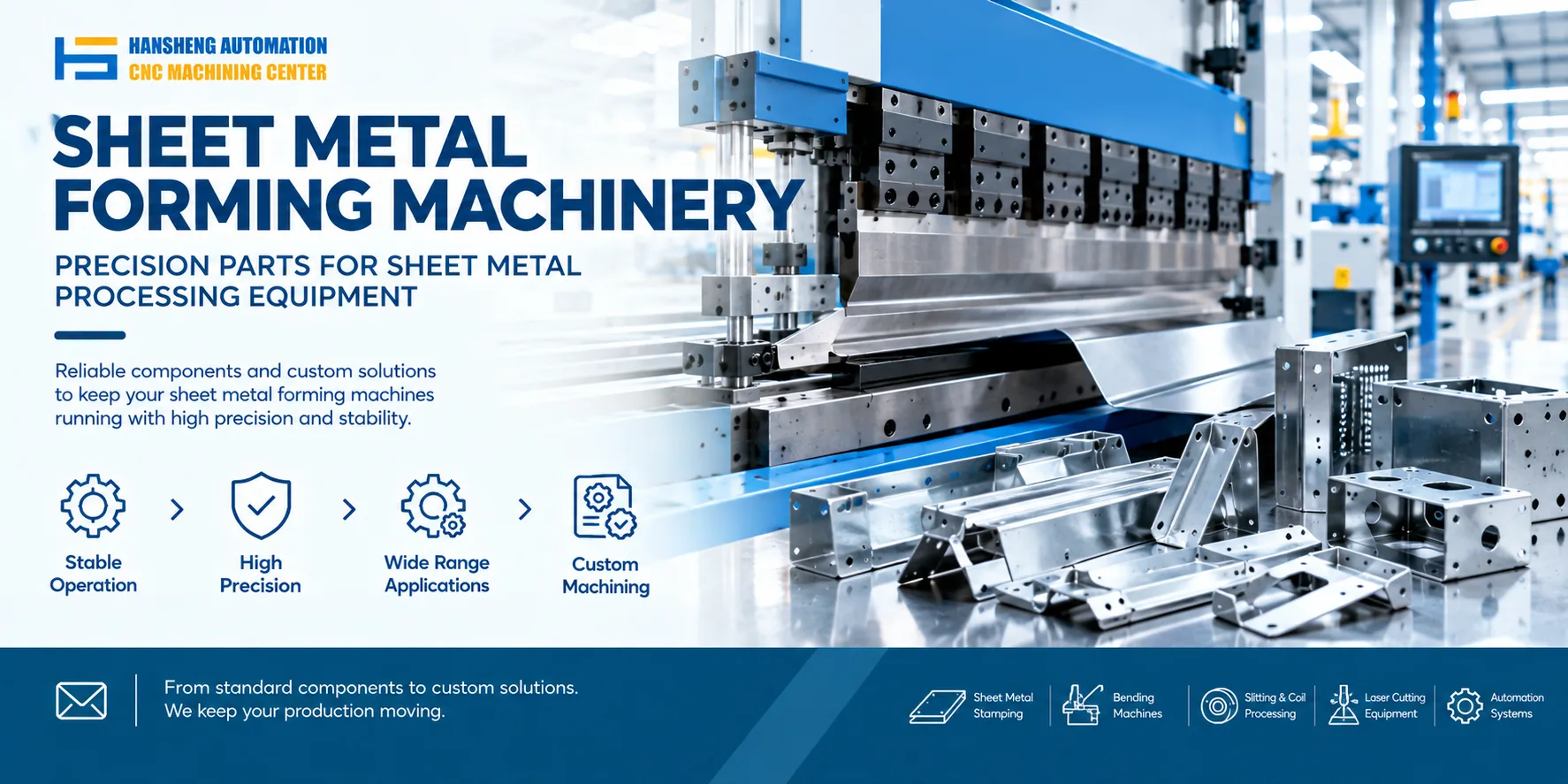
CNC press brakes form sheet metal by applying controlled force through a punch and die. Hydraulic systems commonly drive the ram, while the CNC controller manages stroke position, bending parameters, and backgauge settings. Operating procedures include starting the machine, setting the stroke, selecting the lower die opening, adjusting the backgauge, and using the foot switch.
The exact operating principle and control procedure depend on the machine design. Electromagnetic clamping systems and plastic sheet bending machines use different mechanisms and should be considered separately from conventional hydraulic press brakes.
Working principles of bending machines
Electromagnetic clamping
Some bending machines use electromagnetic clamping to hold sheet material. The clamping assembly consists of a support structure, a worktable, and a clamping plate. When current passes through the coil, it generates a magnetic force that attracts the clamping plate toward the base, securing the material in position.
The clamping plate can accommodate different workpiece shapes, including parts with side walls. This arrangement also simplifies the clamping operation.
Electromagnetic clamping is a clamping method rather than the hydraulic drive principle used by conventional hydraulic CNC press brakes.
Hydraulic transmission
In a hydraulic CNC press brake, the hydraulic pump supplies power to the system, allowing the ram and upper punch to move downward and form the sheet metal.
The hydraulic system controls pressure and movement speed. It is used to process metal sheets, including Q235 steel plate. The CNC controller coordinates the movement and positioning settings according to the programmed bending requirements.
Plastic sheet bending
Plastic sheet bending machines use heat to soften thermoplastic materials so that they can be formed at the required angle. Depending on the process and equipment design, the material can form a continuous corner without separate joining, grooving, or filler rod.
This process can produce an even, visually clean bend and improve production efficiency. The resulting corner quality depends on the material and the heating and forming conditions.
Plastic sheet bending uses a different forming process from metal sheet bending on a conventional CNC press brake.
How to operate a hydraulic CNC press brake
The following procedures describe general setup and operation. Actual controls and operating sequences vary by machine model, so the manufacturer's operating manual must take precedence.
Start the machine and hydraulic pump
Switch on the control panel and start the hydraulic pump. Check that the pump runs normally and that there are no unusual sounds or visible signs of malfunction. At this stage, the machine should remain stationary unless the operating sequence for the specific model requires otherwise.
Adjust the ram stroke
The stroke must be set correctly to prevent the upper tool from moving too far and damaging the tooling or machine.
The original setup guidance specifies maintaining a gap equal to one material thickness at the lowest position. This should not be treated as a universal setting. The actual stroke position must be determined according to the machine, tooling, material thickness, and required bend angle.
Where the machine supports electric adjustment, the stroke can be adjusted more quickly through the control system.
Select the lower die V-opening
A common starting guideline for air bending mild steel is to select a lower die V-opening approximately eight times the material thickness.
For example, a 1 mm sheet would initially correspond to an 8 mm V-opening.
This ratio is a starting point, not a fixed requirement for every material or bending process. The final selection must account for material properties, the required bend radius, flange dimensions, tooling capacity, and machine tonnage.
Adjust the backgauge
The backgauge positions the sheet metal before bending and helps control the flange dimensions.
Depending on the machine configuration, the backgauge may support rapid electric adjustment and manual fine adjustment. Check the positioning accuracy before starting production to reduce dimensional errors and inconsistent bends.
Operate the foot switch
The foot switch initiates the bending operation and allows the operator to control the cycle while handling the workpiece.
The response to pressing or releasing the pedal depends on the machine's control system. Some configurations allow motion to stop when the pedal is released and resume when it is pressed again. Operators must verify the actual pedal logic in the manufacturer's manual before use.
Keep hands clear of the punch and die hazard zone and follow the machine's guarding and safety procedures throughout the operation.
Differences between metal and plastic bending machines
Metal sheet bending machines
Metal bending machines use tooling and controlled force to form sheet metal. The supplied material describes two structural configurations:
F-type design: This traditional arrangement uses an internal adjustable mechanical stop for positioning. The source describes it as having limited resistance to off-center loading and more complex maintenance requirements.
G-type design: This arrangement uses an external sliding-plate mechanical positioning system. The source describes adjustment as simpler and notes that shims can be used to correct angle deviations. Any adjustment should follow the machine manufacturer's procedure.
Metal sheet bending machines can process materials such as Q235 steel. The required machine capacity, tooling, and setup depend on the material dimensions and forming requirements.
Plastic sheet bending machines
Plastic sheet bending machines heat thermoplastic sheet material and form it along the intended bend line.
The process can produce a continuous corner without separate joining or grooving. Depending on the material and application, this can improve the appearance of the finished part, prevent leakage at the corner, reduce manual work, and shorten production time.
These benefits depend on proper control of heating and forming conditions.
How press brakes differ from shearing machines
A press brake and a shearing machine perform different operations.
A CNC press brake uses a punch and die to change the shape of sheet metal. The bending cycle can be interrupted or resumed only as permitted by the machine's control system and safety functions.
A shearing machine cuts sheet metal rather than forming bends.
The supplied comparison also distinguishes between swing-beam and guillotine shears. It describes the curved blade movement of a swing-beam shear as a limitation that can affect blade clearance and cutting quality, while guillotine shears use a different blade movement to address some of these limitations. The claim that fewer domestic manufacturers produce guillotine shears is market-specific and should be verified before publication.
Operating precautions
Before bending, confirm that the stroke settings and tooling arrangement are appropriate for the workpiece. Incorrect settings can cause tool collisions or machine damage.
Select the lower die V-opening according to the material thickness and forming requirements. A suitable opening helps control the bend radius and required force.
Check the backgauge position before processing to reduce dimensional errors. For production runs, verify the first part before continuing with the remaining workpieces.
Operators must understand the foot switch logic and the machine's safety functions before starting production. Never rely on the foot switch alone to protect against access to the punch and die hazard zone.
Custom precision machining for industrial equipment
Hansheng Automation provides custom precision machining based on customer drawings for industrial equipment and other applications. Our work also includes components for yacht equipment and RC racing cars, along with nonstandard parts for tobacco packaging, filling, and food processing machinery. Each part is manufactured according to the supplied drawing and its specific requirements.