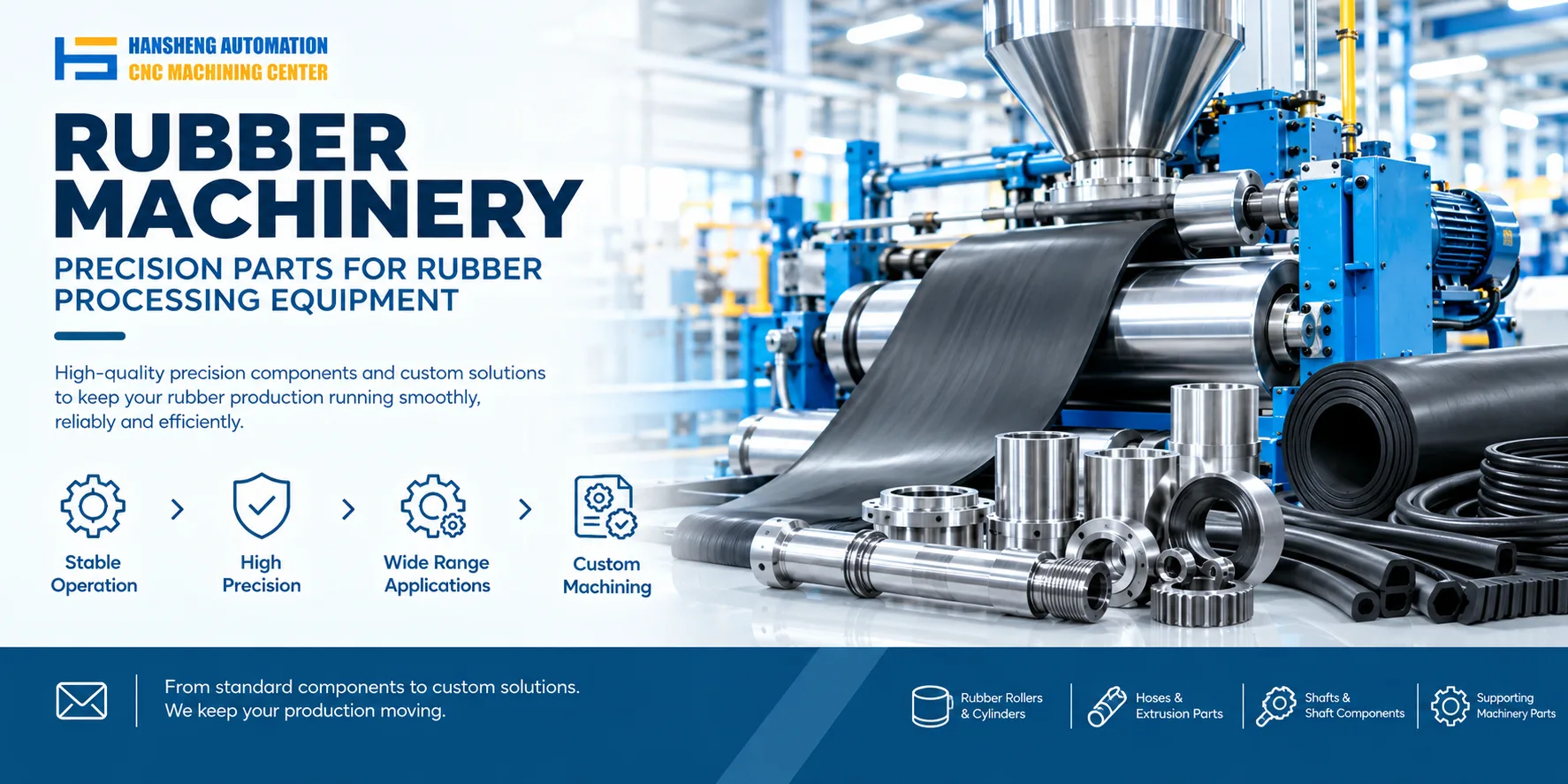
Rubber manufacturing generally involves five main stages: raw rubber mastication, compounding, semi-finished product preparation, forming, and vulcanization. Each stage prepares the material for the next operation and affects the quality and performance of the finished product.
1. Raw rubber mastication
Purpose
Natural rubber and synthetic rubber can have high elasticity and limited processability in their raw state. Mastication reduces the viscosity of raw rubber and improves its plasticity, making it easier to mix with additives and process into the required shape.
The process uses mechanical shear, heat, or chemical peptizers to reduce the molecular weight of the rubber through controlled chain breakdown.
Common equipment
Internal mixers are widely used for efficient, enclosed mastication in industrial production. Open mixing mills are also suitable for laboratory trials and small batch processing.
2. Rubber compounding
Purpose
Compounding combines masticated rubber with ingredients such as reinforcing agents, vulcanizing agents, accelerators, antioxidants, and plasticizers. The aim is to distribute these ingredients uniformly throughout the rubber and obtain a compound with the required processing and performance characteristics.
Common equipment and process control
Batch internal mixers are widely used in industrial rubber compounding, while continuous twin screw mixers are suitable for large scale production.
During mixing, operators must control temperature, shear intensity, and mixing time. Excessive heat or an unsuitable mixing sequence can cause premature vulcanization, also known as scorching, before the compound reaches the forming stage.
3. Semi-finished product preparation
This stage converts the mixed rubber into sheets, coated reinforcement materials, or profiles that can be assembled into the final product. Calendering and extrusion are two common processes.
3.1 Calendering
A calender uses rotating rolls to press rubber into sheets of a specified thickness and width. It can also apply rubber to textile fabric or steel cord to prepare reinforcement layers for products such as tires and conveyor belts.
Roll temperature, speed, and gap must be controlled to maintain dimensional accuracy and consistent coating.
3.2 Extrusion
A rubber extruder uses a screw to convey and plasticize the compound before forcing it through a die to produce a specified cross section.
Typical extruded products include tire treads, sealing strips, and rubber hoses. Extrusion temperature, screw speed, and die dimensions must be matched to the compound and product design to maintain a consistent profile.
4. Forming and assembly
Purpose
Forming combines semi-finished materials from calendering and extrusion with other rubber components to create a complete uncured product, often called a green product or green tire.
For example, tire building involves assembling the tread, carcass, beads, and other components according to the tire design.
Common equipment and process control
Tire building drums and other forming machines position and assemble the individual components.
Accurate alignment and adequate adhesion between layers are important. Misalignment or poor bonding can lead to defects such as delamination, uneven construction, and dimensional inconsistencies.
5. Vulcanization
Purpose
Vulcanization is a central stage in rubber manufacturing. Heat and, where required, pressure promote crosslinking between rubber polymer chains, converting the compound into a three dimensional network.
This process gives the finished product its required mechanical properties, dimensional stability, chemical resistance, and service performance.
Common equipment and process control
Common equipment includes platen vulcanizing presses, vulcanizing autoclaves, and continuous vulcanization lines.
Vulcanization temperature, curing time, and pressure must be set according to the rubber formulation and product design. Incorrect curing conditions can result in undercured or overcured rubber and affect the performance of the finished product.
6. Custom machining for rubber processing equipment
Rubber manufacturing equipment relies on precision mechanical components that must meet specific dimensional and assembly requirements. Hansheng Automation can assess custom machining based on customer drawings, material specifications, and dimensional tolerances.
Our precision machining services also cover non-standard metal components for packaging machinery, tobacco machinery, and filling equipment. We can assess parts for yacht equipment and RC racing cars according to the supplied drawings and manufacturing requirements.