Four-axis robots have four motion axes and feature a compact, lightweight structure. Six-axis robots have six motion axes, offering a more complex design and broader motion capability.
In terms of flexibility and stability, four-axis robots perform well in stability and are especially suitable for space-constrained environments such as stamping operations. Their simplicity makes them ideal for straightforward pick-and-place tasks. Six-axis robots add two extra motion axes, expanding their range of motion and mimicking the flexibility of a human arm and wrist. They can easily grasp and place objects in different orientations and perform finer operations.
In terms of application, four-axis robots are better suited for scenarios with simple installation and commissioning, moderate flexibility requirements, and limited space. Six-axis robots are more effective in complex production line tasks and situations requiring precise control, covering a wider range of industrial automation needs.
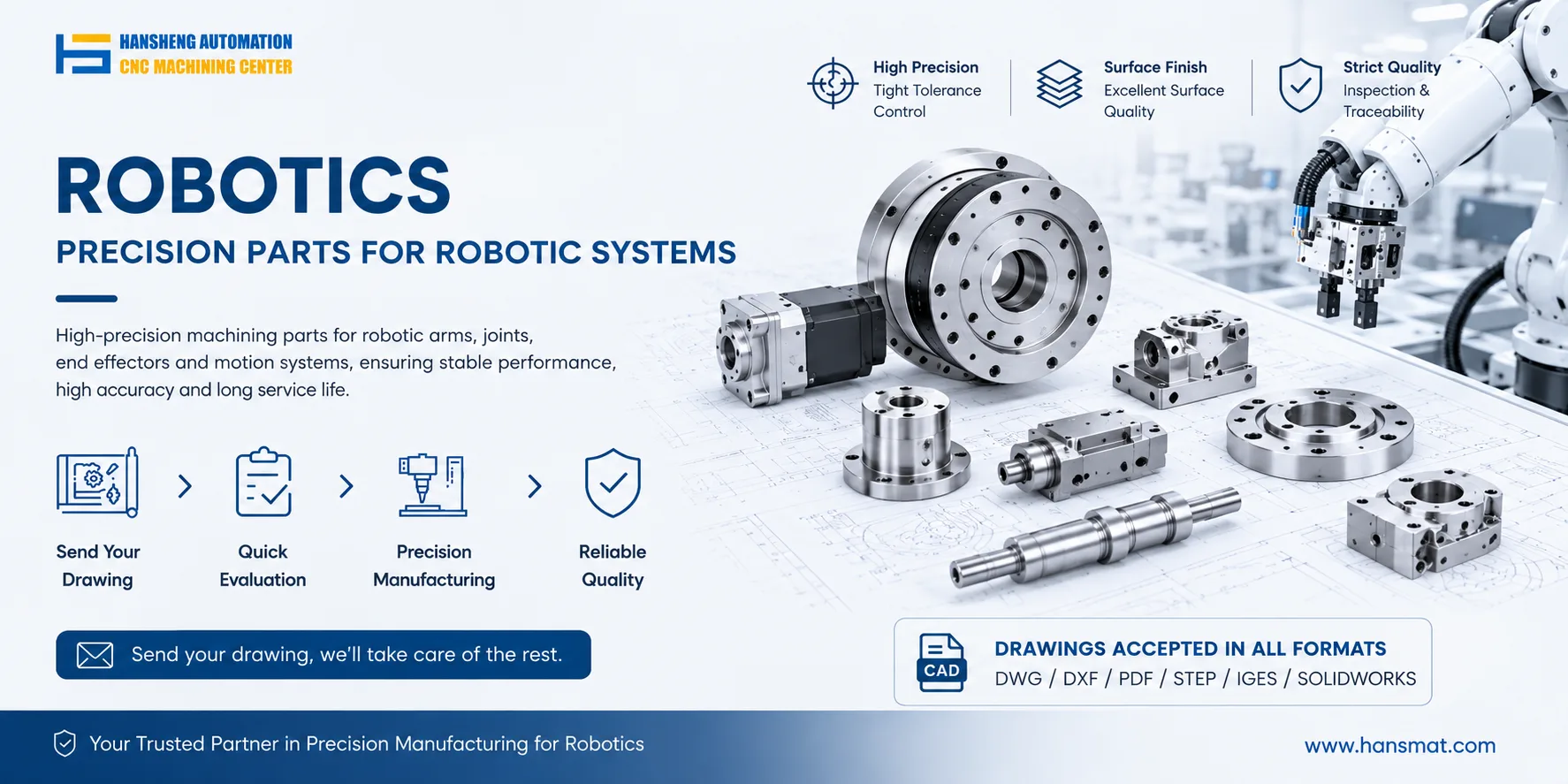
For structural components, reducer housings, or end-of-arm tooling used in either four-axis or six-axis robot systems, Hansheng Automation provides precision machining based on customer drawings, supporting tight tolerances and suitable material selection.
In summary, four-axis and six-axis robots differ significantly in design, flexibility, and application scenarios. Each type offers distinct advantages depending on the specific automation requirements.