Six-axis articulated robots offer several advantages in industrial automation:
- They require relatively low driving force and consume less energy during operation.
- Their compact structure provides a wide working range while occupying a small floor area.
- They can replace human labor in complex, hazardous, or physically demanding tasks.
- They have high reachability. An articulated robot can position its hand inside enclosed spaces such as a car body, which is difficult for a cartesian robot to achieve.
- Because they have no sliding joints, guide rails are not required. Rotary joints are easier to seal, and since bearing components are mass-produced standard parts, friction is low, inertia is small, and reliability is high.
However, six-axis articulated robots also have certain limitations:
- The initial investment cost is relatively high.
- When the robot hand operates near the boundary of the working range, kinematic degeneracy may occur.
- The elbow and shoulder joint axes are parallel. When the large arm and small arm extend into a straight line, the robot can reach distant points, but structural stiffness becomes relatively low at that posture.
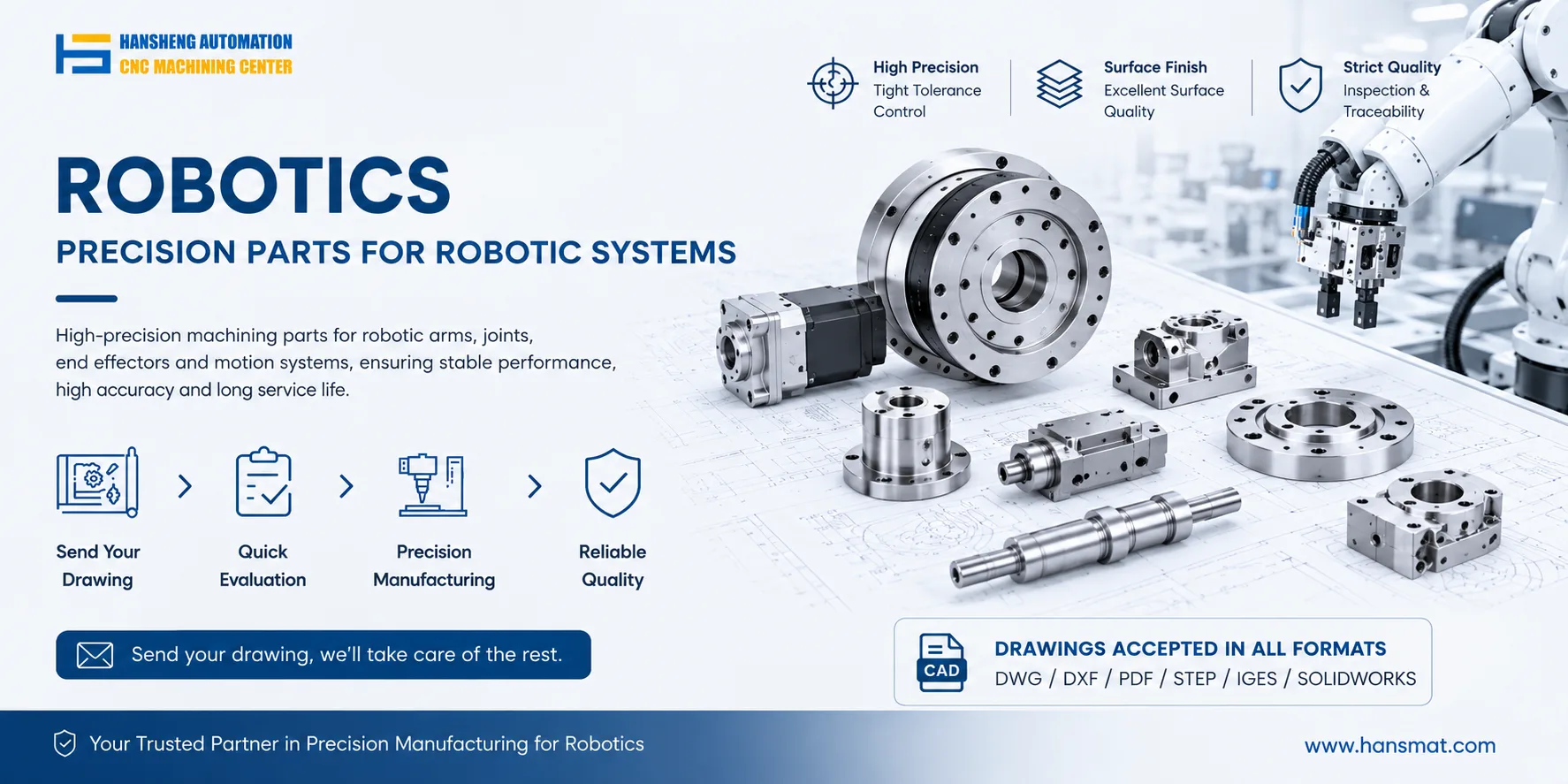
For applications where custom structural components, joint housings, or mounting brackets are needed to improve stiffness or adapt the robot to a specific workspace, Hansheng Automation provides precision machining based on customer drawings.