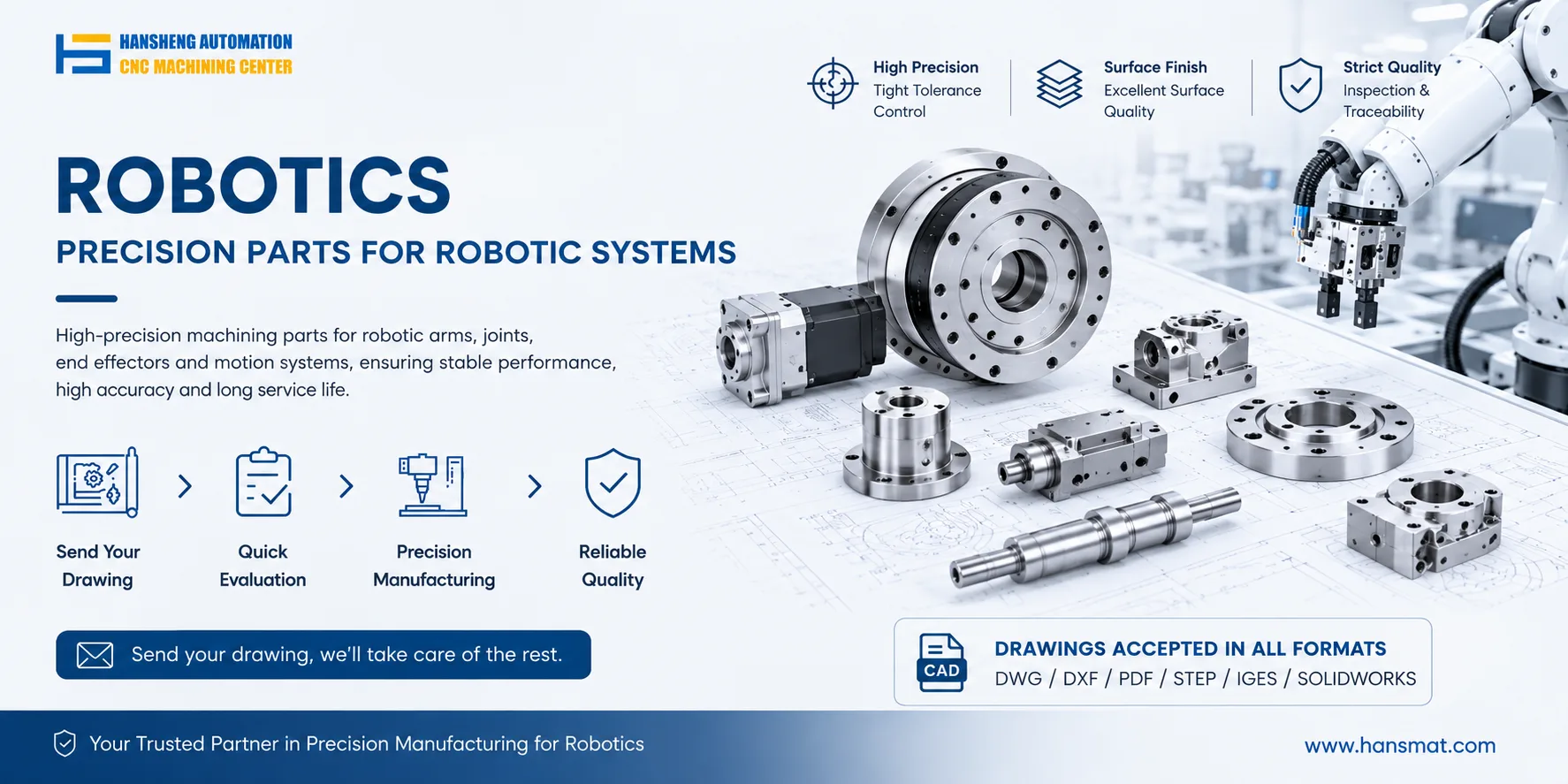
Traditional six-axis robots are widely used in industrial automation. Their design consists of a mechanical body, reducers, and a drive control system. The body structure includes a rotating base, a large arm, and a small arm, typically made from materials such as cast iron, cast steel, cast aluminum, and structural steel. For custom structural components or replacement parts made from these materials, Hansheng Automation provides precision machining based on customer drawings, with tolerances and surface treatments tailored to specific robot requirements.
Reducers are used to carry joint loads. The high-speed, low-torque output of servo motors is converted into low-speed, high-torque motion, increasing the output torque of each axis and allowing the robot to handle heavier payloads. Two main types are used in articulated robots: RV reducers and harmonic reducers. RV reducers offer higher rigidity and rotational accuracy, so they are generally installed in heavy-load positions such as the base or shoulder. Harmonic reducers are commonly used in the forearm and wrist.
The drive control system includes servo motors, servo drivers, and a controller. Servo motors drive the robot joints and must provide a high power-to-weight ratio, high starting torque, low inertia, and a wide speed range. Servo drivers receive commands from the controller and supply the appropriate current to the motors, ensuring that each joint moves with the required speed, acceleration, and position. The controller manages position, velocity, and torque control through internal parameter settings.
A traditional six-axis robot has six degrees of freedom, commonly referred to as the S axis, L axis, U axis, R axis, B axis, and T axis.
- Axis 1 connects the base and supports the entire robot while enabling left-right rotation of the base.
- Axis 2 controls forward and backward swing of the large arm.
- Axis 3 controls forward and backward swing of the small arm.
- Axis 4 controls rotation of the small arm.
- Axis 5 controls rotation of the wrist and is often used for flipping a grasped product.
- Axis 6 controls the rotation of the end effector, allowing more precise positioning of the workpiece.
The main advantages of traditional six-axis robots include a compact structure with a small installation footprint, good flexibility with a large reachable workspace, good obstacle avoidance capability, and sealed revolute joints with low friction and low inertia. Because there are no sliding joints, sealing performance is improved and energy consumption is relatively low.
However, traditional six-axis robots also have limitations. During motion, balance problems and control coupling can occur because the movement of each axis affects the others, requiring complex control algorithms. When the large arm and small arm are fully extended, the structural stiffness decreases, making the robot more susceptible to external forces and reducing accuracy. In addition, singular points exist in the motion space, and control algorithms must be designed to avoid them.