The ZB416 is a hard-pack cigarette carton packaging unit. Its complete workflow starts with feeding small cigarette packs from the upstream packet machine, followed by material arrangement, carton forming, film wrapping, and label application. The final output is a standard 20-pack cigarette carton that meets tobacco industry requirements.
I. Material Feeding Process
(A) Small Cigarette Pack Feeding
Finished small cigarette packs are transferred from an upstream packet machine such as the ZB25 into the ZB416 storage hopper by a belt conveyor. The hopper is equipped with photoelectric sensors to detect the material level. When the level falls below the set value, the machine automatically stops and triggers an alarm.
The packs are arranged by a dividing wheel into a regular stack of 5 columns × 4 rows, corresponding to the standard quantity of 20 packs per carton. A hydraulic push plate then transfers the entire stack to the positioning tray at the carton forming station.
(B) Carton Packaging Material Feeding
Carton board roll material is unwound by a feeding mechanism, coated evenly with water-based adhesive on the bottom and side surfaces by a glue roller, and then cut precisely into single blanks according to the expanded carton dimensions by a servo cutting system.
The dedicated transparent film roll for cartons is conveyed by film guide rollers, cut into single sheets matching the carton dimensions, and simultaneously cleaned of static dust.
II. Carton Forming and Wrapping Process
(A) Carton Shell Forming
The positioning tray moves the cigarette pack stack to the center of the carton blank. Six folding cylinders then complete the folding of the four side panels and the bottom panel, followed by bottom adhesion according to the glue position.
The forming die presses the folded blank into an open-top rectangular carton shell, fully wrapping the pack stack inside. The side panels are bonded for initial fixation.
(B) Transparent Film Heat-Sealing and Wrapping
The formed carton shell is pushed to the film wrapping station. A single sheet of transparent film is placed at the bottom of the carton, and high-temperature heat-sealing rollers complete the bottom and side sealing.
A folding manipulator folds the film over the top and side surfaces of the carton, and constant-temperature heat-press rollers complete full-surface sealing. A cutting mechanism removes excess film edges to prevent residue from affecting subsequent processes.
III. Label Application and Finished Product Output
(A) Label Application and Curing
The label paper is fed to the designated position on the top of the carton by a label feeding wheel, and hot-press glue rollers complete label adhesion. Higher-configuration models can be equipped with an anti-counterfeiting hot stamping device to apply a stamped mark on the label.
The labeled cartons are conveyed through a cooling roller conveyor. Room-temperature air cooling or water cooling is used to quickly cure the adhesive layer and prevent label displacement.
(B) Finished Product Inspection and Output
The station is equipped with sensors for missing pack detection, glue leakage detection, and heat-sealing abnormality detection. Non-conforming cartons are automatically pushed to a waste collection bin.
Qualified cartons are sent by belt conveyor to the finished product transfer area or downstream palletizing equipment. The machine has a built-in counting system for real-time statistics of output per shift and per day.
The heat-sealing station operates at 120°C to 150°C, and the electrical cabinet carries high-voltage risks of 220V/380V. Non-professional maintenance personnel must not open the equipment protective doors without authorization. Daily material replacement and waste cleaning must be performed only after the machine is stopped and powered off.
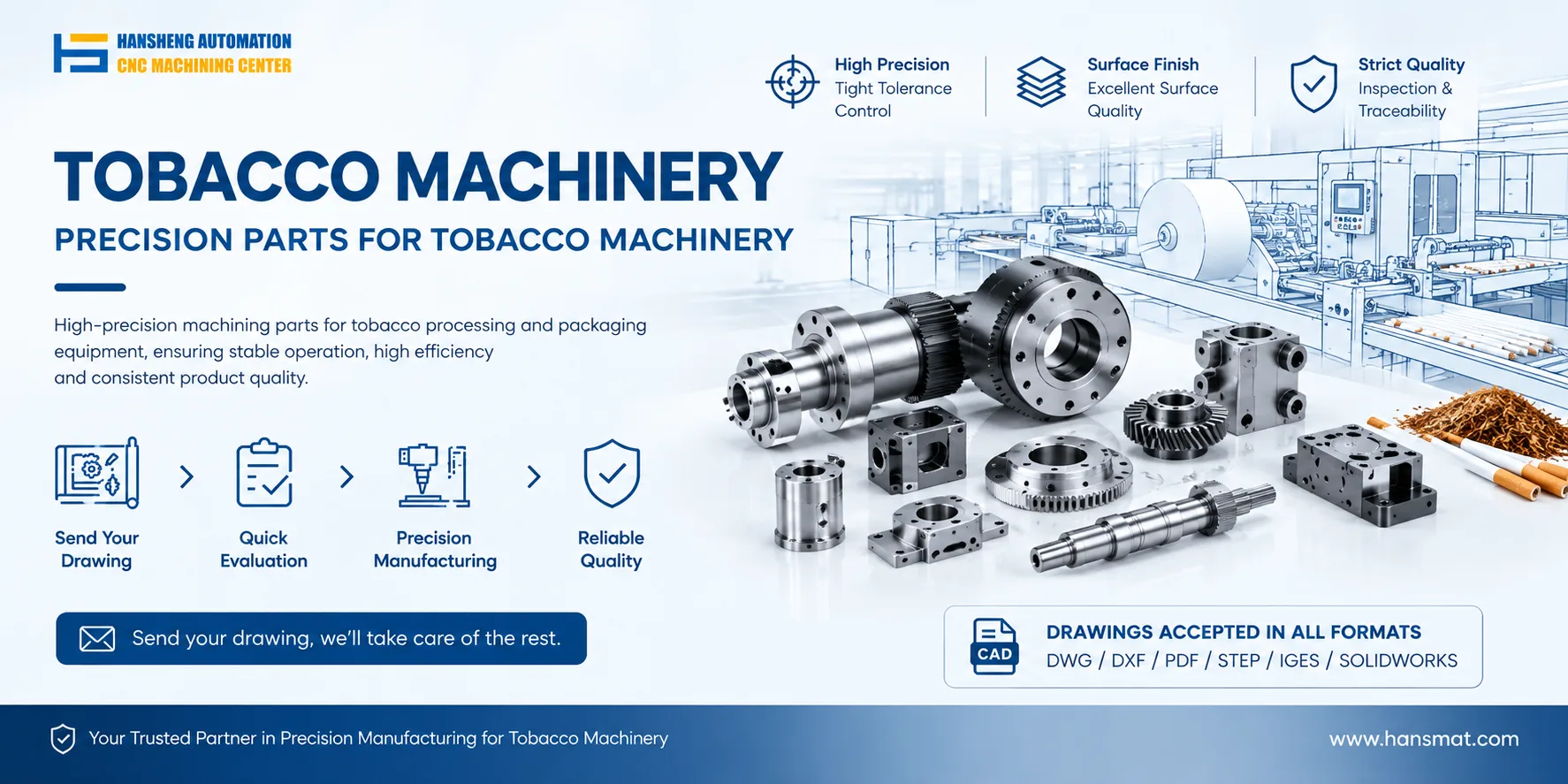
For non-standard replacement parts used in the ZB416, such as folding cylinders, positioning trays, cutting dies, and guide rails, Hansheng Automation provides custom machining services based on customer drawings, supporting both prototype development and small-batch production.