The dry granulation process offers distinct advantages in industrial applications. First and foremost, it directly transforms dry powders into granules without the need for any binders. This process significantly increases the bulk density of the materials, improves their appearance and flowability, and allows for effective control over the disintegration profile of the finished product, thereby facilitating subsequent storage and transportation. Compared to traditional wet granulation, dry granulation is more energy-efficient, simplifies multiple complex process steps, and reduces environmental pollution. Furthermore, its protective and granulating benefits are particularly pronounced for drugs or sensitive materials that are unstable under hot and humid conditions.
However, the dry granulation process also has certain disadvantages that cannot be ignored. The primary issue is the poor pellet-forming effect for certain materials. Because this process lacks steam conditioning and starch gelatinization, the pellet-forming rate is relatively low, resulting in a higher powder rate. In specific production stages, such as in creep feeds and piglet pellet feeds with high sugar content, formulation and pellet formation become even more difficult; all-middling type materials likewise face challenges in forming. Although adding extra water is sometimes used to improve formation, this compromise often severely degrades the final quality of the granules.
Additionally, dry granulation operates at higher squeezing temperatures, which can slow down the pellet-forming speed and further increase the heat generated by friction. When producing specialized feeds such as creep and piglet pellet feeds, this high frictional heat can easily damage heat-sensitive active ingredients, affecting the overall quality of the final product.
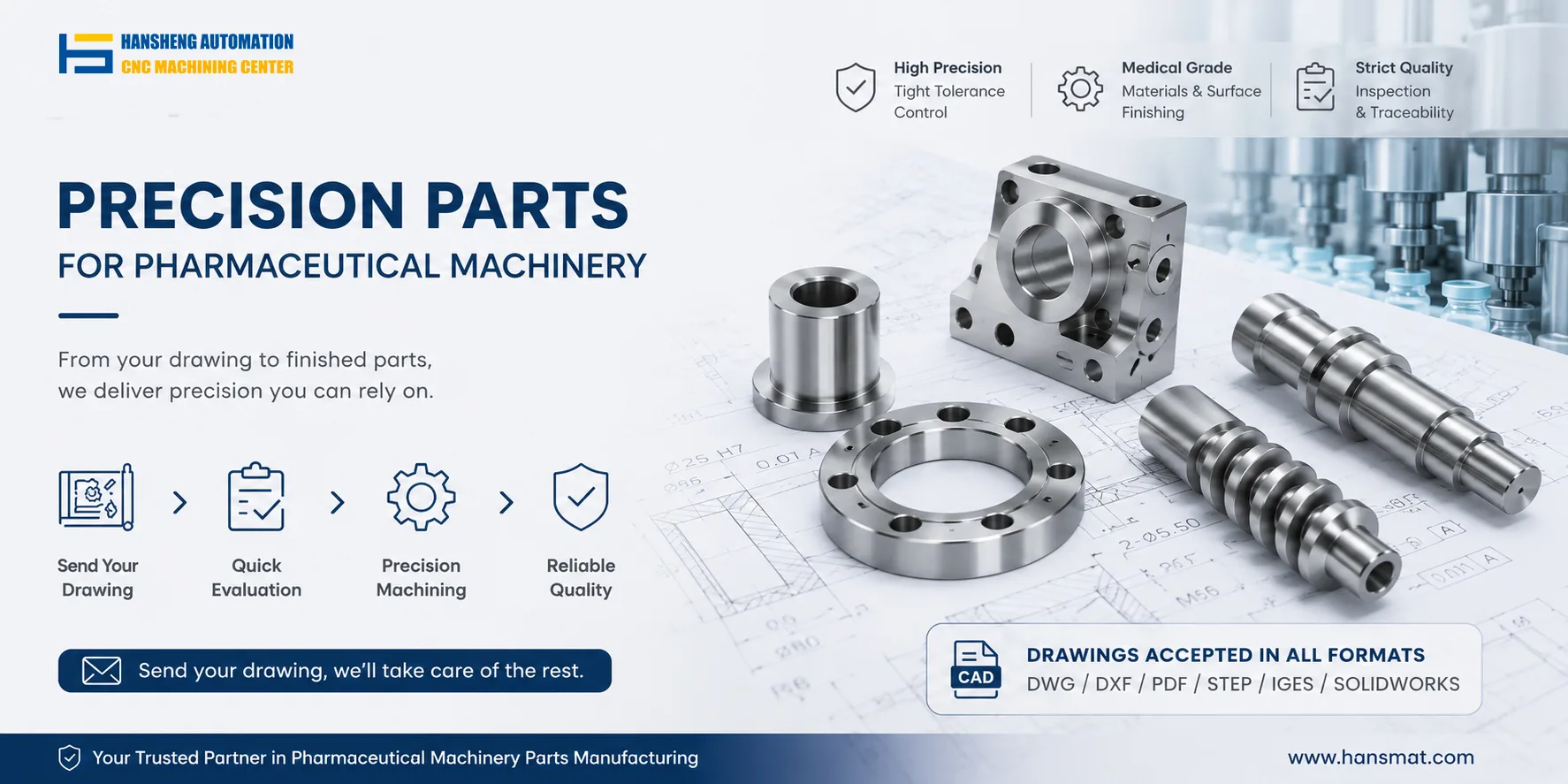
To address the limitations of the dry granulation process, such as excessive frictional heat and uneven pressure distribution that lead to poor forming and degradation of active ingredients, Hansheng Automation supports the precise manufacturing of non-standard components based on customer drawings. According to specific material characteristics, we can custom-machine compacting rollers with tailored surface grooves, high-hardness feeding screws, and sizing screen frames. By optimizing fit tolerances and surface treatment processes for these components, we help clients minimize frictional temperature rise, reduce powder rates during sizing, and significantly improve the pellet-forming quality of challenging materials.