A 3D motion mixer uses the compound movement of the mixing vessel in multiple directions to continuously tumble, disperse, and exchange materials inside the vessel, achieving a more uniform mixing effect. Compared with single-direction mixing methods, three-dimensional motion reduces material segregation and localized accumulation caused by centrifugal forces. This improves the contact frequency between different components, making the mixer suitable for various powders, granules, and other materials.
Working Principle of a 3D Motion Mixer
During operation, the transmission system drives the mixing vessel through multi-directional movements, causing the materials inside the vessel to continuously change their movement paths. Under the combined effects of gravity, inertia, and vessel movement, the materials repeatedly undergo tumbling, convection, and diffusion.
This multi-directional motion allows materials from different areas of the vessel to exchange positions repeatedly, reducing material segregation, accumulation, and localized under-mixing that may occur with conventional single-direction mixing. For materials with differences in density or particle size, the multi-directional movement can further improve material flow and promote more thorough mixing.
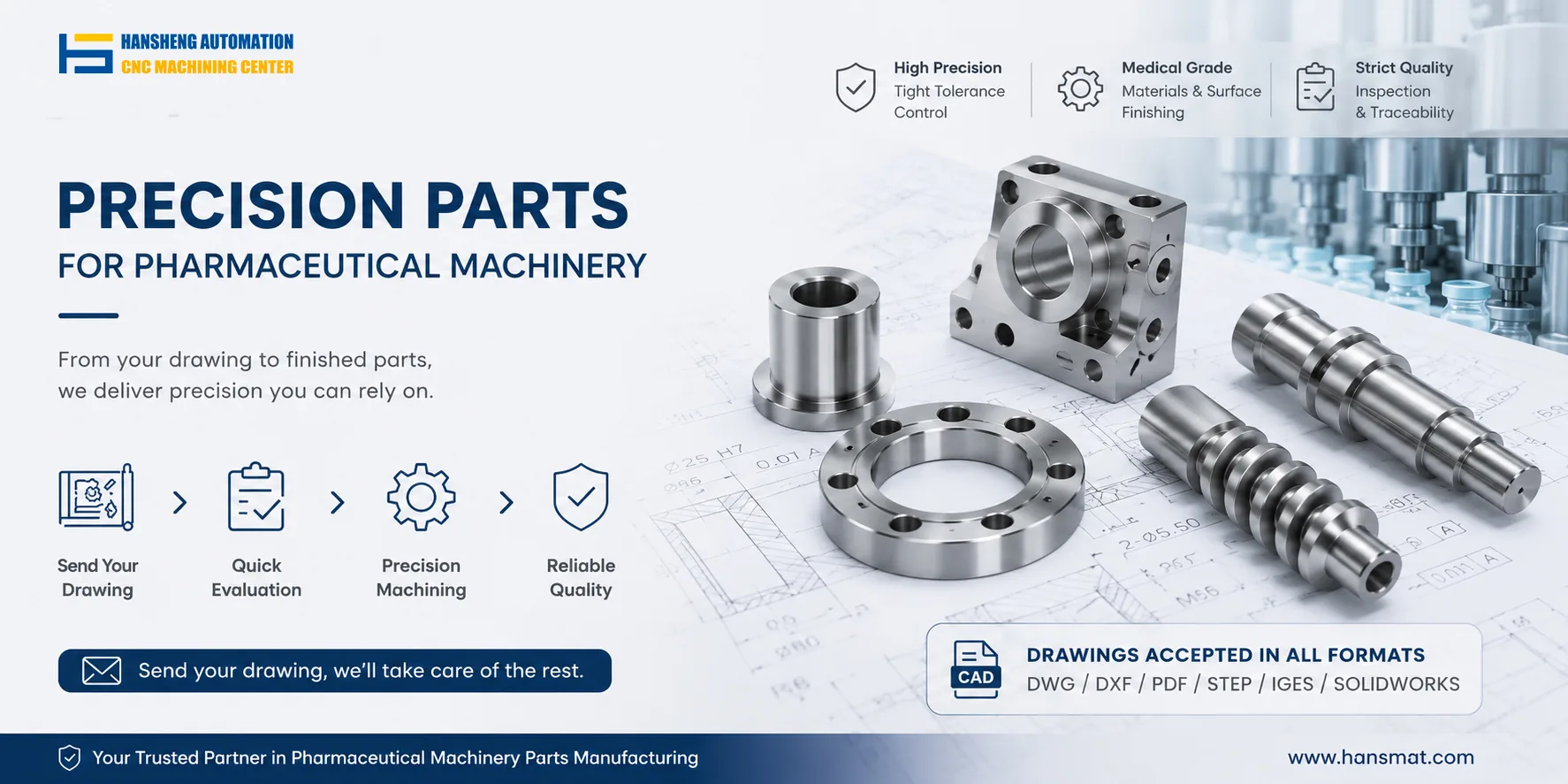
We provide precision machining services for components used in pharmaceutical, food processing, and chemical equipment. Based on customer drawings and technical requirements, we can manufacture shafts, connectors, support components, and other non-standard mechanical parts for 3D motion mixers. We also control dimensional accuracy and fitting tolerances according to the actual assembly requirements.
Main Structural Components of a 3D Motion Mixer
A 3D motion mixer generally consists of a machine base, transmission system, electrical control system, multi-directional motion mechanism, and mixing vessel. These components work together to ensure stable and reliable operation.
Machine Base
The machine base supports and secures the entire mixer. It requires sufficient rigidity and stability to minimize vibration and displacement during operation while providing a reliable mounting foundation for the transmission system and motion mechanism.
Transmission System
The transmission system supplies power to the mixing vessel and motion mechanism, allowing the vessel to follow the specified movement pattern. The machining accuracy of transmission components directly affects operational stability, so critical parts such as shafts, gears, and coupling components generally require consistent dimensions and precise fits.
Electrical Control System
The electrical control system manages equipment start-up, shutdown, and operating parameter adjustment. It controls the operating condition of the mixer according to production requirements, making operation more convenient and allowing the mixing process to be adjusted for different materials.
Multi-Directional Motion Mechanism
The multi-directional motion mechanism is one of the key components of a 3D motion mixer. Through a specific mechanical transmission arrangement, it enables the mixing vessel to move along multiple axes or directions. This mechanism determines the movement pattern of the material and provides the mechanical basis for efficient mixing.
Mixing Vessel
The mixing vessel is the component that comes directly into contact with the material. Manufacturers commonly use stainless steel to provide corrosion resistance, easy cleaning, and good sanitary conditions. The inner and outer surfaces are typically polished to reduce material residue and cleaning dead zones while improving service durability.
For precision components associated with the mixing vessel and other mechanically assembled parts, Hansheng Automation can provide custom machining based on customer drawings. We can develop suitable machining processes according to the required material, dimensions, tolerances, surface treatment, and assembly specifications, and support both one-off and small-batch production of non-standard components.
Application Characteristics of 3D Motion Mixers
With its multi-directional compound movement, a 3D motion mixer provides effective material exchange and can be used for mixing powders, granules, and compound materials in industries such as pharmaceuticals, food processing, and chemicals. In practical applications, mixing performance depends not only on the motion pattern but also on the vessel design, material characteristics, transmission stability, and machining accuracy of critical components.
We provide custom precision machining services for components used in this type of equipment. Based on customer drawings, we can manufacture shafts, sleeves, flanges, gears, connectors, and other non-standard mechanical parts. We select appropriate materials and machining processes according to the specific application requirements, helping customers obtain precision components that support reliable equipment assembly and long-term operation.