

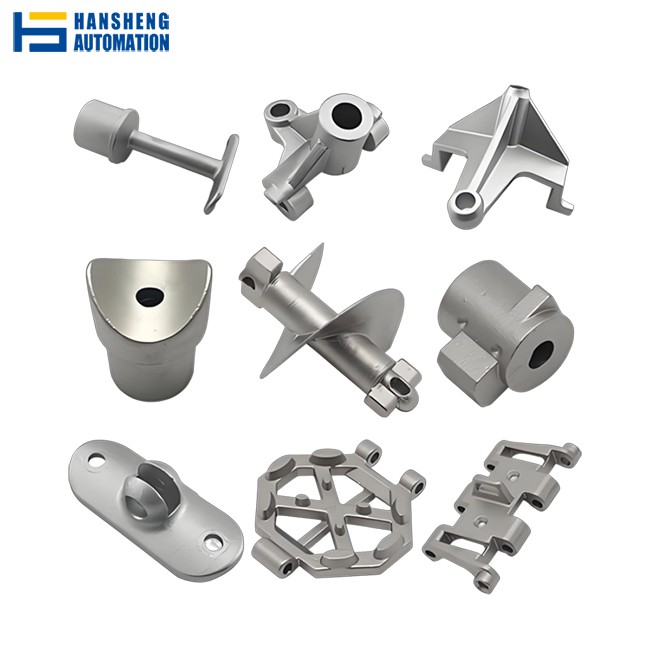
Hansheng Automation (Dongguan) Co., Ltd. is one of the most experienced manufacturers and suppliers of castings machining in China. If you're going to wholesale bulk cost-effective castings machining made in China, welcome to get pricelist and quotation from our factory. Also, customized service and OEM&ODM service are available.
Castings Machining is a process that carrying out further machining treatment such as cutting and forming on the completed metal castings, which make metal castings reach the drawings' requirements for dimensional accuracy, shape accuracy, positional accuracy and surface quality.Casting machining is an important subsequent process in casting production. It is of great significance for improving the quality and performance of castings and meeting the demands of different application scenarios.
Target of Castings Machining
There may be some issues such as dimensional deviations, surface defects or internal stresses during castings. Machining correct the size and shape of castings through processes such as cutting, milling, drilling and grinding. The surface quality of castings will be improved and meet requirements of assembly and usage.
Common machining methods
Turning: It is used for processing the surface of rotating bodies, such as shaft and disc castings. The casting is driven to rotate by a lathe, and the cutting tool moves along the axial or radial direction for cutting.
Milling: It is suitable for processing complex shapes such as planes, grooves, and steps. The rotating tool of a milling machine can perform multi-directional cutting on the surface of castings.
Drilling and boring: These two methods are used to process holes in castings. Drilling involves directly drilling holes in the casting, while boring is the process of enlarging or finishing existing holes to improve their dimensional accuracy and surface quality.
Grinding: By finely processing the surface of castings with grinding tools such as grinding wheels, the surface finish and dimensional accuracy can be improved. It is often used for castings with requirements for high surface quality.
Planing: It is mainly used for processing planes and grooves. The cutting tool of planer moves back and forth in a straight line to cut the surface of castings.
Difficulties and challenges for processing

Control of Dimensional accuracy
During casting process, there may exist dimensional deviations on castings due to shrinkage, deformation and other reasons. Through the precise control of tool path and processing parameter, castings machining ensure that casting's dimensions meet the requirements of drawings.
Requirements of Surface quality
The surface of castings may have defects such as pores, sand holes and oxide scale. Machining needs to select appropriate cutting tools and processing parameters, avoiding tool wear or processing defects to affect surface quality.
Influence of material properties
Castings of different materials (such as aluminum alloy, cast iron, magnesium alloy, etc.) have different cutting properties. Appropriate parameters such as cutting tools, cutting speed and feed rate should be selected based on the material properties.
Processing of Complex structure
For castings with complex structures and irregular shapes, machining needs to design reasonable fixtures and tool paths, ensuring processing accuracy and efficiency.
Processing equipment and tools
Machine tools: lathes, milling machines, drilling machines, grinders, machining centers, etc. Select appropriate machine tool based on the shape, size and processing requirements of castings.
Cutting tools: turning tools, milling cutters, drill bits, boring tools, grinding wheels, etc., select the appropriate tool material and geometric shape based on the processing material and processing area.
Fixture: It is used to fix castings and ensure the position of castings stable during processing. The design of fixtures should consider the shape, size and processing requirements of castings, ensuring reliable clamping without affecting the processing accuracy.
Quality control and inspection
Dimensional inspection
Using tools such as calipers, micrometers and three-coordinate measuring machines to measure the dimensions of casting and ensure the castings meet drawings' requirements.
Shape and position accuracy detection
Through equipment such as levels, dial indicators, and laser interferometers, the shape and position accuracy of castings such as flatness, straightness, perpendicularity and coaxiality can be detected.
Surface quality inspection
Tools such as visual inspection and surface roughness meters are adopted to check the surface finish and defect conditions of castings.
FAQ
Q: How long will the production cycle take for casting machining? Could you meet the requirements of lead time?
A: The production cycle of casting machining needs to be determined based on factors such as the complexity of casting and processing procedures. About whether we can meet the customers' requirements for lead time, it needs to be comprehensively judged in combination with the actual production capacity, production scheduling situation and the specific requirements of customer. We suggest that customers clearly specify the specifications of castings, processing requirements and expected lead time when placing orders, so that we can arrange production reasonably.
Q: What is the precision grade that can be achieved after machining castings? Can it meet the tolerance range requirements of specific drawings (such as ±0.01mm, ±0.05mm, etc.)?
A: The precision grade of casting after machining depends on the casting's original precision, machining method and process conditions. For common tolerance requirements (such as ±0.05mm), they can usually be met by reasonably selecting machining method. For extremely high precision requirements (such as ±0.01mm and below), the quality of castings, equipment capacity and process control level need to be comprehensively considered.
Q: Do you support the special processing technologies or process requirements provided by the customer?
A: When customers put forward special processing technology or process requirements, please communicate fully with us in advance, provide detailed technical data, samples or reference standards, so that we can assess the feasibility and formulate corresponding plans.
Q: Is additional surface treatment (such as sandblasting, polishing, electroplating, anodizing, etc.) required after machining to meet the customer's requirements for surface roughness, corrosion resistance, aesthetics, etc.?
A: Whether additional surface treatment is required after machining depends on the specific requirements of customers, material of the part and usage scenarios. If you don't not have explicit requirements, generally, it is judged based on industry standards and the functions of parts, ensuring that the parts meet the requirements of performance, durability and aesthetics.
Hot Tags: castings machining, China castings machining manufacturers, suppliers, factory, casting mechanical properties, casting exhibition, casting trade, construction casting, casting inspection, casting specification


