

In packaging production lines, transmission component failures are a common cause of downtime. Core components manufactured by Hansheng-such as cam indexers, hollow rotary tables, planetary gearboxes, and gear shafts-are widely used in various packaging lines. Such failures typically stem from cumulative manufacturing tolerances, improper assembly, or delayed maintenance.
This guide draws on extensive machining and field experience to identify the most common failure modes and provide practical prevention strategies for each component type.
The 5 Most Common Failure Modes
1. Precision Drift in Cam Indexers
Cam indexers are primarily used for highly repetitive indexing motions, where wear on the contact surfaces between the cam and rollers can degrade positioning accuracy. Once the indexing error exceeds the standard application tolerance (typically ±30 arc seconds), downstream assembly or inspection processes will begin to accumulate alignment errors.
Common Symptoms
- Inconsistent dwell positioning that worsens gradually over time rather than appearing suddenly
- Vibration at the end of each index cycle, especially at higher speeds
- Audible impact during cam engagement - often dismissed initially as normal mechanical noise
Prevention
- Establish a periodic accuracy audit using a precision rotary encoder. For standard-grade indexers (±30 arc sec), schedule inspection every 2,000–3,000 operating hours; for high-precision units (±15 arc sec), every 1,000–1,500 hours.
- Inspect cam follower contact surfaces for pitting at each scheduled maintenance interval. Replace followers at the first sign of micro-pitting or abnormal wear patterns to prevent progressive damage to the cam profile.
- Verify that the mounting base flatness is within 0.02 mm before installation. Housing distortion transfers directly into the transmission system, leading to inherent indexing errors.

2. Backlash Growth in Planetary Gearboxes
Planetary gearboxes in packaging machinery are typically specified to P2 (≤3 arc min), P1 (≤2 arc min), or P0 (≤1 arc min) backlash grades depending on application requirements. As gear tooth surfaces wear, effective backlash increases. For servo-driven axes, this directly translates into positioning lag and reduced repeatability.
Common Symptoms
- Positional overshoot during direction reversal
- Increased following error in motion controller logs
Prevention
- Compare measured backlash against the rated specification for the given precision grade (P0/P1/P2). Establish an intervention threshold - typically 150% of the rated backlash value (based on field maintenance experience).
- Check coupling alignment during installation. Excessive misalignment accelerates planet carrier bearing wear and increases effective backlash over time.
- Use only lubricants specified for the operating temperature range, and replace them at manufacturer-recommended intervals.
3. Radial Runout in Hollow Rotary Tables
Contamination, inadequate preload, or bearing wear increases radial and axial runout, compromising the accuracy of any tooling or fixture mounted on the table.
Common Symptoms
- Noticeable wobble during rotation
- Premature wear of mounted fixtures
- Uneven friction or resistance during operation
Prevention
- Verify table runout after any impact event or tooling crash. A single overload can permanently shift bearing preload.
- Keep the sealing interface clean. Contamination is the primary cause of premature cross-roller bearing degradation in rotary tables.
- For tables operating in continuous rotation mode rather than indexing mode, increase lubrication frequency accordingly.

4. Flexspline Fatigue in Harmonic Drives
Harmonic drives achieve near-zero backlash (≤10 arc sec) through elastic deformation of the flexspline. This component is subject to continuous cyclic stress. Operating beyond rated torque, poor shaft alignment, or insufficient lubrication accelerates fatigue crack initiation, ultimately leading to flexspline fracture.
Common Symptoms
- Sudden loss of torque transmission, audible crackling under load, backlash increase beyond ≤10 arc sec baseline.
Prevention
- Never exceed the manufacturer's specified peak torque. Operation beyond this limit sharply reduces flexspline fatigue life.
- During major overhaul, inspect the flexspline for surface cracking using dye penetrant or magnetic particle inspection - at least every 5,000 hours or annually, whichever comes first, provided the unit is disassembled.
- Confirm correct lubricant fill volume at installation. Both under- and over-filling accelerate flexspline wear.

5. Gear Tooth Surface Degradation
Transmission gears manufactured below ISO/DIN Level 5 accuracy are more susceptible to uneven load distribution, which accelerates pitting, spalling, and in high-speed applications, scuffing. This applies to both spur and helical gears across the module range used in packaging machinery (typically 0.5–3.0).
Common Symptoms
- Elevated noise levels
- Metal particles in lubricant
- Visible surface cratering on tooth flanks
Prevention
- Inspect shaft journals periodically for wear and surface finish degradation. Journal diameter deviation beyond ±0.005 mm affects bearing fit and introduces runout into the entire drive train.
- Check tooth flanks for early-stage pitting or micro-spalling at scheduled intervals - surface degradation is progressive and will transfer damage to mating components if left unaddressed.
- Match lubricant viscosity to operating pitch line velocity.
- Control assembly clearances carefully. For gears in the 0.1–5.0 module range, excessive clearance allows debris retention and increases dynamic impact loads; insufficient clearance may impair lubrication or cause thermal binding.

Conclusion
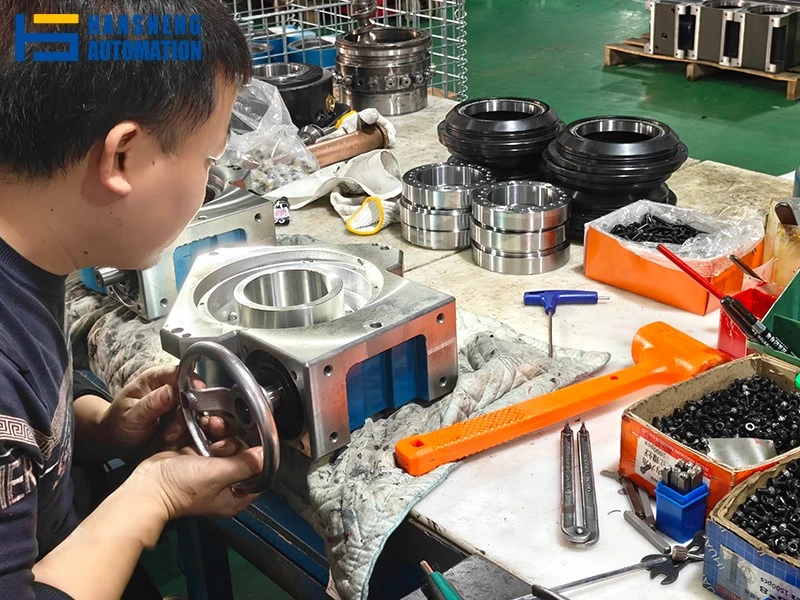
Transmission shaft component failures in packaging machinery are largely predictable and preventable. The causes behind the five failure modes discussed in this article-precision drift, backlash growth, radial runout, flexspline fatigue, and gear tooth surface degradation-are derived from our practical manufacturing experience and customer feedback. Please note that this analysis is not exhaustive and is provided for reference purposes only.
Our recommendation is to establish a systematic inspection schedule, define specific tolerance thresholds for critical components, and partner with manufacturers proven to maintain strict precision control.
If you are evaluating cam indexers, hollow rotary tables, planetary gearboxes, or other precision transmission components for your packaging line and want to discuss tolerance specifications or application requirements, contact our engineering team for a technical consultation.